Every number in restoration comes from an instrument, every instrument has an error family, and a trade that reads meters without verifying them is measuring its own confidence and calling it evidence.
A perfect record of the wrong number
We have argued at length that a restoration without a record is an opinion. That argument stands and this one sits directly on top of it, because it names the failure a record cannot catch.
A drying log can be flawless. Numbered points on a drawing, readings taken at the same locations every day, atmospheric conditions inside and outside, a drying goal set before the first machine was placed, a trend that falls neatly to target and a completion signed and dated. Every element present, every column filled, nothing missing.
And every number in it can be wrong.
A record proves that a reading was taken, by whom, where and when. It does not prove the reading was true. The trade has adopted the first claim and skipped the second, which has given it the appearance of measurement without the discipline underneath it.
Nobody in this trade has ever seen moisture
This is worth stating plainly because it reframes everything that follows. No instrument in a restorer’s case observes water. Every one of them observes something else and infers water from it.
A resistance meter observes how readily a current passes between two points and infers moisture content, because water carrying dissolved ions conducts and dry material does not. A capacitance meter observes how a material alters an electrical field, because water has a much higher dielectric constant than the materials around it. A thermal imaging camera observes surface temperature and infers wetness from a cool anomaly. A hygrometer observes the electrical behaviour of a sensing element.
Four proxies, four inferences, four sets of assumptions. Every removal, every demobilisation and every clearance rests on that chain, which means the honest question on a job is not what the reading was. It is how much weight it can carry.
Four families of error
The first is systematic error, where the instrument is consistently off in one direction. Calibration drifts with age, with impact and with temperature cycling, and a drifted instrument is internally consistent, which makes it invisible in a trend. Resistance meters are calibrated against a reference species of material and need a correction applied for anything else, which most operators have never looked up. They also need a temperature correction, because electrical resistance falls as material temperature rises, so the same material reads higher when it is warm and lower when it is cold. A reading taken on a cold external wall at seven in the morning and compared against one taken on the same wall at four in the afternoon has a correction buried in it that nobody applied.
The second is random error, which is scatter. Contact pressure on a pinless meter, the exact spot chosen, how hard the pins were pushed. Random error is why a single reading is never a measurement and a set of readings sometimes is.
The third is gross error, the blunder, which produces the most spectacular wrong numbers in the trade. Pins driven into a fastener or a metal angle, reading as saturation on a dry wall. A pinless meter held over foil backed insulation, a stud, reinforcing mesh or pipework, all of which alter the field it reads. An instrument left on the scale somebody selected two jobs ago. A relative indication written into a log as though it were a moisture content.
The fourth is reference error, and it has the largest consequence and the smallest chance of being detected. The IICRC S500, the standard for professional water damage restoration, establishes the drying goal by reference, which means measuring unaffected material of the same type in the same building. That practice is correct and it has one assumption in it, which is that the unaffected material is unaffected. Where it is not, every reading in the job is compared against a false baseline and the whole exercise is internally consistent and externally meaningless.
This is not a rare case. In the building described in Monday’s article, the one manufacturing its own water, the whole structure can be sitting at an elevated moisture content, which means the honest reference may not exist inside that building at all. An operator who takes a reference from the next room and finds the affected wall matches it has not shown the wall is dry. They have shown the building is uniformly wet.
Three traps worth naming
The first is conductivity. A resistance reading depends on dissolved ions as much as on water, so anything that raises the ion content of a material raises the reading. An old urine deposit. A grossly contaminated water event. Efflorescence in a masonry wall. Any hygroscopic salt load. A material in that condition reads wet while it is dry, and an operator who trusts the number runs equipment for a week against a reading that will never fall.
The second is case hardening, which we have described before in the context of over aggressive drying. Force the surface faster than the core can release moisture and the outer layer dries, becomes less permeable, and reads dry over a core that is not. The instrument is telling the truth about two millimetres. The log records it as the truth about forty.
The third is depth, and it is almost never written down. A pinless meter integrates across a depth it does not disclose, so it reports an average of a volume the operator did not choose. Pins read between their tips, so the depth is whatever depth they were driven to, which means two operators at the same marked point with different hands produce two different trends from one wall. A monitoring point is not defined by its position on a drawing. It is defined by its position and its depth, and a point without a recorded depth is a point that cannot be re read.
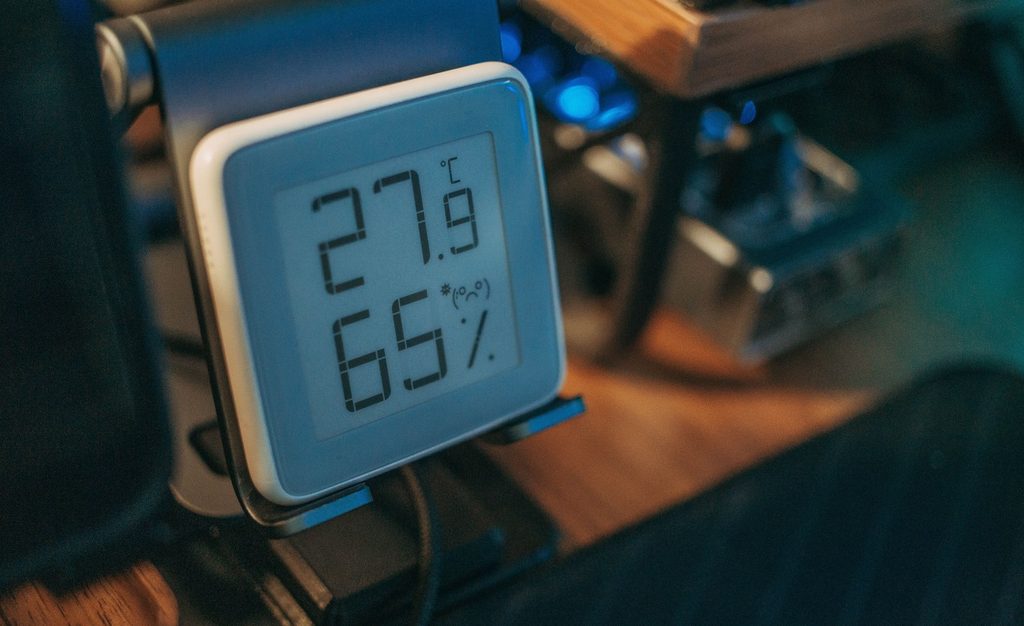
The atmospheric side has its own version. A hygrometer sitting in a dehumidifier’s airstream, against a cold external wall, or in sunlight through a window reports a microclimate rather than a room. Capacitive humidity sensors drift with age, and one that has been sitting in a saturated environment can read high for some time after it is moved.
What verification actually means
It does not mean two meters agreeing. Two instruments of the same type, from the same manufacturer, sharing the same calibration bias, will agree beautifully and be wrong together. Agreement between like instruments is the easiest and least informative check available.
Verification means four things.
A check against a known value, on a schedule, recorded with the date. For a moisture meter that is a calibration check reference, which takes seconds. For a humidity sensor it is a salt solution check, where a saturated salt solution in a sealed container holds a known relative humidity at a known temperature and the sensor is compared against it. Neither is expensive or difficult, and most operators in this market have never performed either.
A cross check by a different physical principle. Resistance against capacitance is a genuine cross check because the two infer moisture from unrelated properties. Where a decision is large enough to warrant it, the gravimetric method settles the argument, which means taking a sample, weighing it, drying it to constant mass and weighing it again. That method is the reference against which the hand instruments were calibrated in the first place, and it exists for the job where somebody has to be right rather than confident.
Reproducibility. A second operator reading the same marked point, at the same depth, with the same correction, should land on the same number. Where two operators cannot reproduce each other, the point is not sufficiently defined and the trend built on it is not evidence.
And metadata. A number by itself is a digit. A reading is a number plus the instrument, the scale, the correction applied, the material temperature, the depth, the point and the time. Every element of that is required for the number to be reproduced, and a log that records only the number has preserved the least useful part of the measurement.
The register, the schedule and the rule
The systems answer to all of this is unglamorous and cheap.
An instrument register. Every meter, hygrometer and camera by serial number, with the date of its last check and the result. Instruments age, get dropped, sit in a hot vehicle all summer, and quietly change.
A check schedule that is actually run, with the checks recorded whether they pass or fail. A failed check is the most valuable entry the register will ever hold, because it dates the period during which previous readings became unreliable.
A documented correction practice. Which species correction, which temperature correction, applied by whom, written next to the reading rather than held in somebody’s head.
Defined points, with depth. Marked, numbered and recorded to the depth, so that the trend survives a change of operator.
And three rules. No decision of consequence rests on a single instrument or a single point. A reading that contradicts the physical picture gets investigated rather than discarded, because it is either a fault in the instrument or a reservoir nobody has found, and both of those are worth knowing. And a reading that favours us gets the same scrutiny as a reading that does not, which is the rule that is hardest to hold and the only one that makes the others mean anything.
The Crusader instrument standard
Stage one. Check before the job, not after the complaint. Instruments are checked against known references on a schedule, the results are recorded against the serial number, and an instrument that fails a check does not go back in the vehicle.
Stage two. Establish the reference honestly. Unaffected material of the same type in the same building where that exists, and a plain statement in the file where it does not, together with what we used instead. A reference we are unsure of is declared rather than quietly adopted.
Stage three. Define the points fully. Position, material, depth, numbered on a drawing, so the series is reproducible by somebody other than the person who created it.
Stage four. Record the reading with its metadata. Instrument, scale, correction, material temperature, depth, time. The number alone does not go in the log.
Stage five. Cross check at decision points. Before any removal, any demobilisation and any clearance, the reading that justifies it is confirmed by a second principle rather than a second pass.
Stage six. Site the atmospheric instruments deliberately and say where they were. Not in a machine’s airstream, not against a cold surface, not in sun, and the location recorded so the reading can be interpreted later.
Stage seven. Treat an anomaly as a finding. A point that will not fall, a reading that contradicts the room, or a reference that matches an affected material all get investigated and written up, including when the finding enlarges our own scope.
Eco chemistry, and what measurement subtracts
Our bench is plant derived surfactants, readily biodegradable under OECD 301 within twenty eight days, unfragranced, with no quaternary ammonium compounds in routine work, and hydrogen peroxide based oxidative chemistry only where a disinfection step is genuinely indicated. The connection to metrology is tighter than it appears.
Chemistry is what gets applied when nobody knows the answer. An operator who cannot establish whether a material is dry reaches for an antimicrobial as insurance. An operator who cannot establish where the water is treats a larger area than the water occupies. An operator who cannot tell whether an odour has a remaining source applies something to the smell. In every case the product is being purchased to cover an absence of measurement, and the household pays for it twice, once on the invoice and once in what is left in the building.
The inverse holds just as reliably. A job with verified instruments, a defensible reference and reproducible points uses very little product, because the operator knows what is happening and does not need to buy reassurance. Measurement is the cheapest reduction in chemical load available to this trade, and nobody sells it that way because it is not a product.
Long lasting client tips
Six questions worth asking anybody who brings a meter into your building.
First. When was that instrument last checked, and against what. The answer should be a date and a reference. An operator who has never checked an instrument does not know its bias, and a bias is invisible in a falling trend.
Second. What are you reading, and is that a moisture content or a relative indication. Both are legitimate and they are not the same claim. A relative indication is for finding moisture. A moisture content is for proving it has gone.
Third. Where did the drying goal come from, and are you confident that reference material is unaffected. In a building with a seasonal damp problem, that question is not pedantic. It is the whole job.
Fourth. What depth are the readings taken at, and is that written down. If the answer is that it depends who is holding the meter, the trend is not a trend.
Fifth. Before anything is removed or any equipment leaves, has the reading been confirmed by a second method. One instrument making one inference is a thin basis for cutting out a wall or closing a job.
Sixth. Ask what the reading would look like if the instrument were wrong. A professional can answer that, because they have thought about the error. An operator who cannot imagine the instrument being wrong is not measuring. They are reading.
The bold position
The restoration trade bought the instruments and declined the discipline that makes instruments mean anything, and because the instruments look authoritative nobody has noticed the gap.
We will name the failure mode plainly. It is the unverified reading presented as evidence. A number quoted to a household, written into a report, relied on to cut out a wall or to sign off a building, taken on an instrument of unknown calibration, on an unrecorded scale, at an unrecorded depth, with no correction applied, against a reference nobody tested. The number is specific, it is written down, and it carries exactly as much authority as the care taken to produce it, which in a great many cases is none.
There is a second failure that is worse because it hides inside good practice. It is the operator who has adopted the record, taken the readings diligently every day at marked points, built a clean falling trend and closed the job on target, with an instrument that has drifted or a reference that was never dry. That operator has done everything the trade asks of them and produced a well documented wrong answer, which is harder to challenge than no answer at all, because it comes with a table.
Naming it without venom matters, because nothing in this market requires any of it. No licensing regime, no mandated calibration interval, no requirement to record a correction, no consequence for a reading that cannot be reproduced. The checks cost almost nothing. What they cost is the possibility of discovering that last month’s readings were unreliable, and an industry nobody has ever asked for its calibration records has no reason to go looking.
Cleaning Crusader checks its instruments against known references on a schedule and records the results against serial numbers. We declare the reference material we used and say plainly when a sound one was not available. We record depth, scale, correction and material temperature alongside every number. We cross check by a second physical principle before any removal, any demobilisation and any clearance. And we treat a reading that contradicts the picture as a finding to chase rather than an outlier to drop, including when chasing it makes our job bigger.
A meter does not measure water. It measures one electrical property of a material and hands you an inference, and the only thing standing between that inference and a household’s building is whether anybody bothered to check.
Forged in Standard. Built on Excellence.
Cleaning Crusader. Built for impact. Driven by excellence. Guided by purpose.