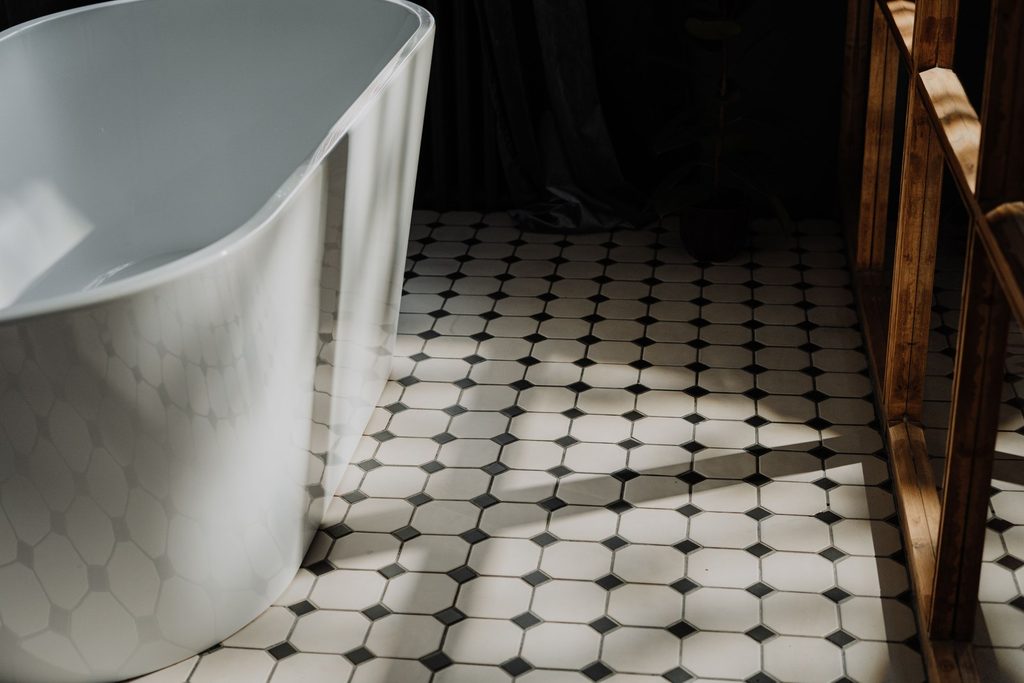
A tiled floor is the one interior surface in a house that cannot be renewed in part. That single property should govern how it is maintained, and it is the property nobody mentions when it is sold.
The quote nobody asks for
Households ask us what a tile and grout restoration costs. In twenty years nobody has ever asked the question that would actually frame the decision, which is what it would cost to replace that floor instead.
It is worth answering, because the answer reorganises everything. Replacing the tiled floor in a bathroom is not a flooring job. It is a strip out, a new waterproof membrane, a new screed with the falls reset to the waste, new tiling, a new shower screen because the old one will not come off the old silicone and refit to new tiles, and frequently new cabinetry because the old unit was tiled around. It is one of the most expensive and most disruptive projects a household ever undertakes inside its own walls, and the room is unusable while it happens.
Now compare that to a carpet. A carpet is replaced in a day, room by room, at a price the household can obtain in three phone calls, with no effect on anything else in the building.
Those two assets are maintained by the same industry, discussed in the same vocabulary, and quoted by the same square metre. They are not remotely the same kind of thing, and the difference is not cost. It is that one of them has a replacement option and the other does not.
The replaceability spectrum
Run through the soft and hard surfaces in a house and rank them by how easily each can be renewed.
Upholstery sits at the easy end. A chair is one object. It can be recovered, repaired, or carried out the door and replaced by itself, and nothing else in the room is affected.
Carpet is next. It is renewed per room, matching between rooms is a choice rather than a requirement, the old floor leaves in a trailer and the new one is laid the same afternoon. Every decision about carpet is made in the knowledge that a reset is available at a known price.
A tiled floor is in a different category entirely. It cannot be renewed per square metre, it usually cannot be renewed per room without consequences for the room next door, and in a wet area it cannot be renewed at all without rebuilding the elements underneath it. The replacement unit is not the tile. It is the room, and in a wet area the room includes its waterproofing.
That is the whole article, and it has a straightforward consequence. On a carpet, maintenance buys years of appearance against a cheap and available replacement. On a tiled floor, maintenance defers an event that the household cannot easily afford and cannot conveniently schedule. The maintenance argument is stronger on the hard floor and it is made almost exclusively about the soft one.
Why a tiled floor cannot be repaired in part
Four reasons, and they compound.
The first is matching. Ceramic and porcelain tiles are fired in production runs, and shade varies between runs, which is why boxes carry a shade or batch code and why tilers are told not to mix them. A tile from the same range bought eight years later is a different batch at best. In most cases the range has simply been discontinued, because tile ranges have commercial lives measured in a few years and the floor has a design life measured in decades. The product that matches your floor stopped being manufactured while you were still enjoying it.
The second is the spare box. The honest answer to the first problem is to keep spare tiles from the original batch, and almost nobody does. The box goes to the tip in the second year, or it survives in a shed with no label, no room noted and no batch code, which makes it a box of tiles rather than spares.
The third is the bed. A tile is bonded to an adhesive bed, which is bonded to a screed or a slab. Removing one tile means cutting out the grout around it, breaking the tile up, and chiselling the bed back to a flat, sound surface, all of it immediately adjacent to tiles that are also bonded and brittle. Edge chips on the neighbours are common and they are not repairable. The repair tends to grow.
The fourth is the layer under the bed, and in a wet area it is the one that matters most. Waterproofing in a domestic wet area is a specified element in its own right, governed in this country by AS 3740, the Australian standard for waterproofing of domestic wet areas. The membrane sits below the bed, it is continuous by design, and it is the element that keeps water out of the frame and the adjoining rooms. Breaking into a wet area floor means breaking into the membrane, and a membrane that has been cut and patched is not the element that was specified. This is why a shower floor repair so often becomes a shower rebuild, and why the honest operator says so at the start rather than halfway through.
A long life assembly with a short life consumable
Here is the framing that makes a tiled floor manageable rather than frightening.
The tile is close to permanent in ordinary domestic service. A fired ceramic surface on a sound bed, walked on by a household, is not a wearing part on any timescale an owner needs to think about.
Running through that permanent surface is a cementitious material with a service life, and alongside it are flexible sealant joints with a shorter service life again. The grout is the consumable. The silicone at the wall to floor junction and at the internal corners is the other consumable, and it is the shorter lived of the two.
Nobody treats either as a consumable. A household that cheerfully accepts that a hot water system has a life, and that a car needs a service interval, has never once been told that the grout in their bathroom is a maintained element with a renewable life and that the silicone bead has a replacement interval measured in years rather than decades.
The consequences of that gap are predictable. The grout is loaded, cleaned by mopping, which is a delivery mechanism rather than a cleaning one, and left until it is dark enough to be a complaint. The silicone at the shower junction cracks, releases from one face, and admits water into the wall base, where it is found eventually by somebody like us, after the frame has been wet for a year. A failed sealant bead a few millimetres wide is the most common path for water into a wall in a Perth house, and it costs almost nothing to renew on schedule.
The one way ladder
A tiled floor has five positions on it, and every move is in one direction.
Position one is maintenance. Water off the surface, the right chemistry, no acid in routine work, the pore network kept clear. This is the only rung with no cost beyond its own.
Position two is restoration. Alkaline chemistry matched to the soil, real dwell, mechanical energy shaped to the recess, hot rinse with capture, then an impregnator on a clean dry substrate. This recovers a loaded grout line and it is available for as long as the grout has section left.
Position three is regrouting. The old grout is mechanically removed to depth and the joint is refilled. It is a genuine renewal of the consumable and it is the rung most households have never heard of. It is labour, it is slow, it is noisy, and it is a fraction of a replacement. The honest limit is that it needs sound bed and sound tile edges, and each cycle takes a little more from the joint.
Position four is colour sealing. A pigmented coating bonded over the grout line, which changes the maintenance model from a porous material to a coated one. It is a legitimate engineering decision where the grout is structurally sound and porosity is the failure. It also forecloses the impregnator route permanently, because you are now maintaining a coating.
Position five is replacement of the room, with everything described above.
The ladder has a side exit, and it is the one owners most need to know about. If the assembly is moving, none of the rungs apply. Hollow sounding tiles, hairline cracking that runs across tiles rather than along joints, grout that keeps falling out of the same joints, or a tile that has lifted are signals about the bed, the substrate or the absence of movement joints. Surface work over a moving assembly is a cosmetic finish on a structural problem, and it belongs to a tiler or a builder before it belongs to us.
The Crusader hard floor method
Stage one. Sound the floor before assessing the surface. A tap along the field tells us whether the bed is bonded, and a bed that is not bonded changes the entire recommendation.
Stage two. Measure the joint rather than looking at it. We record erosion depth relative to the tile edge, because that number decides which rung of the ladder the floor is standing on. A joint eroded well below the tile face has left position two behind whatever the colour suggests.
Stage three. Survey the sealant separately. Every internal corner, every wall to floor junction, every penetration. Sealant is a different material with a different life and it is almost never inspected by anybody.
Stage four. Read the moisture before promising a result. Where the wet area is admitting water into the structure, no surface outcome holds and the first call is a waterproofer. The IICRC S500, the standard for professional water damage restoration, is clear that porous materials in a contaminated loss are items for removal rather than drying in place, and a wall base that has been wet behind a failed bead for a year is that situation rather than a cleaning situation.
Stage five. Name the rung in writing, with the reason. Including the ones that cost us work. We say regrout when regrouting is the answer, and we say the room has reached replacement when it has.
Stage six. Set the interval by wetting hours rather than by the calendar. A shower used twice a day is not on the same schedule as a guest bathroom used twice a year, and treating a house as one interval overspends in one room and underspends in the one that matters.
Stage seven. Record it against the asset. Joint depth, sealant condition, treatments applied, interval advised, with dates. Across ten years that record is the only honest basis for deciding whether a household is maintaining a floor or deferring a renovation.
Eco chemistry, and the heaviest waste in the house
Our bench is plant derived surfactants, readily biodegradable under OECD 301 within twenty eight days, unfragranced, with no quaternary ammonium compounds in routine work, and hydrogen peroxide based oxidative chemistry only where a disinfection step is genuinely indicated. For hard floor work the bench adds organic acids and chelants selected for biodegradability, used at known dilution and neutralised afterwards, and never on a calcareous stone.
The larger environmental number in this article is not the chemistry. It is the bathroom.
A tiled floor carries high embodied energy. The tile was fired. The cement was calcined. The sand, the screed and the adhesive were all quarried and carted. When a wet area is stripped out, almost none of it is recoverable. Broken tile bonded to adhesive bonded to screed is dense, heavy, mixed waste with no practical recycling path, and it leaves in a skip bin by the tonne rather than the roll.
Which means the environmental case is the same case as the financial one, only more so than it is on a soft floor. Years deferred on a bathroom renovation are the single largest environmental decision available in that room, and they are purchased with maintenance, a sealant bead renewed on time, and a household that stops putting an acidic product down a grout line.
Long lasting client tips
Six rules for anybody who owns a tiled floor and intends to keep it.
First. Find out whether your spare tiles exist, and if they do, write the room and the batch code on the box and photograph the label. If they do not exist, you now know that the floor has no part replacement path, which is information worth having before you make any decision about it.
Second. Treat the silicone as a maintained item. Walk the shower and the wet area junctions once a year, look for cracking, dark lines along one edge, or a bead that has released from the tile or the frame, and have it cut out and renewed when it goes. This is the cheapest water damage prevention available in a house.
Third. Keep acidic products out of routine work. A product sold for removing cement residue works by removing cementitious material, and the grout in your bathroom is cementitious material. Each cycle leaves the joint rougher and quicker to resoil.
Fourth. Change the mop water more often than feels necessary and rinse with clean water afterwards. Dirty mop water is the mechanism that loads a grout line, and a clean rinse pass is the difference between cleaning the floor and feeding it.
Fifth. Ask about the joint depth, not the colour. A restoration quote on an eroded joint is a quote to clean something that needs refilling, and the household will read the modest result as a failed service.
Sixth. Investigate hollow sounding tiles, cracks that cross tiles, or grout that keeps coming out of the same joint, instead of having them cleaned again. All three are structural signals and no surface treatment answers them.
The bold position
The tile category sells appointments on an asset with no replacement option, and it has never once told an owner what the alternative to maintenance actually costs. That omission is why the maintenance decision keeps getting made as though it were a cosmetic one.
We will name the failure mode plainly. It is the operator who will clean a grout line indefinitely and never say the word regrout. The joint erodes a little further each cycle, the result gets a little weaker each time, the owner is a little more disappointed each year, and at no point does anybody tell them that the consumable running through their permanent floor has a renewable life and that they passed the point of recovery three services ago. The silence is not usually dishonest. Regrouting is harder work, slower, less profitable per hour, and sits outside the capability of most operators holding a wand, so it does not get named.
There is a second failure that costs far more. It is the sealant bead nobody inspects. Every wet area in this country has a few metres of flexible joint keeping water out of a wall, with a service life, and no owner on earth has ever been told it has one. We find the consequence of that after the fact, in a wall base, in August, with a household asking us where the leak is.
Cleaning Crusader sounds the floor before it assesses the surface, measures joint depth rather than reading colour, surveys the sealant as its own item, and names the rung of the ladder in writing including when the rung is regrouting or replacement. We set the interval by how many hours a room spends wet, we record it against the asset, and we tell owners plainly when the first call belongs to a waterproofer or a tiler.
The carpet in your house will be replaced two or three times. The tiled floor was supposed to outlast all of it, and the only part of it that was ever going to need renewing is the narrow line of material running between the tiles.
Innovation creates legacy.
Cleaning Crusader. Built for impact. Driven by excellence. Guided by purpose.