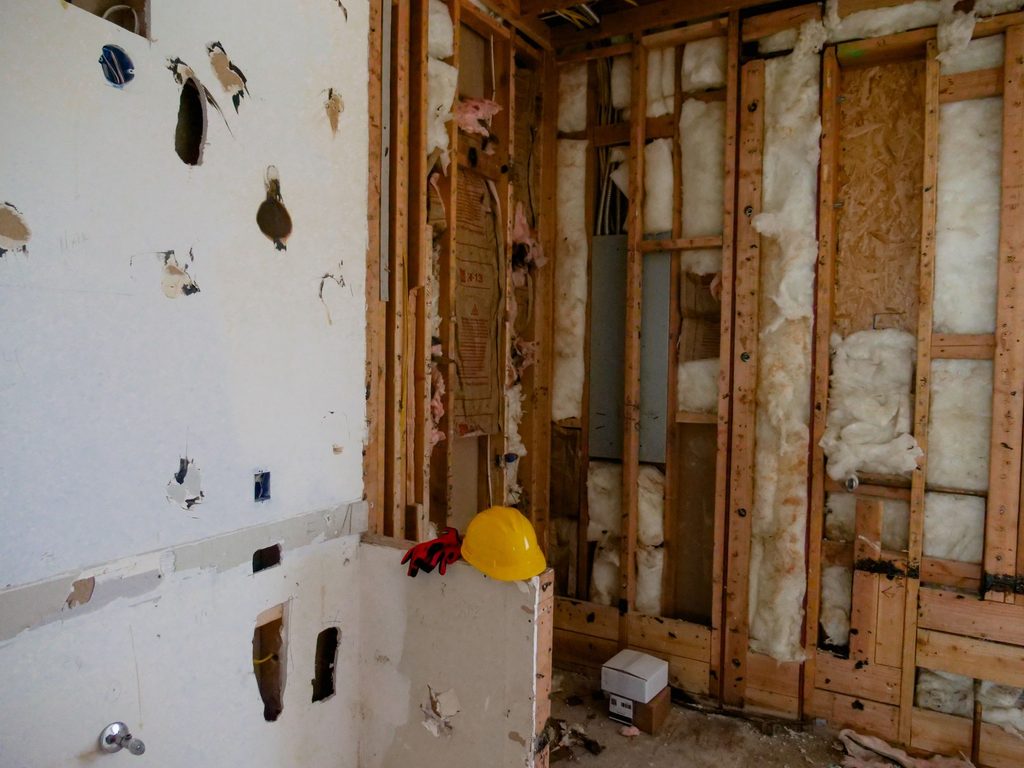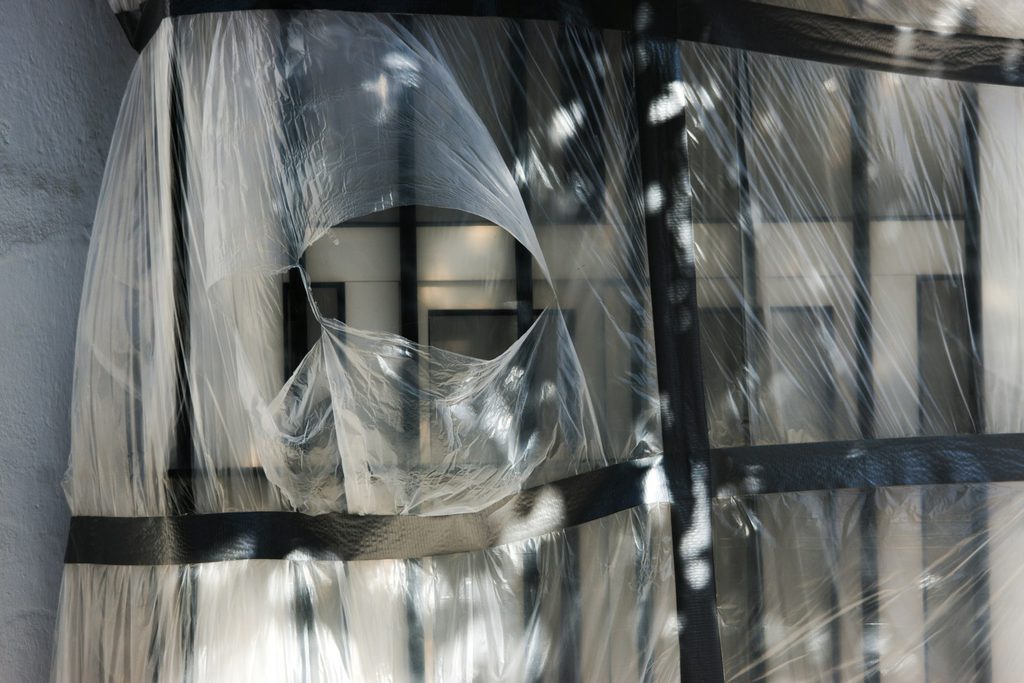
A sheet taped across a doorway is a visual promise, not an engineering control. Containment is a pressure system, and the moment a wall is opened inside a chamber that is not under negative pressure, every gap in the building becomes an exit.
The barrier that works in one direction only
Two remediations are performed in the same week in two similar Perth houses. Both have plastic sheeting taped across the doorway of the affected room, both have operators in protective equipment, and both look, in a photograph, like the same job.
In the first house a machine runs inside the chamber, drawing air through a staged filter set and pushing it out through a hose that leaves the building. The sheeting across the doorway is visibly sucked inward and stays that way all day. Air entering through every seam, every gap in the skirting and the controlled opening at the base of the barrier is moving into the room and not out of it.
In the second house the sheeting hangs loose. There is a machine, and it is recirculating air inside the room through a filter. When the operator cuts the plasterboard, the pressure inside that room rises slightly, and air carrying everything released by the cut moves outward through the gap around the door frame, under the barrier, and through the wall cavity into the room next door.
Those two jobs are not variations of one method. One is contained and one is decorated. From the hallway, and in the completion photographs, they are indistinguishable, which is why the second version has become normal.
This article is the engineering of containment. What it is for, the physics that makes it work, why a perfectly sealed room is a failed containment, how to verify one in two minutes, and the structural reasons a trade that owns the equipment often does not run it properly.
What containment is actually for
The IICRC S520, the standard for professional mould remediation, describes a remediation as a sequence that is planned, contained, executed and then verified. Containment sits in the middle of that sequence for a specific reason, and the reason is the vocabulary the standard gives us for describing a space.
Condition 1 is normal fungal ecology. Condition 2 is settled spores and fungal fragments with no active growth, which is indirect contamination and invisible. Condition 3 is actual growth in or on a material.
A remediation exists to return a Condition 3 space to Condition 1 without creating new Condition 2 anywhere else, and every physical act inside that room works against the second half of that sentence. Cutting a contaminated material releases enormous quantities of particulate. Pulling plasterboard off a frame releases more. Removing a saturated cushion releases more again. Any of those performed in a room that is not under negative pressure pushes the released material into the rest of the building, and the household has paid for the conversion of one contaminated room into a contaminated house.
There is a reason the discipline is built around removal rather than measurement. The World Health Organization’s 2009 guidelines on indoor air quality, dampness and mould concluded that no numerical threshold for indoor fungal concentration could be established, and the recommendation that followed was to prevent and remediate dampness rather than to measure toward a permitted level. If the objective is removal, then how the material leaves the building is the whole job.
Containment has three jobs, in order of importance. It prevents migration of contamination during disturbance. It keeps the volume under control small, so drying and filtration capacity are concentrated where they are needed. And it separates the work area from the people who live there. Only the first is urgent, and it is the one that fails most often.
The physics, which is simpler than the equipment suggests
Air moves from higher pressure to lower pressure. That is the entire principle. A containment works by holding the work area at a slightly lower pressure than the building around it, so that every leak in the barrier runs inward.
The differential required is tiny. A few pascals is enough to reverse the direction of leakage across a seam, which is a small fraction of what a closed door experiences when the wind blows. Containment does not need to be strong. It needs to be consistently negative for the whole duration of the disturbance, and verified rather than assumed.
The differential is created by removing more air from the chamber than enters it. A negative air machine draws air from inside the containment, passes it through staged filtration finishing in a high efficiency particulate filter, and exhausts it. The exhaust must leave the building. An exhaust discharged into a roof space, a hallway or an adjoining room has filtered the air and then delivered it somewhere that is now part of the problem, and we have been called in to correct exactly that.
Two numbers govern the setup. The first is the volume of the chamber, which sets the airflow needed to achieve a meaningful rate of air change inside it. The second is the achieved pressure differential, which is what proves the direction of leakage. Air changes do the cleaning. The differential does the containing. An operator who has calculated one and ignored the other has half a system.
A perfectly sealed room is a failed containment
Here is the detail that separates people who have read the standard from people who have been shown a photograph of it.
A containment has to leak. It has to leak deliberately, in one direction, through a path the operator chose.
If a chamber is sealed so thoroughly that no air can enter it, the extraction machine cannot move air. Flow collapses, the air change rate drops to nothing, the barrier is pulled hard against the frame, and the machine runs loudly while achieving very little. In practice something gives, and what gives is the weakest seam rather than a path somebody designed.
So a correctly built containment includes a controlled make up air path. Usually that is the base of the entry barrier, or a deliberately unsealed section at a known location, sized so that the machine can draw its rated flow while the chamber stays negative. The air entering through that path comes from the building, moves across the work area, and leaves through the filter. That is a working chamber. The room is being continuously flushed in a known direction.
This is why the state of the barrier is such a useful indicator. A sheet bowed inward and steady means the system is working. A sheet hanging slack means there is no differential. A sheet drawn in hard and drum tight, with the machine labouring, means the chamber is sealed too well and the flow has stalled.
The components, and the ones that get skipped
A containment is assembled from parts, and the parts that get left out are predictable.
Critical barriers come first. Heavy gauge sheeting sealed to walls, floor and ceiling rather than taped across an opening, with tape selected so it holds for the duration and releases without taking paint. Every penetration inside the work area is sealed as well. An unsealed vent, a gap around pipework in the wall cavity, or a hole left by a removed fitting is a bypass, and air will prefer it to the path you designed.
A decontamination chamber is second, and it is the component most often missing in residential work. It is a small staged airlock at the entry, two or three compartments deep, so that an operator can remove protective equipment and bagged waste in sequence rather than carrying contamination straight into the hallway. A single zip through a single sheet is not a decontamination chamber.
Filtration is third. Staged pre filters protecting a high efficiency particulate filter, with the pre filters changed on a schedule and the changes recorded. A loaded pre filter is the quiet killer of containment, because airflow falls as it blocks and the machine continues making exactly the same noise. An operator who has not checked a pre filter in three days does not know what their differential is.
Waste handling is fourth. Contaminated material is bagged inside the containment, the outside of the bag is wiped down, and the bag leaves through the decontamination chamber along a protected path. Carrying an open bag of wet contaminated plasterboard down a carpeted hallway undoes the work of the entire chamber in nine seconds.
And pressure monitoring is fifth. A manometer, read and logged, so the differential is a recorded number rather than an impression.
How to verify a containment in two minutes
This is worth knowing, because a client can do most of it from the hallway.
Look at the barrier. It should be bowed inward and should stay that way. Look at where the exhaust hose goes, and follow it until you see it leave the building. Listen for whether the machine is running continuously rather than being switched on when somebody arrives.
Then the two tests an operator should perform and document. A smoke or tissue check at the seams, the entry and any penetration, which should show air drawn into the chamber at every point. And a manometer reading recorded with the time, which converts the visual impression into evidence.
Both take a couple of minutes. Both are repeated daily rather than once at setup, because tape lifts, sheeting tears, pre filters load, and somebody props the entry open to carry a tool through. Containment is not an installation. It is a condition that has to be maintained and verified for as long as the work continues.
The Crusader containment standard
Stage one. Scope before building. The Condition 3 materials are marked and the Condition 2 zone is defined, and the containment is built to that scope rather than to the nearest convenient doorway. A barrier that encloses less than the contaminated area is a barrier with the problem on both sides of it.
Stage two. Seal the envelope, including every penetration, vent and cavity opening inside the work area, and protect the egress path outside it.
Stage three. Calculate rather than guess. Chamber volume against machine capacity for the air change rate, and the make up air path sized and located deliberately so the chamber can run negative at full flow.
Stage four. Build the decontamination chamber, even on a small domestic job. The standard that only applies to large jobs is not a standard.
Stage five. Exhaust outside the building. Never into a roof space, never into another room, and never into a space the household uses.
Stage six. Verify and log daily. Pressure differential by manometer with a time stamp, a tissue check at the seams, pre filter condition, and the machine run times. The containment gets the same treatment in the file as the moisture readings.
Stage seven. Brief the occupants in writing. Which rooms are out of use, for how long, what they must not do, and why the machines stay on overnight. A household that understands the chamber will protect it. A household that does not will switch it off because of the noise.
And the sequence rule that governs all of it. Containment before disturbance, every time, including on the small job where nobody would notice its absence.
Eco chemistry, and engineering instead of product
Our bench is plant derived surfactants, readily biodegradable under OECD 301 within twenty eight days, unfragranced, with no quaternary ammonium compounds in routine work, and hydrogen peroxide based oxidative chemistry only where a disinfection step is genuinely indicated. Containment is where that specification is easiest to hold, because physical control does the work that chemistry is otherwise asked to do.
The common alternative to proper containment in this market is a product. Fogging a space with a biocide, applying an antimicrobial coating, or treating surfaces across a house that was contaminated during an uncontained demolition. Each of those is chemistry purchased to compensate for engineering that was not performed, applied across far more area than a chamber would ever have needed, in a building people are about to move back into.
S520 is explicit that remediation means the removal of contamination, and that dead fungal material is still contamination. A biocide answers a question the standard does not ask. Containment answers the one it does, which is whether the material left the building without being distributed through it on the way out.
The unfragranced rule carries its own weight here as well. Verification after a remediation includes an olfactory criterion, applied by the assessor on the day and by the occupants over the following months. A fragranced product disables both. We hand back a space that smells of nothing, because nothing is the correct result and the only one a household can check for itself.
Long lasting client tips
Six questions and checks for anyone whose home is being remediated.
First. Ask whether containment is in the scope, in writing, and ask what pressure differential it will be run at and how that will be recorded. An operator who answers in pascals and mentions a manometer is running a system. An operator who answers that they will seal the room is describing a sheet.
Second. Follow the exhaust hose with your own eyes until you see it leave the building. This is the single most informative thirty seconds available to a client, and an exhaust discharging into a roof space or a hallway is a problem you can identify without any training.
Third. Look at the barrier. It should be bowed inward toward the work area and it should stay bowed all day. Slack plastic means there is no differential and the chamber is doing nothing.
Fourth. Ask who changes the pre filters and how often, and ask to see it in the log. A blocked pre filter turns a negative air machine into an expensive fan, and nothing about the sound of the machine will tell you.
Fifth. Do not open the containment to have a look, and do not let anyone else. Every entry that bypasses the decontamination chamber carries material into the part of the house you are paying to protect.
Sixth. Leave the machines running overnight and through the weekend. They are noisy, the noise is the point, and a chamber that is switched off at night is a chamber that is positive for eight hours in the middle of the job.
The bold position
Containment is the most skipped engineering control in Australian residential remediation, and it is skipped for reasons that have nothing to do with equipment cost. The gear is inexpensive, widely available and rents by the day. What is missing is not capital. It is the willingness to spend half a day building something the client cannot see, that makes the job look slower and more invasive than the quote down the road, and whose absence will never be detected.
We will name the failure mode plainly. It is disturbance before containment. Cutting, pulling, scraping or lifting a contaminated material in a room that is not under verified negative pressure, which converts one affected room into an affected building and hands the household a problem with no visible cause. The failure surfaces months later, somewhere else, usually as a stain in a hallway or a persistent odour in a bedroom that nobody can connect to work done in a different room in a different season.
There is a second failure that compounds it. Because the contamination has been distributed rather than removed, the next operator inherits a house that reads as broadly affected with no identifiable source, and the honest scope for correcting it is several times the size of the original job. Clients in that position frequently conclude that remediation does not work. What did not work was a sheet of plastic taped across a doorway while somebody opened a wall behind it.
Cleaning Crusader builds containment to the scoped Condition 2 zone rather than to the nearest doorway, runs verified negative pressure with the differential logged daily, builds a staged decontamination chamber on jobs of every size, exhausts outside the building, and will not disturb a contaminated material until all of that is in place and checked. We tell clients what to look for so they can verify it themselves, including on our own jobs.
A barrier that leaks inward is engineering. A barrier that only looks like one is a photograph of a standard.
Silent strategy. Visible legacy.
Cleaning Crusader. Built for impact. Driven by excellence. Guided by purpose.