Almost all furniture leather in this country wears through a polymer coating rather than through the hide, which means an entire aisle of conditioners is sold to a layer that cannot absorb them. The care industry has built a ritual on top of a material it has stopped describing accurately.
The headrest goes first, every time
Walk through any Perth home with a leather lounge that is more than five years old and look at three places. The headrest. The inside face of the armrest. The front edge of the seat cushion.
Those three will be darker, duller and often slightly tacky, while the back panel and the outer sides look nearly new. Every operator in this trade has seen that pattern a thousand times, and almost every household has been told the piece needs feeding.
It does not need feeding. What has happened at those three locations is that a polymer coating has been softened and abraded by body oils, perspiration salts and contact, and the coating is the wear surface. The hide underneath is largely unchanged. The difference matters enormously, because a softened coating is a repair question and a dry hide is a chemistry question, and the products sold for the second do nothing for the first.
This article is the material science of furniture leather. What a hide actually is, how the three finish families behave, how to tell in ten seconds which one you own, why the conditioner cannot reach what it claims to reach, and what an honest leather service consists of.
What a hide actually is
A textile is a set of yarns woven or tufted into a structure. Leather is nothing like that. It is a three dimensional network of collagen fibre bundles, interwoven in every direction, varying in density through its own thickness. The tight outer layer carries the grain, the characteristic surface pattern of the animal. Below it the fibre structure opens out into the corium, which gives the hide its body.
Two manufacturing steps turn that into furniture. Tanning stabilises the collagen so it will not decay, and the dominant process for upholstery hide is chrome tanning, with vegetable tanning used on some premium and traditionally finished pieces. Then comes fat liquoring, which is the step nobody is told about and which explains most of the confusion in this category.
During fat liquoring, oils and emulsions are introduced into the wet, swollen hide inside a rotating drum, so they deposit between the collagen fibre bundles and allow those bundles to slide past one another. That sliding is what suppleness is. Leather is not soft because its surface is oily. It is soft because its internal fibre structure is lubricated between the bundles, and that lubrication was installed at the tannery, with the hide wet, under mechanical action, before any finish went on.
Hold that fact for the conditioner section. It is the whole argument.
Three finishes, and the one you almost certainly own
After tanning and fat liquoring, the hide receives a finish, and the finish family decides how the piece must be treated.
Full aniline leather is dyed through with transparent dye and carries no pigment layer and no protective topcoat. The grain is visible and unmasked. It absorbs, it darkens where it is touched, it develops a patina, and it stains from water, from oil and from almost anything spilled on it. It is expensive, it is uncommon, and it is unforgiving.
Semi aniline leather carries a light pigment and a thin topcoat. It keeps much of the natural grain while gaining some resistance. It sits in the middle on both price and tolerance.
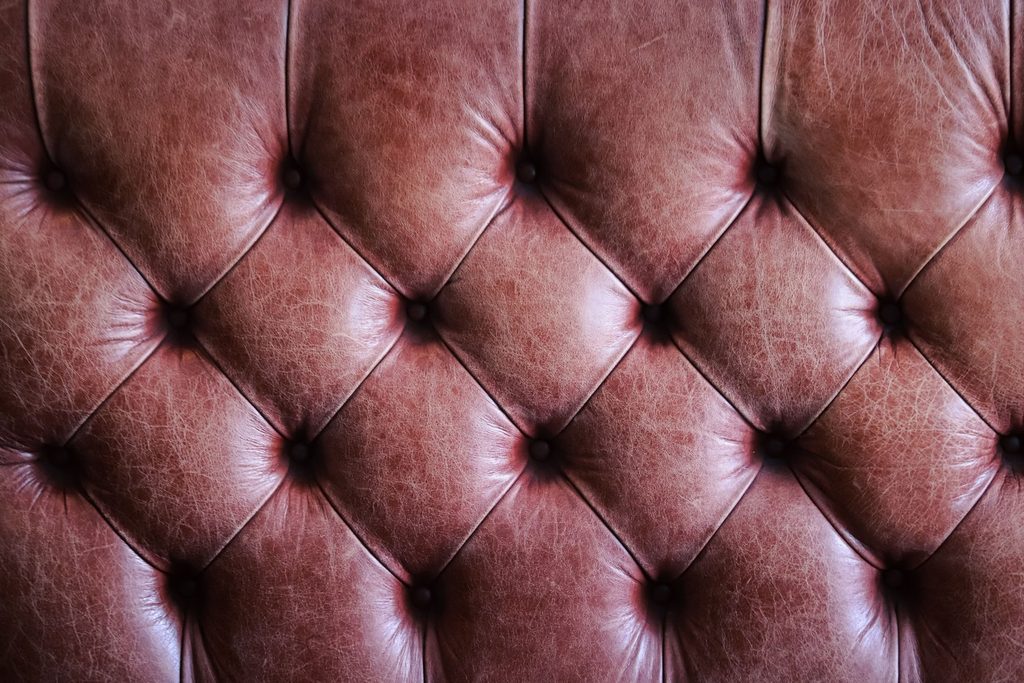
Pigmented leather, also sold as finished or protected leather, carries an opaque pigmented layer and a clear topcoat, usually polyurethane based, often with an embossed grain pressed into it. The overwhelming majority of furniture leather sold in Australia is in this family. On a pigmented piece the colour you can see is a coating, the surface you touch is a coating, and the wear surface is a coating. The hide is a substrate underneath it.
You can identify which you own in about ten seconds. Put a single drop of water on an inconspicuous area, low on a back panel or under a cushion. On an aniline hide it darkens the leather and absorbs within seconds. On a pigmented hide it beads and sits on the surface until you wipe it away. Then run a damp white cloth over the same concealed area and look at the cloth. Colour on the cloth means an unstable or already compromised finish, and it changes the method immediately.
Three minutes of testing. It is the difference between a professional and a gambler, and it is exactly the same discipline we apply to a fabric before we open a bottle.
What actually fails, in order of frequency
The first and most common failure is body oil and perspiration at the contact zones. Human skin deposits oils and salts, those migrate into a polyurethane topcoat, and they act as plasticisers. The coating softens, loses its original hand, picks up soil more readily, and eventually goes tacky. That is the headrest. It is a chemical attack on a coating, it progresses wherever heads and forearms rest, and it is almost entirely preventable with a damp cloth once a week.
The second is abrasion. Grit carried on clothing collects in the seat creases and along the front edge of a cushion, and every time somebody sits down that grit is worked against the finish. The coating thins. Eventually it wears through to the pigment and then to the hide, and at that point no cleaning product in existence recovers it.
The third is dye transfer. Indigo from new denim is the classic case, and on a light coloured pigmented leather it is one of the most common complaints in the trade. The dye migrates into the topcoat rather than sitting on it, which is why gentle cleaning removes some and never all of it.
The fourth is alkaline damage. Leather is manufactured and stabilised on the acidic side of neutral. Household spray cleaners and dish detergent in water are alkaline, and alkalinity attacks both the finish and the collagen itself, producing a stiff, dull surface that cracks sooner than it should. More leather is damaged in Australian homes by a kitchen spray bottle than by anything else.
The fifth is sunlight and heat. Ultraviolet exposure degrades both the finish and the dye, and a piece sitting in a west facing window or against a heater loses both flexibility and colour. Moving the furniture is free and more effective than anything you can apply.
And the sixth, which is real and routinely misdiagnosed, is genuine loss of flexibility in the hide. It happens when fat liquor is depleted by prolonged heat or by repeated wetting and drying. It is slow, it is uncommon in ordinary indoor use, and when leather cracks the crack has usually started in the finish rather than in the collagen.
The conditioner, honestly
Here is the sentence the category does not want written down. On a pigmented leather, a conditioning cream applied to the surface is applied to a polymer coating, and it does not reach the hide, because the coating is there specifically to stop liquids reaching the hide.
What such a product can do is limited to three outcomes. It can temporarily change the gloss, which reads as nourishment and lasts until the next wipe. It can leave a film that attracts soil, which makes the piece dirty faster. Or, if it carries silicone or wax, it can leave a residue that interferes with any future refinishing, because a new pigment coat will not bond to a silicone contaminated surface. That last one is the expensive outcome, and it is identical in mechanism to the problem a silicone product creates on any other coated surface.
Feeding is not a mechanism that operates through a cured polyurethane topcoat. The lubrication inside a hide was introduced in a drum at a tannery with the hide wet and swollen, and it cannot be reinstated from a bottle on a Sunday afternoon.
There is a legitimate product in this category and it should be sold for what it is. A water based protector leaves a thin sacrificial layer on top of the topcoat, which slows soil adhesion and slows dye transfer from clothing. That is a modest, genuine benefit on a piece in daily use. It is not nourishment, it is not restoration, and it does not reach the leather. An operator or retailer describing it as any of those three is selling a story.
Full aniline leather is the exception that proves the rule. With no topcoat in the way, a correctly formulated product can genuinely be absorbed, which is precisely why those pieces also absorb water, oil and everything else. The products work on the leather that needs the most care and do nothing on the leather that almost everybody owns.
The Crusader leather protocol
Stage one. Identify the material. Finish family by water drop test, colour stability by concealed cloth test, and an inspection of the grain, the edges and the seams to establish whether the piece is a hide at all. Reconstituted products made from leather fibre bonded to a polymer surface, and coated synthetic materials sold to resemble leather, both behave differently and neither can be refinished when the surface layer delaminates. A client is entitled to know which of those they own before any money is spent.
Stage two. Dry removal first. Vacuum with a soft brush, working the creases, the seam channels and under the cushions, because that is where abrasive grit collects and where the finish is being cut every time somebody sits down.
Stage three. Clean with chemistry matched to the finish and to the leather’s acidic requirement, applied to a cloth or as a controlled foam rather than poured onto the piece, worked panel by panel, never saturating. Water is a tool here and not a medium. A leather panel is not rinsed.
Stage four. Treat the contact zones as a separate operation. The headrest and the armrest carry a body oil load that the panel pass will not lift, and they need a specific degreasing step with a controlled dwell, tested first, because the coating in those areas is already the most compromised surface on the piece.
Stage five. Dry with a clean towel and ambient air. No heat, no high velocity air at a panel, no sun. Leather that is dried aggressively stiffens.
Stage six. Say the word refinishing when the finish has worn through. A pigmented coating that has abraded to the hide cannot be cleaned back. It is repaired by colour matching, applying pigment and a new topcoat, and that is a repair discipline with its own training. Where a hide has split or a seam has failed, the work belongs to an upholsterer rather than to us, and we say so.
Stage seven. Protection, disclosed accurately. Where a water based protector is appropriate we apply it and we describe exactly what it does, which is to slow soil and dye transfer on the topcoat for a period, and nothing else.
Eco chemistry for hide and finish
Our bench is plant derived surfactants, readily biodegradable under OECD 301 within twenty eight days, unfragranced, with no quaternary ammonium compounds in routine work, and hydrogen peroxide based oxidative chemistry only where a disinfection step is genuinely indicated. For leather the bench adds one constraint and removes two product families.
The constraint is pH. Chemistry for leather is formulated to sit on the acidic side of neutral, matching the material’s own stabilised state, because alkalinity damages both finish and collagen. That single specification rules out most of what is sold as a general purpose cleaner.
What we exclude is silicone and wax. Both produce an immediate improvement in gloss and both leave a persistent film that attracts soil and prevents later refinishing. A product that makes a panel look better this afternoon and makes a repair impossible in four years is a bad trade made invisible by time.
The reasoning behind the unfragranced rule is sharper on upholstery than anywhere else we work. This is the surface a household is in sustained skin contact with. People sleep against it, sit on it for hours and press their faces into it. Anything we leave in or on that surface is in contact with a person for a large part of their day, which is a strong argument for leaving as little as possible.
Long lasting client tips
Six rules that will keep a leather piece out of the replacement cycle.
First. Run the water drop test and learn what you own. A drop that beads means a coated leather and a completely different care regime from a drop that soaks in. Ten seconds of testing will save you from most of the mistakes available.
Second. Never use a household spray or dish detergent on leather. Both are alkaline, both attack the finish and the collagen, and this is the most common cause of leather damage in Australian homes.
Third. Wipe the headrest and the armrests weekly with a slightly damp cloth. Body oils are what soften a topcoat, and removing them before they migrate is worth more than every product in the care aisle combined.
Fourth. Vacuum the creases and the seams monthly with a soft brush. The grit sitting in a crease is cutting the finish every time somebody sits down, and it is the one failure that cannot be reversed.
Fifth. Keep the piece out of direct sunlight and away from heaters, and keep brand new denim off a light coloured leather. Ultraviolet degrades finish and dye, and indigo migrates into a topcoat rather than sitting on it.
Sixth. Stop buying conditioners for a coated leather. If you want to spend money on protection, buy a water based protector from someone willing to tell you exactly what it does, and be sceptical of anything described as feeding, nourishing or restoring.
The bold position
Leather care in this country is sold as a ritual because a ritual is repeatable and a diagnosis is not. A kit at the point of sale, a cream every six months, a protection plan written against no identified finish. None of it requires anybody to establish what the material is, which is convenient, because establishing that would reveal that most of the products do not reach the layer they describe.
We will name the failure mode plainly. It is leather cleaned as an afterthought at the end of another job. The machine is still hot, the lounge is in the same room, a small hand tool goes on the same hose at the same temperature, and nobody has tested the finish or the colour stability. Four minutes of decision making, applied to the most expensive single textile item in the house. That is not carelessness so much as a commercial habit, and the client has no way of knowing that the moment they just approved is the highest risk moment in the job.
Cleaning Crusader identifies the finish family and tests colour stability before anything is opened, cleans at a pH matched to the material rather than to our convenience, treats the contact zones as their own operation, and uses no silicone and no wax at any point. We tell clients when a piece needs refinishing rather than cleaning, when it belongs to an upholsterer, and when the honest answer is that a reconstituted surface has delaminated and cannot be recovered at any price.
Leather is a hide with a coating on it, and almost everything sold to care for it is addressed to the hide. Treat the coating and the hide looks after itself for thirty years.
Discipline creates freedom.
Cleaning Crusader. Built for impact. Driven by excellence. Guided by purpose.