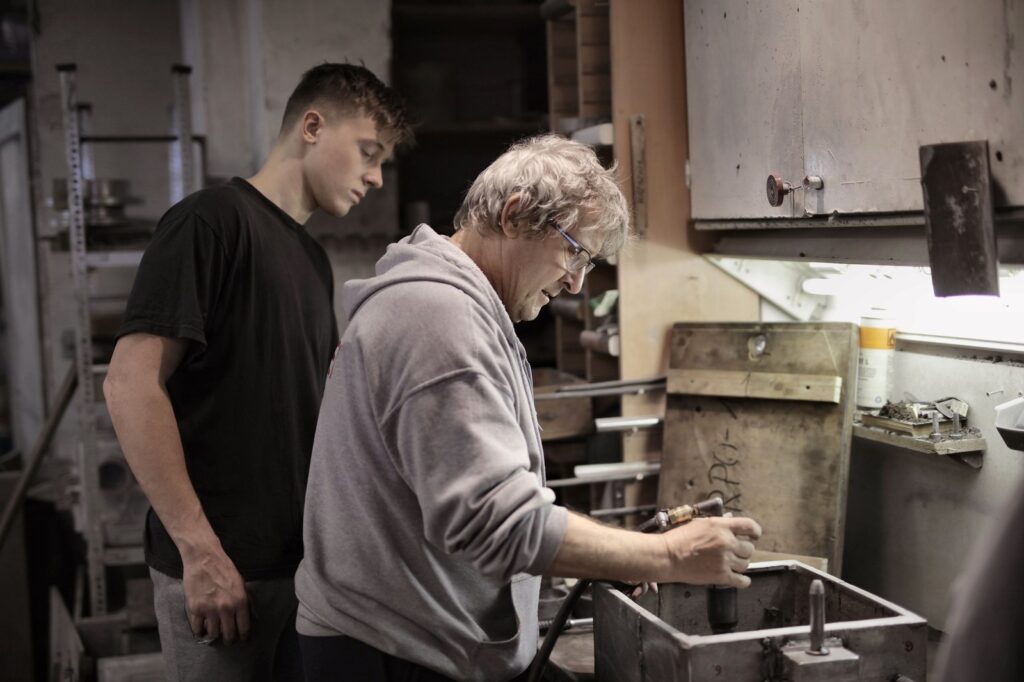
Every discipline this series has argued for, engineering the clean, training the operator, documenting the standard, holding restraint when nobody is watching, building for the long horizon rather than the next invoice, only survives the person who currently practises it. A firm that has built all of that and cultivated nobody to carry it forward has not built a legacy. It has built an expiry date and simply not looked at it yet.
The standard that lived in one person
There is a version of this story that plays out quietly across the trade, and it rarely announces itself as a crisis until it already is one. A firm builds a genuine standard over years, an operator who reads moisture correctly without needing the meter to confirm it, who can tell a fibre type by feel before checking the label, who has internalised the chemistry, the documentation discipline, the restraint to do the extra drying day nobody will ever see. Customers notice. Referrals build. The firm’s reputation, on paper, looks like it has arrived. Then that operator retires, or moves on, or simply gets tired, and the standard the firm was so proud of turns out to have been living in one set of hands the entire time, hands that were never deliberately asked to teach anyone else what they knew.
This is not a hypothetical. It is close to the default outcome for a trade built the way cleaning and restoration is currently built in Australia, casualised, transactional, rewarding the person who can do the job today over the person who spends part of today teaching someone else how. Every argument this series has made, across twelve manifestos before this one, has quietly assumed a firm that survives long enough for those arguments to matter. This thirteenth manifesto makes the assumption explicit, and asks the harder question underneath it. Survives through whom.
Five arguments that all require someone still standing
This series has made a connected case across its manifestos so far, and it is worth naming five of its central threads plainly, because each one depends entirely on a person who is present, trained, and willing to hold it. The first argument was engineering, that cleaning is not housekeeping but preservation work, carpets treated as lungs, grout treated as load bearing infrastructure, a customer’s asset protected rather than merely tidied. That argument requires an operator who understands the engineering, not one following a checklist without knowing why the steps exist. The second was training, that the trade’s chronic weakness is a workforce sent to jobs it was never properly taught to do, and that the lever available to any firm serious about standards is investment in the people doing the work. The third was documentation, that a standard which exists only in memory is not a standard at all, and that writing it down is what allows it to survive any single person’s departure, in principle if not yet always in practice.
The fourth was restraint, the argument that the truest competitive advantage a firm holds is the discipline exercised when nobody is watching, the extra drying day, the containment built when a wipe would have looked the same to an inspector who never came. And the fifth, the most recent, was the long horizon, the case that a firm built for the next thirty years rather than the next invoice compounds a reputation, a relationship base and an asset worth more each year it holds the line. Read together, these five arguments describe a firm that invests heavily today for a return that arrives later, sometimes much later, and every one of them depends on there being someone still there to receive that return and to keep making the same investment after the person who started it has gone. None of these five arguments survive on their own. They survive only through the hands that are taught to carry them forward, and that is the argument this series has never yet made directly.
A trade that is ageing without a plan to replace itself
It is worth being honest about the structural pressure working against succession in this trade, rather than treating the problem as a matter of individual firms simply forgetting to plan. The cleaning and restoration trade in Australia sits within a broader pattern documented across the skilled trades more generally, an ageing workforce, a documented decline in apprenticeship and structured training uptake over the past decade, and a casualised employment model that treats most workers as interchangeable labour rather than as trainees on a deliberate pathway toward mastery. National training data has repeatedly shown that a meaningful share of people who begin a trade apprenticeship do not complete it, and the structural reasons are well understood, inconsistent supervision, inconsistent pay progression, and a workplace culture that too often treats a trainee as a cost to be minimised rather than a future standard bearer to be built.
Cleaning and restoration is arguably more exposed to this pattern than trades with a formal licensing structure behind them, precisely because there is often no external qualification forcing a firm to invest in structured training at all. A plumber or an electrician operates inside a licensing framework that mandates a training pathway whether any individual employer wants to invest in one or not. A cleaning and restoration operator can, in most jurisdictions, be handed a machine and a chemical and sent to a job the same week they are hired, with no external structure requiring anyone to teach them the chemistry, the moisture science or the documentation discipline this series has spent twelve manifestos arguing for. Where that external structure does not exist, the entire burden of building the next generation of the trade falls on individual firms choosing to do it anyway, and most of the trade, under margin pressure and staffing shortages, is not choosing to.
The apprentice as an investment, not a cost
The commercial logic that keeps most firms from training seriously is straightforward and worth naming without contempt for the operators caught inside it. A new person is slower than an experienced one, makes mistakes an experienced person would not, and requires supervision time from someone who could otherwise be earning on a job of their own. Every hour spent teaching a new operator to read a moisture meter properly, to identify a fibre correctly, to understand why a drying target matters rather than simply following a checklist number, is an hour not billed directly to a customer that day. Under enough margin pressure, that arithmetic looks like training is a cost the firm cannot afford, and a great many firms in this trade have made exactly that calculation and concluded that hiring already competent operators from elsewhere, or simply running leaner with fewer skilled hands, is the more sensible path.
This calculation is short sighted in precisely the way this series has argued against in every manifesto so far. Training an apprentice is not a cost sitting outside the firm’s other investments. It is the same category of investment as the extra drying day, the documentation nobody reads until they need it, the long horizon over the next invoice, money and time spent now for a return that arrives later and compounds for as long as that person stays in the trade. A firm that trains one operator to a genuine standard has not spent money on a slower month. It has planted a source of correctly done, well documented, properly explained work that will run for the next twenty or thirty years of that person’s career, likely training others in turn. Measured against a single week’s productivity, an apprentice is a cost. Measured against the horizon this series has already argued a serious firm should be thinking in, an apprentice is close to the highest return investment available, because it is the only investment that multiplies itself by producing another person capable of making the same investment again.
What a firm actually owes the person coming up behind it
Cultivating apprentices properly is not simply a matter of hiring someone young and hoping they absorb the standard by proximity. It requires the same documented discipline this series has argued for in every other part of the operation. A trainee needs the chemistry explained, not merely demonstrated, so that they understand why a pH neutral rinse matters on grout rather than simply performing the step from memory without the reasoning behind it. They need moisture science explained with the same seriousness this series has given it across its science pillar, so that a drying target is understood as a documented threshold with a reason behind it rather than an arbitrary number on a meter. They need to be shown the restraint argument directly, taken to see the extra step taken when nobody was watching, so that the standard is transmitted as a value rather than merely a set of instructions to follow under supervision and abandon once supervision ends.
This is slower than simply hiring someone already competent, and it is meant to be. The whole argument of the long horizon manifesto was that the slower road, held consistently, arrives somewhere the fast road never reaches. Training an apprentice properly is the clearest possible application of that same principle to the question of people rather than customers or assets, patience over the immediate productivity of a fully formed hire, because a firm that only ever hires people already trained elsewhere is not building anything of its own. It is borrowing standards other firms built, and it has no answer for what happens when the trade as a whole stops producing people to borrow from.
The firm that does not cultivate its successors
A firm that has invested seriously in engineering thinking, in documentation, in restraint, in the long horizon, and has done all of it without deliberately building the next generation of people to hold those standards, has built something genuinely impressive that is nonetheless quietly running on a countdown. Every one of those disciplines lives, in the end, in the judgement and the habits of the specific people currently practising them. When those people leave, retire, or simply move on without having taught anyone else to hold the same standard with the same seriousness, the firm does not gradually decline. It often looks perfectly healthy on paper right up until the standard it was known for is simply no longer being delivered, replaced by whoever was hired to fill the gap without ever being properly shown what the gap actually required.
This is the sense in which a firm that does not cultivate apprentices is quietly planning its own expiry, whether or not anyone inside it would describe it that way. The expiry is not announced. It arrives as a slow drift, a slightly less thorough drying job, a documentation habit that quietly lapses, a customer experience that is competent but no longer distinctive, until the thing that made the firm worth choosing over its competitors has thinned out without a single dramatic moment anyone could point to and call the cause.
The bold position
We will say this plainly. A firm can build every discipline this series has argued for, the engineering, the training of its current people, the documentation, the restraint, the long horizon, and still fail the single test that determines whether any of it outlives the people currently holding it. That test is simple. Has this firm deliberately built its own successors, or has it simply been fortunate enough, so far, that the people who built its standard have not yet left. Most firms in this trade have never been asked that question directly, because the trade as a whole has never treated apprenticeship and succession as a discipline worth the same seriousness as chemistry or documentation, and the ageing, undertrained state of the broader industry is the visible cost of that neglect.
Cleaning Crusader treats cultivating the hands that come after as a discipline in its own right, equal in seriousness to the engineering, the science and the restraint this series has spent twelve manifestos building the case for, because none of those disciplines mean anything on the only timescale that actually matters, decades, unless there is someone still standing who was taught to hold them and who is teaching the next person in turn. The work is the proof, but only for as long as someone is still doing it the way it was meant to be done. Building that continuity, deliberately, is not a side project sitting alongside the real work of this trade. It is the only way anything this series has argued for gets to still be true in thirty years, and a firm that has not started building it yet should treat this as the most urgent manifesto in the series, not the most philosophical one.
Innovation creates legacy.
Cleaning Crusader. Built for impact. Driven by excellence. Guided by purpose.