A fresh sheet tells the eye that the bed underneath is clean. The eye is wrong. A mattress in daily use is an upholstered object holding a dense, ongoing biological population governed by body heat and trapped moisture, and removing that population is an extraction problem, not something a change of linen can touch.
The gap between what the eye sees and what is there
Pull back a fresh sheet on any bed and the mattress underneath looks, to the eye, essentially clean. It is pale, unmarked, unremarkable. This visual impression is one of the more reliable illusions in the home, because a mattress is not a surface. It is a thick, upholstered object built from multiple layers of quilted fabric, foam, and fibre fill, and the population living inside those layers has almost nothing to do with what the surface looks like from above. A mattress can appear immaculate and simultaneously hold one of the densest concentrations of biological material anywhere in a house.
This is the gap this article is about. Most homeowners assess the cleanliness of their bedroom by what is visible, the sheet, the doona cover, the pillowcases, all of which are laundered regularly and look and smell fresh as a result. The mattress itself, as an item of upholstered furniture, is almost never professionally cleaned the way a sofa or an armchair is, despite carrying a soil and biological load that a sofa rarely approaches. The gap between the perceived state of the bedroom and the actual state of the mattress underneath it is, itself, worth naming as a psychological phenomenon before it is worth naming as a hygiene one. People form a sense of a clean, restorative bedroom environment from a surface they can see while remaining entirely unaware of the population directly beneath it.
What the population actually is
The organism at the centre of this article is the house dust mite, a microscopic arachnid measuring a fraction of a millimetre, invisible to the naked eye, and present in essentially every mattress in ongoing domestic use regardless of how visually clean the home appears. Dust mites do not bite and do not carry disease. Their significance lies entirely in what they eat and what they leave behind. Their primary food source is shed human skin cells, and the human body sheds a very substantial number of skin cells every day, the great majority of which settle into bedding and the upper layers of the mattress during the many hours spent in contact with it. A mattress in active use is, from the mite’s perspective, an abundant and continuously replenished food source.
The mite population does not simply eat and remain static. It reproduces on a cycle measured in weeks, and a mattress that has been in use for years without professional extraction cleaning can develop a population running into the hundreds of thousands to low millions across its full volume, concentrated most heavily in the layers closest to where the body rests. The allergen of consequence is not the mite itself but its waste. Dust mite faecal pellets contain a specific protein allergen, extensively studied in the allergy and respiratory literature, that is small, light, and readily inhaled once disturbed. It is one of the most common indoor allergen triggers documented for asthma and allergic rhinitis, and a mattress carrying a substantial mite population is, in practical terms, a continuous low level source of that allergen for as long as it remains untreated.
Why the mattress is the ideal habitat
Dust mites thrive under a narrow band of conditions, and a mattress in nightly use happens to recreate that band with remarkable consistency. Mites proliferate fastest in relative humidity somewhere in the region of seventy to eighty percent and in temperatures close to the mid twenties in Celsius terms. A human body in contact with a mattress for six to nine hours maintains a surface temperature in that same range directly against the quilted layer, night after night, for as long as the mattress remains in service. This is the body heat half of the mechanism named in this article’s angle, and it is not incidental. It is the single most consistent heat source any upholstered item in the home receives.
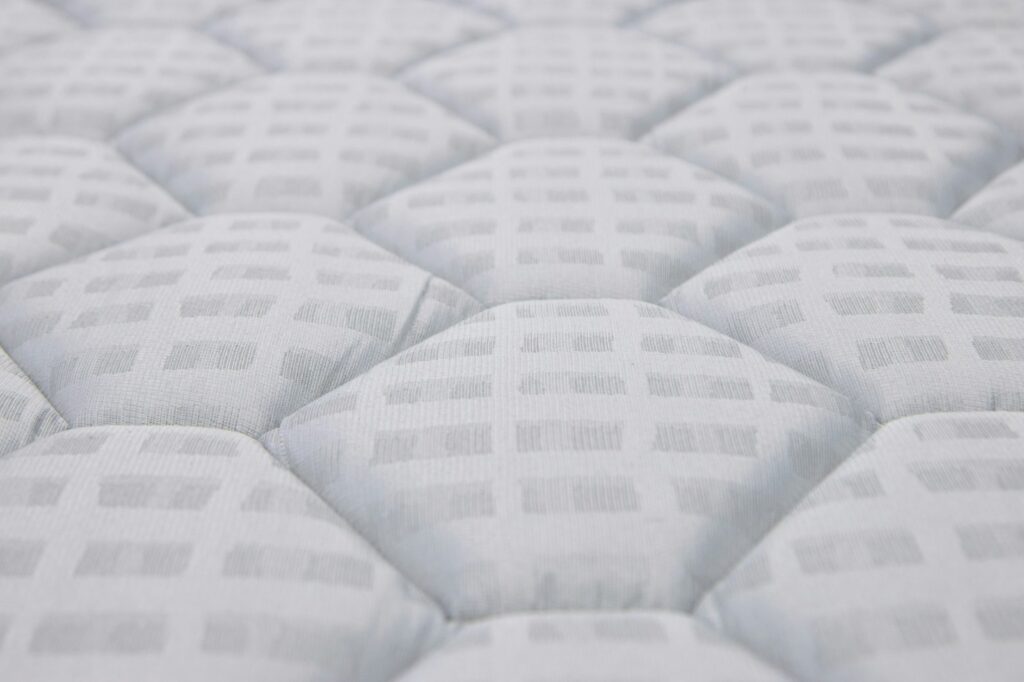
The moisture half of the mechanism comes from ordinary human perspiration during sleep. The body loses a measurable volume of water through the skin overnight, and a significant proportion of that moisture is absorbed directly into the quilted layers and the fill immediately beneath the sheet, because a mattress is built for comfort and support, not for moisture management. Unlike a garment engineered to wick moisture away from the body, a mattress’s quilted construction, layers of fabric and thin padding stitched together in a pattern designed purely for surface feel, traps that moisture close to where it was released. The combination of sustained body heat and absorbed moisture, repeated nightly across years of use, produces a stable microclimate inside the upper layers of the mattress that sits almost precisely within the range dust mites require to flourish. No other piece of upholstered furniture in a typical home receives this combination of heat and moisture on anything like the same nightly schedule.
Why this is an extraction problem, not a surface routine
The instinctive response to this information is to vacuum the mattress more often, and vacuuming does help at the margin, removing loose surface dust and some proportion of allergen sitting on the exposed sheet contact surface. It does not touch the population living inside the quilted layers. A domestic vacuum cleaner is built to lift loose particulate from a hard or lightly piled surface using airflow alone. It has neither the suction depth nor the agitation to reach mites, faecal allergen, and shed skin cells embedded several layers down inside a quilted, padded structure, which is precisely where the bulk of the population and the allergen load actually sit. Surface vacuuming addresses the least significant fraction of the problem while leaving the microclimate and the population that depends on it fully intact.
This is why the mattress has to be approached as an upholstery extraction problem rather than a hygiene routine. Extraction cleaning, using controlled moisture, appropriate chemistry, and mechanical agitation followed by thorough vacuum recovery, physically reaches into the quilted layers rather than skimming the surface, lifting shed skin cells, mite bodies, and the allergen bound within them out of the structure rather than simply displacing dust on top of it. This is the same underlying discipline used on a heavily soiled sofa or armchair, applied to an object that happens to be flat, quilted, and slept on rather than sat on.
The extraction approach carries a genuine technical constraint that a surface routine does not. A mattress contains foam and fibre fill that tolerates far less moisture than a sofa cushion built for shorter, more occasional contact. Over wetting a mattress during an extraction clean risks driving moisture deeper into the fill than it can shed through normal drying, recreating, at a larger scale and for a longer period, exactly the humid microclimate the mite population depends on. A mattress that is cleaned wet and dried slowly can end up, for a period of days, more hospitable to the population it was meant to reduce, not less. Controlled, low moisture extraction, matched to rapid, forced air drying, is not an optional refinement of the method. It is the difference between a treatment that removes the population and a treatment that briefly disturbs it before conditions recover in its favour.
The Crusader mattress extraction protocol
Every Cleaning Crusader mattress service begins with a full HEPA filtered vacuum pass across the entire surface and all accessible seams, removing loose surface dust and allergen before any moisture is introduced, since treating a soiled surface with liquid first only redistributes what a dry pass would have lifted cleanly. The mattress is then treated with a low moisture encapsulation or controlled extraction method appropriate to its construction, calibrated specifically to avoid saturating the foam or fibre fill beyond what rapid drying can resolve. Quilted seams and tufted button points, where allergen and skin cell debris concentrate most heavily because loose material settles into the low points of the stitching, receive targeted agitation to lift material a general pass across the flat surface would miss. A second HEPA filtered vacuum pass follows the treatment once the surface has reached a safe, workable dryness, recovering the loosened material before it can resettle into the structure. Forced air drying, using purpose built air movers rather than relying on ambient bedroom airflow, brings the mattress to a fully dry state well within the window needed to prevent any moisture related rebound in the mite population.
Eco chemistry for mattress upholstery
The Cleaning Crusader upholstery chemistry bench is built on plant derived surfactants, biodegradable within twenty eight days under OECD 301, unfragranced, with no quaternary ammonium compounds in routine cleaning. A mattress sits in direct, sustained skin contact for a large proportion of every day, more than almost any other surface in the home, which makes the choice of chemistry more consequential here than on a sofa used for a few hours in the evening. The low moisture, plant derived formulation used on mattress extraction is selected specifically because it lifts allergen and soil effectively without leaving a fragranced or chemically heavy residue against a surface the body will be in contact with for hours immediately afterward.
Long lasting client tips
First. Have a mattress professionally extraction cleaned on a regular interval rather than waiting for a visible reason. Because the population and its allergen load are invisible from the surface, there is no visual cue that will ever prompt timely action on its own.
Second. Vacuum the mattress surface with a HEPA filtered attachment between professional services. This will not reach the population living in the quilted layers, but it does reduce the surface allergen load that becomes airborne when the bed is made or disturbed.
Third. Use a mattress protector as a physical barrier, not as a substitute for extraction cleaning. A protector reduces how much new skin cell and moisture material reaches the mattress surface in the first place, which slows the rate at which the population rebuilds after a professional clean, though it does not remove what has already accumulated beneath it.
Fourth. Air the mattress periodically by leaving it exposed to open airflow and, where practical, direct sunlight for a few hours. Ultraviolet exposure and reduced humidity both work against the conditions the mite population depends on, though this is a supporting measure and not a substitute for extraction.
Fifth. Never attempt a heavy, DIY wet clean of a mattress at home. A garden hose, a carpet shampoo unit not built for controlled drying, or an oversaturated spot treatment risks driving moisture into the fill faster than a household environment can dry it out, and a mattress that stays damp for days becomes, temporarily, a more favourable habitat than the one you started with.
Sixth. Understand that a mattress showing no visible stains is not evidence the population beneath it is small. Visual cleanliness and biological load are two separate measurements, and the second one is the reason the extraction service exists at all.
The bold position
We will say this plainly. Australian households treat sofa and lounge upholstery as an item worth professional cleaning every year or two, and treat the mattress, an item receiving vastly more sustained body contact and holding a vastly larger biological load, as something that never needs the same attention until it is replaced entirely. This is not a hygiene failure so much as a category error. The mattress has been culturally filed under bedding, something laundered and changed, rather than under upholstery, something extracted and maintained, and the mismatch means the one piece of furniture in the home most exposed to heat, moisture, and skin contact is also the one piece least likely to ever receive an extraction service.
The population beneath the sheet is not a failure of housekeeping. It is the predictable outcome of physics and biology operating on an upholstered object every single night, entirely independent of how tidy the bedroom looks. A vacuum will not reach it. A fresh sheet will not touch it. Only a controlled extraction, matched to the mattress’s own moisture tolerance and dried fast enough to prevent the treatment itself from creating a worse microclimate, actually reduces what has built up inside the quilted layers over years of use.
Cleaning Crusader treats the mattress as the upholstered asset it is, not as an oversized pillow that launders itself by association with the sheet on top of it. We extract, we dry under controlled airflow, and we tell the customer plainly that the surface they can see was never a reliable guide to what was living underneath it.
Restraint matters more than noise.
Cleaning Crusader. Built for impact. Driven by excellence. Guided by purpose.