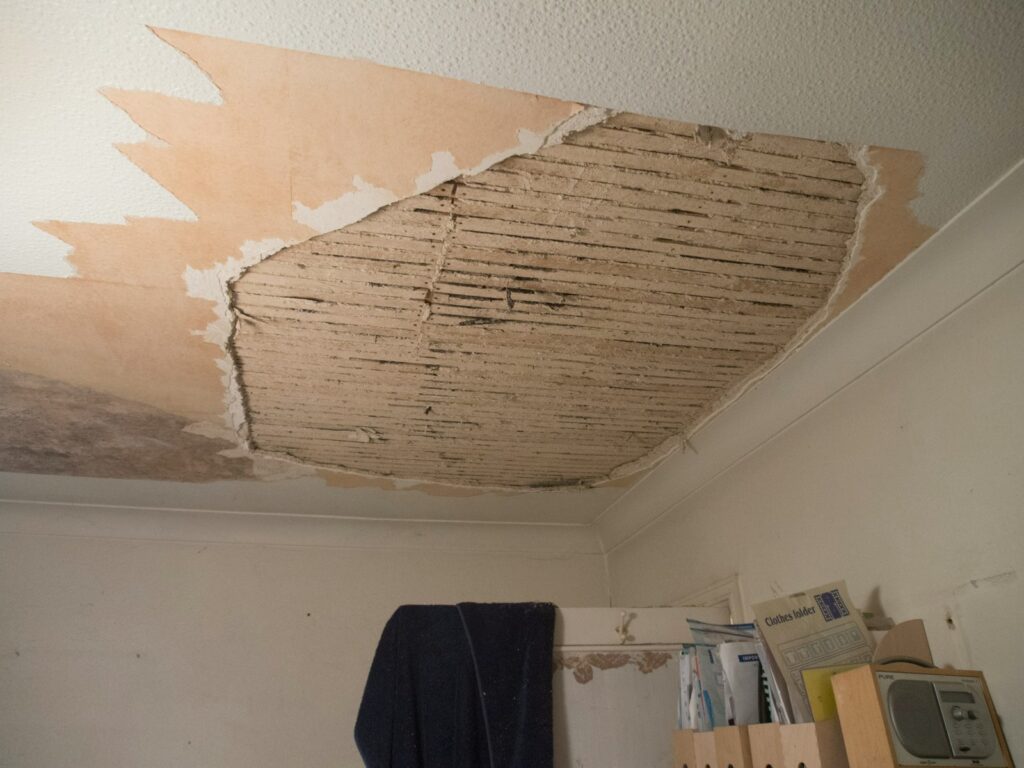
A ceiling that looks dry on the surface can still be carrying litres of trapped water in the cavity behind it, and the insulation batt sitting against the plasterboard is the reason the collapse happens weeks after everyone has stopped worrying about the leak.
The job that looked finished
A Perth roof lets rain through during a storm. Water tracks along a truss, finds a low point in the ceiling cavity, and stains a patch of plasterboard the shape of a continent. The homeowner calls a drying company. Air movers arrive, a dehumidifier runs for two or three days, the visible stain fades, the surface reads dry on a moisture meter, and the job is marked complete. Six weeks later, on an ordinary Tuesday with no storm anywhere near Perth, a section of that same ceiling comes down onto the lounge room floor.
This is not a rare or freak sequence. It is a predictable outcome of treating a ceiling as a single surface rather than as a two part system, a visible face and a hidden cavity, each behaving completely differently once water gets into the roof space. Structural drying that stops at the plasterboard face and never properly addresses what is happening in the batt sitting directly behind it is not a completed job. It is a deferred failure with a countdown clock that nobody is watching.
We restore water damaged interiors, not roofs. What follows is the drying science that explains why a ceiling can look fine for weeks and then fail, and why the cavity, not the visible face, is the part of the job that decides whether the ceiling survives.
Two materials, two completely different relationships with water
A residential ceiling is built from two materials with almost opposite behaviour once water reaches them. The plasterboard, typically ten to thirteen millimetres of gypsum core between two paper liners, is a relatively dense, low porosity material. It absorbs water readily at a wetted surface but it also releases that water at a comparatively fast rate once warm, dry, moving air is applied to its face, because the moisture sits largely at or near the surface and in the gypsum crystal structure rather than deep within a fibrous mass.
The insulation batt resting on top of the plasterboard, whether glass wool or mineral wool, is the opposite kind of material entirely. It is almost pure air by volume, held in shape by a low density fibre matrix with an enormous internal surface area relative to its weight. That fibre structure is superb at trapping still air for thermal performance, and it is equally effective, for the same structural reason, at trapping and holding liquid water once it becomes wet. A saturated batt can hold a multiple of its own dry weight in water within its fibre network, water that sits in small capillary pockets between fibres rather than on an exposed surface where moving air can reach it directly.
This is the mechanism that catches restoration jobs out. A drying technician places air movers and a dehumidifier in the room below the ceiling. The moving air dries the exposed painted face of the plasterboard efficiently, because that face is directly in the airstream and the gypsum releases surface moisture readily. The moisture meter reading taken against that face drops into an acceptable range within a day or two. But the batt sitting above the plasterboard, pressed against its back face and largely sealed off from the room’s airflow by the plasterboard itself, is not in that airstream at all. It is drying, if it is drying, at a rate governed by whatever slow air exchange exists in the roof cavity, which on a still day can be close to none.
Why the visible read is not the whole read
The IICRC S500 water damage restoration standard, the industry reference for structural drying, is explicit that moisture assessment has to include all affected materials, not only the ones easiest to reach with a meter from the room below. A technician who takes one reading against the painted plasterboard face and calls the ceiling dry has performed an incomplete assessment by the standard’s own definition, because the standard requires drying to documented goals across every affected material in the assembly, not a single representative surface.
Two categories of moisture meter matter here and they answer different questions. A non penetrating meter, read against the painted face, tells you about moisture content near that surface. A penetrating meter, or a probe inserted through a small access point into the cavity itself, tells you about the insulation and the framing behind it. Relying on the non penetrating reading alone because it is faster and does not require an access hole is how a technician arrives at a false all clear. The gap between what the surface reads and what the cavity actually holds is exactly the gap that produces a collapse weeks later.
Thermal imaging is a useful screening tool for locating the boundary of a wet area quickly, because evaporative cooling in a still damp material shows up as a temperature differential on a thermal camera even through an intact painted surface. It is a screening tool, not a moisture reading. A thermal camera tells a technician where to place the moisture meter probe. It does not replace the probe, and a scope of work built on thermal imaging alone without confirming penetrating moisture readings in the cavity is skipping the step that actually matters.
What saturated weight does to a ceiling over time
Plasterboard is not designed to carry significant additional load beyond its own weight and a reasonable safety margin for incidental contact. Dry gypsum board already sits close to the practical limit of what the ceiling fixings and the framing spacing are designed to support in ordinary use. Saturated gypsum can weigh meaningfully more than its dry state, and a saturated insulation batt sitting on top of it adds a second, larger source of extra weight, because the batt is holding water across its entire volume rather than only at its surface.
The failure sequence is gradual rather than immediate, which is precisely why it does not happen on the day of the leak. Wet gypsum loses core cohesion slowly as the crystal bonds within the plaster soften under sustained moisture exposure. The paper facing, which provides much of the board’s tensile strength, delaminates from the gypsum core as the adhesive bond breaks down under prolonged wetting. Ceiling fixing screws, still seated in gypsum that is losing strength around the fixing point, begin to lose their grip. None of these changes is visible from below. The ceiling can look, and even test, dry at the painted surface while every one of these structural changes continues progressing in the material immediately behind it, fed by a batt that is still slowly releasing moisture into the board from above, days or weeks after the surface first read dry.
The eventual collapse is the visible endpoint of a structural failure that began at the moment of saturation, not a new event. By the time the ceiling comes down, the drying company that closed the job weeks earlier has typically already been paid and has moved on to other work, and the causal link between the original storm and the eventual collapse is easy for a homeowner or an insurer to miss entirely.
The Crusader cavity drying protocol
Every ceiling water event Cleaning Crusader attends is treated as a cavity job first and a surface job second. The technician establishes the extent of the wet area using thermal imaging, then confirms actual moisture content using penetrating readings taken through small, deliberately placed access points rather than relying on the painted face alone. Category of water is established at this stage too, since Category 1 clean water from a burst supply line behaves very differently over time to Category 2 or 3 water carrying contamination, and the drying plan and the salvage decision for the insulation both depend on which category applies.
Where the batt is confirmed saturated, our default position is removal rather than in place drying. A wet batt is an extremely inefficient thing to dry through a sealed cavity, because the fibre structure that traps water so effectively also resists the airflow needed to release it, and the time required to dry a batt in place, if it is even achievable to a safe standard, routinely exceeds the time and cost of removing it and replacing it with new insulation once the framing and plasterboard are confirmed dry. The IICRC S500 standard supports this position, since it treats the salvageability of an affected material as a legitimate technical judgement based on the material’s structure and the practicality of restoring it to a pre loss condition, not an assumption that everything gets dried in place by default.
Where the plasterboard itself is not yet failed structurally, we set up cavity access, typically small drilled openings at points that allow airflow to be driven directly into the roof space above the affected ceiling section, and we run dehumidification against psychrometric goals for the cavity air itself, not only the room below. Drying is confirmed complete only when penetrating moisture readings in the framing and in any retained insulation return to an acceptable range consistent with the unaffected reference material elsewhere in the same ceiling, and that confirmation is documented, because a ceiling drying job without a documented moisture log is a job nobody can verify was actually finished.
Eco chemistry in a cavity environment
Where framing timber has been exposed to moisture for long enough to carry a risk of microbial growth, our approach uses the same chemistry bench across every job type. Plant derived antimicrobial treatments, unfragranced, are applied to timber surfaces only where drying alone will not adequately address existing microbial load, and only after moisture content has been brought down to a level where the treatment can actually work rather than being immediately re wetted. We do not apply broad spectrum biocides as a substitute for proper drying, and we do not use quaternary ammonium compounds in routine work. A cavity that has been dried correctly rarely needs aggressive antimicrobial intervention in the first place, because the fungal growth that concerns most homeowners requires sustained moisture over days, not the brief window of an actively managed drying job.
Long lasting client tips
First. Ask what was actually tested, not just what was dried. A technician who can describe the penetrating moisture readings taken in the cavity, not only the surface reading in the room, has done the assessment properly. If the answer is vague, the ceiling has not been properly assessed.
Second. Expect insulation removal to be recommended for any batt confirmed saturated, and treat that recommendation as good news rather than an upsell. Removing and replacing a wet batt is usually faster, cheaper and more reliable than attempting to dry it in place, and it removes the hidden reservoir that causes delayed failures.
Third. Ask for a moisture log, not just a verbal confirmation that the job is finished. A documented log showing readings over several days, trending down to a stated goal, is the only real evidence that a ceiling cavity has actually dried rather than simply having its surface dry while the cavity behind it lags.
Fourth. Do not repaint or patch a water affected ceiling section until drying has been confirmed and documented. Painting over a surface that reads dry but sits above a still damp cavity traps whatever residual moisture remains and can mask a developing problem rather than solving it.
Fifth. Treat any sagging, however slight, as a structural warning rather than a cosmetic issue. A ceiling that has begun to sag has already lost some cohesion in the gypsum core, and that process does not reverse itself once drying is complete. A sagging section should be assessed by a qualified trade for replacement, not simply monitored.
Sixth. If a ceiling water event happened weeks or months ago and was called finished quickly, with no cavity access and no documented log, it is reasonable to ask for a follow up assessment, particularly before any renovation, sale or new tenancy in that property.
The bold position
We will say this plainly. A large share of ceiling water damage jobs performed in Australian homes are closed on the strength of a single moisture reading taken against the painted face, with no cavity access, no penetrating reading in the insulation or framing, and no documented log showing the cavity itself reached a proper drying goal. The visible surface reads dry because gypsum releases surface moisture quickly under an air mover. That reading says almost nothing about the insulation batt sitting immediately behind it, a material built by design to hold water for far longer than the board it rests against.
The consequence of this shortcut does not appear on the day the job is closed. It appears weeks later, when saturated weight and a slowly weakening gypsum core finally exceed what the fixings can hold, and a section of ceiling comes down in a room where nobody has thought about that storm in over a month. The homeowner is left assuming the ceiling simply failed, when the failure was set in motion the day the surface was dried and the cavity was not.
Cleaning Crusader treats every ceiling water job as a cavity assessment first. We take penetrating readings in the insulation and the framing before we call any ceiling dry, we remove saturated batts rather than gambling on drying them in place, and we hand over a documented moisture log showing the cavity itself reached the standard, not only the surface everyone can see. The ceiling holds the water longest. Our job is to know exactly how long, and to prove it before we leave.
The work is the proof.
Cleaning Crusader. Built for impact. Driven by excellence. Guided by purpose.