A disciplined cleaning schedule is not an expense against a carpet. It is the single decision that determines whether the carpet is a fifteen year asset or a five year one, and the arithmetic is not close.
The bill nobody connects to the cause
A carpet in a busy Perth household rarely fails all at once. It fails the way most assets fail, quietly, in small increments that nobody notices until the cumulative total is a fibre that looks worn, flattened, and dull years before its rated life should have ended. The homeowner calls a flooring retailer, is quoted several thousand dollars for replacement, and accepts the figure as simply the cost of having a family and a floor. Almost nobody connects that bill to the maintenance schedule that preceded it, because the connection is invisible in the moment and only obvious in hindsight.
This article makes the connection explicit. Carpet fibre wear is not primarily caused by walking. It is caused by what is embedded in the fibre while the walking happens. A disciplined hot water extraction schedule, typically every six to twelve months for a busy household, is the cheapest capital decision available to a homeowner who wants their carpet to last the length of its design life rather than a fraction of it. Skipping that schedule is not saving money. It is borrowing against the fibre and paying the loan back early, with interest, in the form of premature replacement.
We are going to walk through the mechanism, the economics, and the specific abrasive chemistry that turns ordinary household soil into a fibre destroying agent when it is left in place. The case is not sentimental. It is a cost curve, and the curve favours maintenance decisively.
What is actually embedded in a carpet
Carpet fibre, whether nylon, polyester, or wool blend, is engineered to withstand a rated amount of foot traffic measured in cycles, a industry shorthand for one footstep’s worth of compression and shear on the pile. Manufacturers publish traffic ratings against this measure, and a mid range residential carpet is typically rated for many years of normal household use under the assumption that the fibre itself, not what is sitting inside it, is the primary wear factor.
That assumption holds only if the carpet is kept relatively free of embedded particulate. In practice, a carpet accumulates a soil load that is overwhelmingly mineral in composition. Outdoor grit tracked in on footwear is largely silica based, quartz and related crystalline minerals that register at roughly seven on the Mohs hardness scale, several points harder than the synthetic polymer fibres used in almost every residential carpet on the market. Vacuuming removes a meaningful share of this particulate from the surface and the upper pile, but a portion works its way down to the base of the fibre with every footstep, wedging between individual filaments where a vacuum’s airflow has limited reach.
Once lodged at the base of the pile, that silica particulate becomes a permanent abrasive resident. Every subsequent footstep grinds the fibre against the embedded grit under the load bearing weight of a person’s body mass. This is not a metaphor. It is a direct mechanical wear process, fibre against mineral, repeated thousands of times per week in a high traffic hallway or living room. The fibre does not fail from the footstep itself. It fails from the footstep grinding it against the grit the footstep itself carried in weeks or months earlier.
The wear curve, in numbers
Carpet fibre wear is not linear against soil load. It accelerates. A lightly soiled fibre wears at close to its rated baseline. A moderately soiled fibre, the kind found in a household that vacuums regularly but extracts infrequently, wears measurably faster because the embedded grit increases the abrasive contact area with every cycle. A heavily soiled fibre, the kind found in a household that has gone eighteen months or more without a professional extraction, can show visible pile crush, colour dulling, and fibre splitting in high traffic zones years ahead of the manufacturer’s rated life, because the abrasive load has been compounding the entire time.
The Carpet and Rug Institute’s extraction protocols, which the Crusader hot water extraction method is aligned to under IICRC S100, exist specifically because vacuuming alone cannot remove the deeper embedded particulate that drives this accelerated wear. Vacuuming addresses surface soil. Hot water extraction, delivered at sufficient temperature and pressure with an appropriate dwell time for a pre applied treatment, is the only routine intervention that reaches the base of the pile where the abrasive grit actually collects. A household relying on vacuuming alone is managing the visible half of the soil problem while the half doing the structural damage continues to accumulate untouched.
This is where the cost comparison becomes concrete. A professional hot water extraction for an average Perth home typically costs a few hundred dollars and is recommended every six to twelve months depending on household traffic, pets, and children. Across a fifteen year carpet life, that is a recurring, predictable, modest cost. A premature full carpet replacement, driven by fibre wear that has progressed past the point of recovery, typically costs several thousand dollars for materials and installation across an equivalent home, and it typically arrives five to eight years earlier than the carpet’s rated life would otherwise suggest. The maintained carpet and the neglected carpet were the same product on the day they were installed. The only variable that separated a fifteen year asset from an eight year one was whether the abrasive load was removed on a schedule or left to compound.
Why the failure point cannot be reversed
This is the detail that makes the economics one directional rather than a matter of preference. Fibre wear from embedded abrasive grit is mechanical damage to the polymer or protein structure of the fibre itself, not a surface soil condition. A soiled fibre can be cleaned. A worn fibre, one where the individual filaments have been physically abraded, thinned, or split by grit under repeated load, cannot be restored to its original condition by any cleaning process, however advanced. Extraction removes future abrasive load. It cannot undo damage that has already occurred.
This is the point at which many households discover the schedule matters more than they assumed. A carpet extracted regularly from the point of installation never accumulates the abrasive load that causes accelerated wear, and the fibre ages close to its rated traffic cycle count. A carpet left unextracted for years, then brought in for a first professional clean, will come up visibly cleaner and will smell noticeably better, but the wear that has already occurred in the fibre structure is permanent. The clean addresses the soil going forward. It does not reverse the abrasion already sustained. This is why the maintenance decision has to be made early and kept on schedule, rather than treated as a recovery option once wear is already visible.
The Crusader carpet asset protection schedule
Our recommended extraction interval is not arbitrary. It is set against the rate at which an average household’s traffic pattern rebuilds an abrasive soil load to the point where accelerated wear begins. For a typical family home with moderate foot traffic and no pets, a twelve month interval keeps the abrasive load within a range that does not meaningfully accelerate fibre wear. For a household with pets, young children, or traffic through the same hallway multiple times daily, a six month interval is the more accurate match to the actual soil accumulation rate.
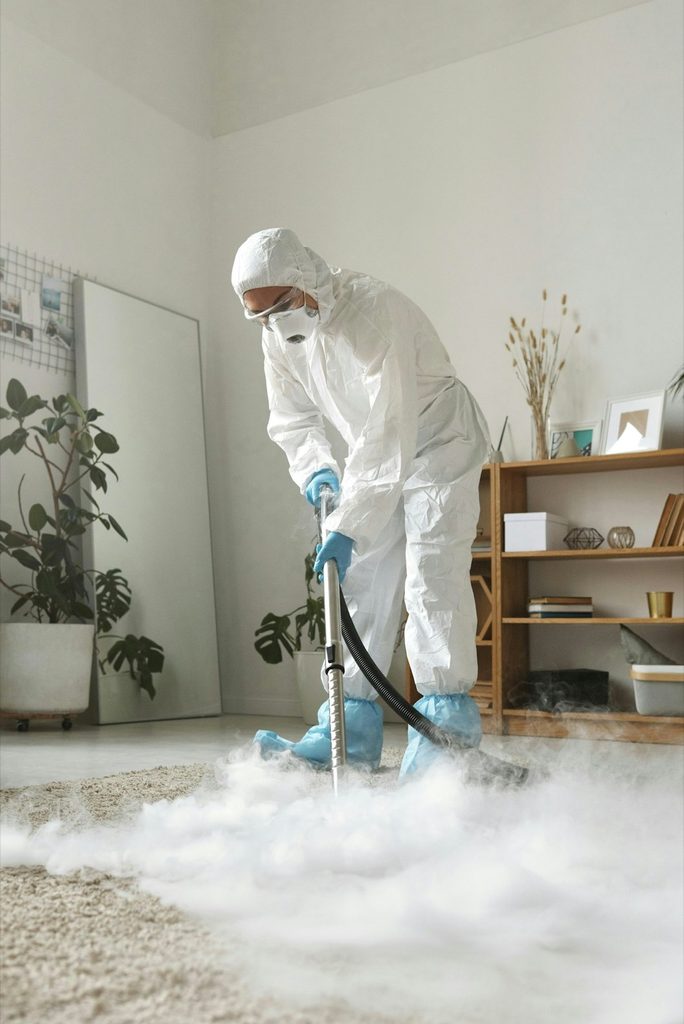
The method itself follows the same logic as the tile and grout protocol elsewhere in this series, matched to fibre rather than to a cementitious substrate. A pre treatment appropriate to the fibre type and soil condition is applied first, given adequate dwell time to begin suspending embedded particulate rather than simply the surface film. Mechanical agitation follows, using equipment calibrated to the pile height and fibre type so that agitation loosens embedded grit without itself contributing additional mechanical stress to the fibre. Hot water extraction under pressure then flushes the loosened particulate out of the base of the pile and recovers it, along with the water carrying it, rather than allowing it to resettle. A final grooming pass restores pile direction and appearance, and where the carpet condition warrants it, a pH check confirms the fibre has been rinsed back to a neutral range rather than left with a residue that would itself attract new soil at an accelerated rate.
Eco chemistry for carpet fibre protection
Our carpet chemistry bench uses plant derived surfactants, biodegradable within twenty eight days under OECD 301 testing, and left unfragranced so that no fragrance chemical is deposited into a fibre structure that a household’s children and pets will spend hours in direct contact with. We do not use quaternary ammonium compounds in routine carpet cleaning, because a quaternary residue left in fibre attracts soil at a higher rate than a properly rinsed neutral fibre, which works directly against the wear reduction goal this entire protocol exists to achieve. Where biological contamination such as pet accidents is present, our chemistry bench moves to a hydrogen peroxide based treatment, which breaks the organic matter down and then decomposes to water and oxygen, rather than leaving behind a residue that itself becomes part of the future abrasive and soil load.
Long lasting client tips
First. Schedule professional hot water extraction every six to twelve months based on your household traffic, not on how the carpet looks. Visible soiling and embedded abrasive load are not the same thing, and a carpet that still looks acceptable can already be carrying a wear accelerating grit load beneath the surface.
Second. Place a two mat system at every external entry point, a coarse outdoor mat to knock off grit and a finer indoor mat to capture fines that make it past the first. This single intervention meaningfully reduces the volume of silica based grit reaching the carpet in the first place, which reduces the abrasive load extraction has to remove later.
Third. Vacuum high traffic areas at least twice weekly using a vacuum with genuine beater bar agitation rather than suction alone. Vacuuming will not reach the base of the pile the way extraction does, but it removes surface particulate before foot traffic has a chance to drive it deeper.
Fourth. Address any spill within the first few minutes with plain water and a clean white cloth, blotting rather than scrubbing. Scrubbing drives both the spill and any grit sitting nearby further into the pile base, compounding rather than resolving the problem.
Fifth. Remove shoes at the door wherever practical, particularly footwear worn outdoors on unsealed paths or gravel. A significant share of the silica grit entering a home arrives on the sole of a shoe, and removing shoes at the threshold is a zero cost intervention with a measurable effect on long term fibre wear.
Sixth. Rotate furniture position every twelve to eighteen months where practical. Concentrated point loads under furniture legs compress and crush pile in a fixed spot over years, and rotating the load spreads wear more evenly across the fibre, extending the useful life of the areas that would otherwise bear the concentrated damage.
The bold position
The carpet industry, and much of the cleaning industry that services it, has allowed households to believe that carpet replacement is simply a function of time and taste. It is not. It is overwhelmingly a function of abrasive soil load left uncleaned, and the industry rarely says so plainly because a customer who understands the mechanism will ask harder questions about maintenance schedules rather than simply accepting a replacement quote when the fibre finally gives out.
We will say this directly. Most carpet replaced before its rated life has expired was replaced because of embedded grit, not because the fibre was inherently short lived. The household paid for a fifteen year carpet and received an eight year carpet, and the difference was not the product. It was the maintenance discipline applied to it.
Cleaning Crusader prices and schedules carpet extraction as an asset protection service because that is what it functionally is. We are not selling a smell improvement or a visual refresh, though both occur. We are selling the removal of an abrasive load before it can do permanent, irreversible damage to a fibre structure that cannot be repaired once it has been ground down. The customer who follows the schedule pays a small, predictable amount every six to twelve months. The customer who does not pays a much larger amount, years earlier than necessary, for a replacement that a disciplined schedule would have made unnecessary. The arithmetic is not close, and it deserves to be stated as plainly as it actually is.
Where Skill Becomes Legacy.
Cleaning Crusader. Built for impact. Driven by excellence. Guided by purpose.