A carpet can feel bone dry to the hand while the underlay beneath it remains dangerously wet. This is why we map moisture at fixed points across the whole drying period, rather than trusting a touch test to tell us when equipment can come out.
The guess that costs everyone
Structural drying does not end when a room stops looking wet. It ends when the affected materials return to a moisture content consistent with the rest of the unaffected structure, and those two moments are frequently separated by days, not minutes. A carpet surface dries to the touch quickly because surface fibre releases moisture into the air readily. The underlay beneath it, and the subfloor beneath that, dry far more slowly, and a visual or touch based assessment of the carpet surface tells an assessor nothing reliable about what is happening one or two layers down.
This is where a great deal of restoration work quietly goes wrong, not through carelessness but through the absence of a system that would catch the problem. An operator removes equipment because the room looks and feels dry, furniture is moved back into place, and weeks later a musty smell develops beneath a rug or a skirting board begins to bubble, because the drying was declared finished on the basis of an impression rather than a measurement. The customer is left with a job that appeared to succeed and then failed months later, and the company has no record to show whether the drying was actually complete or merely assumed to be.
The alternative is not complicated. It is disciplined. Moisture mapping is the practice of recording instrumented readings at fixed points across every affected material, at the start of the job and at defined intervals throughout, until every point returns to a documented dry standard. It is systemised, it is boring in the way that all good safety systems are boring, and it is the single practice that most reliably separates a genuinely complete drying job from one that only looks complete.
The instruments and what they actually measure
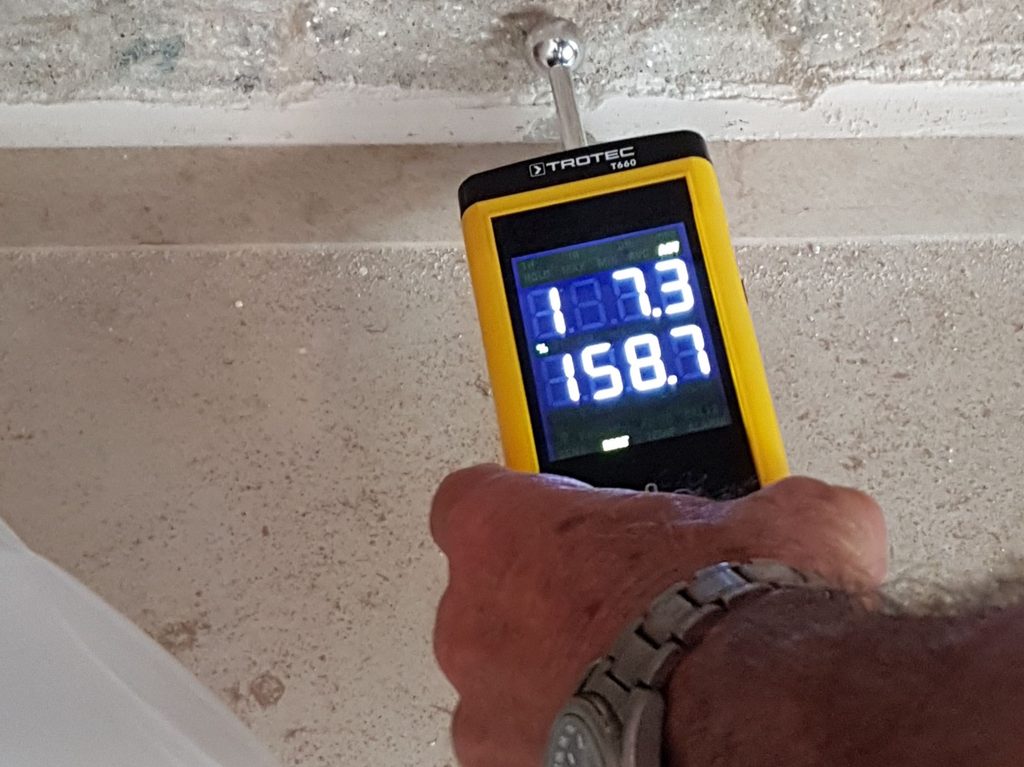
Two instrument types do the bulk of the work in a moisture mapping protocol. A pin type meter drives two small electrodes into the material and measures electrical resistance between them, which correlates with moisture content because water conducts electricity far more readily than dry building material. It is precise and it is the reference method for a specific point, but it marks the surface slightly and is used at defined test points rather than across an entire area.
A non invasive pinless meter uses an electromagnetic sensing pad pressed against the surface to estimate moisture content in the material beneath it without penetrating anything, which makes it suitable for rapid scanning across a wide area, including finished surfaces where a visible puncture mark would be unacceptable, such as a polished tile or a painted skirting board. A thorough moisture mapping protocol uses the pinless meter to scan broadly and identify the affected extent, then the pin meter to take precise readings at the fixed grid points that will be tracked across the whole drying period.
A third measurement, less discussed outside the trade, is the psychrometric reading of the air itself, temperature and relative humidity taken with a hygrometer at multiple points in the affected space. Air readings matter because a room can contain materials that read dry on the meter while the ambient humidity remains elevated enough to slow further drying or begin re wetting a material that has only just reached the dry standard. All three measurements together, not any single one alone, is what a defensible drying record actually requires.
Establishing the dry standard
A moisture reading is meaningless without a reference point to compare it against, because different materials naturally hold different baseline moisture levels depending on their composition and the general humidity of the region. A carpet in Perth in a dry winter week and the same carpet in a humid summer week will both read as normal at different absolute numbers. This is why the IICRC S500 standard for water damage restoration is built around the concept of a dry standard, an unaffected reference point in the same structure, of the same material, measured at the same time as the affected points, against which every affected reading is compared.
In practice this means identifying an area of the same carpet, the same type of skirting, or the same wall lining material, in a part of the home the water event did not reach, and taking a baseline reading there at the start of the job. The affected points are considered dry not when they reach some fixed universal number, but when they converge with the reference reading taken from the unaffected area, typically within a small tolerance band. This approach accounts for seasonal humidity, material variation, and regional conditions automatically, because the reference point is drawn from the same conditions as the affected points, on the same day.
Building the grid
A moisture mapping grid is a simple, fixed layout of test points across every affected material, established on the first visit and measured at the same points on every subsequent visit for the life of the job. The grid is typically drawn onto a floor plan sketch of the affected area, with each point numbered, so that day three’s reading at point four is genuinely comparable to day one’s reading at point four, rather than an assessor estimating a new point each visit and losing the ability to track a trend over time.
Grid density depends on the affected area and the pattern of the water event. A localised leak beneath a single appliance might warrant six to eight points concentrated around the source and tapering outward. A larger flood event affecting multiple rooms warrants a grid spanning every affected room, with points placed at the perimeter, where water often wicks furthest and dries slowest, as well as at the centre of the affected area. Skirting boards and the lower sections of wall linings get their own points, since these materials frequently retain moisture longer than the floor covering above them, exactly the scenario described earlier where a carpet reads dry while the material beneath and around it does not.
Each point is logged with the date, the time, the instrument reading, the material type, and the corresponding dry standard reading from the unaffected reference area. Readings are taken daily for the first several days of an active drying job, tapering to every second day as the readings converge toward the dry standard. The full log, not a verbal summary of it, is what constitutes the record of the job.
Why the log protects both sides
A documented moisture mapping log serves two parties simultaneously, and this is worth stating plainly rather than assuming it is obvious. It protects the customer, because it provides evidence that the drying was genuinely completed to a defined standard before equipment was removed and the space was returned to normal use, rather than relying on an operator’s word that things felt fine. If a problem does emerge later, the log shows exactly what was measured, when, and against what reference, which is the material the customer, their insurer, or a subsequent assessor needs to determine whether the original drying was adequate or whether a new, unrelated issue has developed since.
It equally protects the company performing the work. Disputes over water damage restoration are not rare, and the most common dispute is a claim that a job was left incomplete, sometimes made well after the fact when an unrelated issue has arisen and a customer or a subsequent trade attributes it to the original drying. A company holding a complete moisture mapping log for the job can demonstrate precisely what was measured and when the affected points converged with the dry standard, converting what would otherwise be a dispute resting on memory and impression into a matter of documented fact. This is not a defensive posture adopted out of distrust of customers. It is the same discipline that protects any serious trade, an accurate record that speaks for the work after the operator has left the property.
A worked example of what the grid catches
Consider a laundry flood affecting an adjoining carpeted hallway. On day one, the pinless scan shows elevated readings across the carpet for roughly two metres from the laundry doorway, and pin meter readings at the six grid points established across that zone range widely, highest nearest the door and tapering toward the reference point taken from an unaffected section of the same hallway carpet further along. By day three, five of the six points have converged with the dry standard. The sixth, positioned at the base of a run of skirting closest to the laundry wall, remains well outside the tolerance band.
Without the grid, a general impression of the hallway on day three would likely read as dry, since the carpet across most of the affected zone genuinely is. With the grid, the sixth point flags a localised problem precisely where a wall cavity or a skirting run is retaining moisture that the open floor area has already shed. Equipment stays in place, targeted at that specific point, for two further days until it too converges with the reference reading. Without the grid, that skirting run would most likely have been left to dry unassisted once the rest of the hallway looked finished, and the outcome, months later, would likely have been exactly the kind of localised mould growth or skirting swelling that a slow, undetected pocket of retained moisture produces.
The chemistry bench, tied to the record
Where a hydrogen peroxide based treatment is applied during a drying job because the source water carried biological contamination, that decision is recorded in the same job file as the moisture readings, noting what was applied, where, and why, rather than treated as a separate, undocumented step. Our plant derived, unfragranced surfactants used for any general surface cleaning during the job are logged the same way. The documentation discipline applies to the chemistry exactly as it applies to the moisture readings, because a defensible job record covers everything done to the property, not only the measurements taken of it.
Long lasting client tips
First. Ask to see the moisture mapping grid for your job, not just a verbal update that things are drying well. A genuine grid has numbered points on a sketch and dated readings against each one. Second. Ask what the dry standard reference point is for your specific job and where it was measured, since a reading without a reference point to compare against tells you very little. Third. Request the full log at the end of the job, not a summary, and keep it with your other property records in case a question arises later. Fourth. Do not agree to equipment removal on the basis of a visual or touch impression alone. Ask specifically whether the grid points have converged with the dry standard. Fifth. If skirting boards or wall linings were affected, confirm they were mapped separately from the floor covering, since these materials dry at different rates and a floor only assessment can miss a slower drying material nearby. Sixth. Keep the moisture mapping log alongside any insurance documentation for the event, since it is frequently the single most useful piece of evidence if a dispute or a related issue arises months later.
The bold position
Too much structural drying work in this industry ends on an impression rather than a measurement. A room looks dry, the smell has gone, the customer wants their furniture back, and the operator, under time and cost pressure, calls the job finished without the instrumented evidence to support that call. This is how carpets get replaced back over underlay that never actually reached a dry standard, and it is how avoidable secondary mould claims arise months after a job was supposedly completed successfully.
We map every affected point, against a genuine reference standard, for the full duration of every drying job, and we hand the customer the complete record at the end of it. This is more paperwork than a touch test requires. It is also the only version of the work that can actually be verified after the fact, by the customer, by an insurer, or by us. A drying job that cannot be proven complete is not complete. It is a guess with the equipment already removed.
Most platforms give you information. We give you leverage.
Cleaning Crusader. Built for impact. Driven by excellence. Guided by purpose.