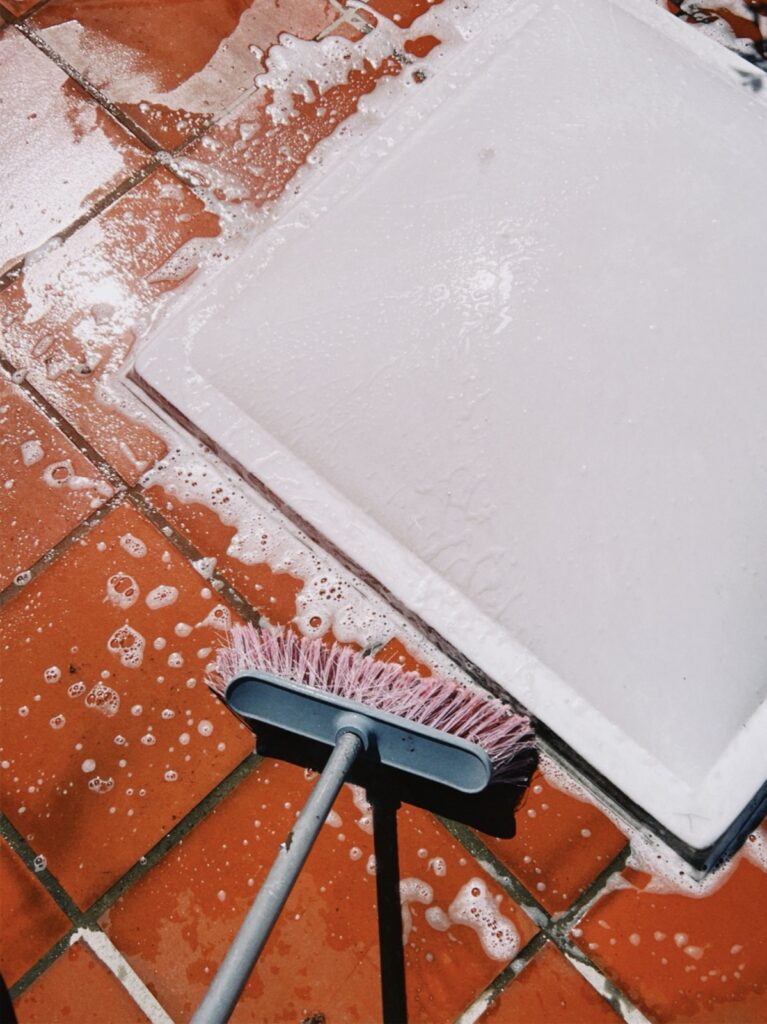
A tiled floor is only as sound as the porous cement lines holding it together. Grout is not a colour choice. It is the component that decides whether a property manages moisture properly beneath its most expensive surfaces or fails quietly for years before anyone notices.
The line item nobody puts in the budget
A property manager building a five year capital works schedule for an investment property will budget for the hot water system. They will budget for the paint cycle, and the carpet replacement interval. Almost none of them will put a figure against grout. Grout sits in the mental category of things that get cleaned, not things that get maintained, and that single category error is quietly costing Perth property owners far more than a sealing programme ever would.
The reframe this article makes is direct. Grout is not decoration sitting between tiles for visual continuity. It is a porous cementitious material with a genuine internal void structure, and that structure is either managing moisture properly beneath a tiled floor or it is not. When it is not, the consequence is not a stained grout line. The consequence is water finding its way to a substrate that was never built to tolerate ongoing moisture exposure, and a repair bill that starts in the hundreds of dollars and can end in the tens of thousands.
This is a capital argument, not a cosmetic one. We are going to walk through what grout actually is as a material, what happens when its void structure is left unmanaged, what a sealing schedule actually buys a property owner, and why the cost of neglect compounds silently until the day a tile lifts, a subfloor is found damp, or an entire bathroom floor needs to come out.
What grout actually is, as a material
Cementitious grout, the sanded and unsanded product used in the overwhelming majority of Australian tile installations, is a mixture of Portland cement, fine aggregate, water, and in most modern formulations a polymer additive to improve flexibility and reduce shrinkage. Cement and water undergo a hydration reaction that forms a crystalline lattice of calcium silicate hydrate, which is what gives cured grout its hardness. That reaction never consumes all the mixing water chemically. A portion occupies space during curing and, once it evaporates, leaves behind a network of capillary pores running through the depth of the grout line.
Documented figures for cementitious systems generally put this void fraction between fifteen and twenty five percent of total volume, meaning close to a fifth of every grout line in an average Perth bathroom or kitchen is open pore space rather than solid material. A wetter mix at installation, common where a tradesperson prioritised workability over durability, produces an even higher void fraction and a more absorbent line for the life of the installation. This structure is not a manufacturing flaw. It is inherent to how cement cures, and it is precisely why grout needs ongoing management rather than a single application and forget approach.
Epoxy grout is a separate category worth naming because it behaves differently. Epoxy grout cures through a chemical resin reaction rather than cement hydration, and its void fraction and water absorption are close to negligible by comparison. Epoxy does not need sealing. Cementitious grout, which remains the majority installation across Perth homes built and renovated over recent decades, does.
Where the water actually goes
Water applied to a tiled surface, whether from a shower, a mop, or a spill, does not simply sit on top of grout that is unsealed or under sealed. Capillary action, the same physical force that draws water up a paper towel, pulls moisture into the pore network the instant it contacts the surface. From there the moisture has somewhere to go, and in most Perth tile installations that somewhere is downward, toward the substrate beneath the tile bed.
In a properly detailed wet area, a waterproofing membrane sits beneath the tile bed and intercepts that moisture before it reaches structural material. Many established Perth homes, particularly those built or renovated before current waterproofing requirements were standard practice, either lack a continuous membrane or have one that has degraded or been penetrated at a fixing point over the years. Where that is the case, moisture that tracks through an open grout void has a direct path to timber sheet flooring, particleboard substrate, or the concrete slab itself, none of which are designed for repeated saturation cycles.
The consequences develop slowly and are rarely visible until they are advanced. Efflorescence, a white mineral deposit, can appear on grout or adjacent surfaces as dissolved salts migrate to the surface and crystallise on evaporation, a visible sign of moisture movement through the material. Grout itself can begin to spall, meaning the surface layer crumbles and detaches, as repeated wetting and drying cycles and salt crystallisation stress the cured cement matrix from within. Where moisture reaches the tile adhesive layer, bond failure follows, and a tile that was structurally sound begins to sound hollow when tapped, an early indicator of delamination that most homeowners never think to check for. Left further, the substrate itself can begin to deteriorate, and by the time that damage is discovered, the repair is no longer a grout job. It is a full tile removal and relay, often with subfloor replacement included.
The biological dimension compounds this. A grout void that retains even a small residual film of moisture provides the conditions a mould or mildew colony needs to establish itself within the pore structure, shielded from the mechanical action of ordinary surface cleaning. The World Health Organization’s 2009 guidance on dampness and mould in the built environment is unambiguous that persistent moisture in a building material is the single governing factor in whether biological colonisation occurs, and a compromised grout void in a bathroom is exactly the persistent moisture reservoir that guidance describes.
The capital cost argument
Set the numbers side by side and the case makes itself. A professional grout deep clean and reseal across an average bathroom runs to a modest, entirely budgetable cost, repeated on a twelve to twenty four month cycle for wet areas. A full tile removal and relay, triggered by advanced substrate damage that a sealing programme would have prevented, runs to many multiples of that figure for the same floor area, before accounting for the disruption of an unusable bathroom during the works, potential structural repair to the subfloor, and the risk of matching discontinued tile stock across a partial replacement.
This is the same logic a property owner already applies to a hot water system or a security alarm service contract. Nobody budgets zero dollars for hot water system maintenance on the basis that the unit sounds fine when it runs. The capital works schedule exists precisely because deferred maintenance on a building component compounds into a larger, less predictable cost later. Grout belongs in that schedule for the same reason a stormwater drain or a subfloor damp course does. It is the component managing water at a vulnerable junction in the building, and its condition determines whether that junction holds or fails.
A property valuation does not usually list grout condition as a line item, and this is arguably the market’s own blind spot rather than evidence the asset does not matter. A buyer’s building inspection can and often does flag hollow tiles, visible substrate staining, or advanced grout spalling as a defect requiring further investigation, and a defect flagged at inspection becomes a negotiating point on price or a condition of sale. An owner who has maintained a sealing schedule across the life of a property walks into that inspection with a floor that reads as sound. An owner who has not walks in with a floor that reads as a liability, regardless of how the tile itself looks from a standing height. The maintenance record is protecting resale value as much as it is protecting the substrate.
The Crusader grout restoration and sealing protocol
Our protocol starts with an honest inspection, not an assumption. We identify the grout type, cementitious or epoxy, assess the current void condition and any existing sealant performance, and check for early indicators of substrate moisture such as hollow sounding tiles or visible staining at floor level. Where cementitious grout is confirmed as needing attention, the sequence runs in a fixed order because the order matters as much as the individual steps.
The grout line is deep cleaned first, using hot water extraction with mechanical agitation matched to the grout width, to lift embedded soil and biological contamination out of the pore structure rather than simply refreshing its surface appearance. The line is then dried fully. This step is frequently skipped by operators working to a tight schedule, and it is the single most damaging shortcut in the entire sequence, because sealing over damp grout traps residual moisture inside the void permanently rather than closing the void against future moisture. Only once the grout has reached an appropriate dry moisture reading does the penetrating sealer go on. A penetrating sealer does not cap the pore structure with a surface film. It lines the internal pore walls with a hydrophobic barrier, raising the threshold at which capillary wicking can occur, so future water contact is far less able to migrate into the void in the first place.
Eco chemistry for grout maintenance
Our grout chemistry bench is a plant derived surfactant system, biodegradable within twenty eight days under OECD 301 testing, applied at a pH held close to neutral so the cleaning step itself does not etch or degrade the cured cement matrix before sealing. We do not use quaternary ammonium compounds in routine grout cleaning, because they build up as a residue inside a porous substrate over repeated visits rather than breaking down, working directly against the goal of a clean, receptive pore structure for the sealer to bond to. Where biological contamination in the void is confirmed rather than assumed, our bench uses a hydrogen peroxide based formulation, which breaks down to water and oxygen after use and leaves no persistent residue reacting unpredictably inside the material over time.
Long lasting client tips
First. Treat grout sealing as a scheduled item, not a reactive one. A penetrating sealer in a wet area typically performs for twelve to twenty four months before its hydrophobic performance drops meaningfully, and resealing before that window closes keeps the void closed rather than reopening it to a fresh contamination cycle.
Second. Use a squeegee on shower tiles and glass after every use. Removing standing water before it has time to wick into the grout removes the single largest ongoing source of new moisture migration in any bathroom, at no chemical cost and under thirty seconds of effort.
Third. Avoid vinegar and other low pH household acids as a routine grout cleaner. Vinegar sits well outside the stable range for cured cement, and repeated exposure etches the surface, widening the pore openings this article has described and accelerating the rate contamination and moisture can migrate inward.
Fourth. Ask about grout condition at any property changeover, whether buying, selling, or taking on a new rental tenancy. A grout inspection takes minutes and reveals whether a sealing programme is due, whether spalling has already begun, and whether a tile sounds hollow, all of which belong in a pre purchase or condition report conversation rather than a surprise six months later.
Fifth. Improve bathroom ventilation wherever practical. An extraction fan that clears humidity within twenty to thirty minutes of a shower reduces the residual moisture available to sustain any biological colonisation inside the void between cleans, a passive intervention that compounds the value of every active clean and reseal that follows it.
Sixth. Ask any tradesperson quoting a regrout what waterproofing membrane condition they have confirmed beneath the tile bed, particularly in an older property. A sealing programme protects the grout void. It cannot compensate for a compromised membrane, and a property owner deserves to know which risk they are actually managing.
The bold position
The property industry has, for decades, filed grout under cosmetics rather than capital maintenance, and the filing is wrong. A stained grout line is treated as an inconvenience to be mopped or ignored. A hollow sounding tile is treated as a curiosity rather than an early warning. By the time either is treated seriously, the cost has usually already moved from a sealing programme measured in a modest annual figure to a relay job measured in thousands of dollars, plus the subfloor repair that a compromised membrane and years of unmanaged moisture migration has made necessary underneath.
We will name this plainly. Most property maintenance schedules in Western Australia do not include grout as a line item, and the omission is not because grout does not matter. It is because the trade has never made the capital case clearly enough for property owners and managers to see it as infrastructure rather than as a cleaning chore. Cleaning Crusader treats every tiled surface as a system with a substrate underneath it worth protecting, not a finish worth wiping. We inspect, we clean, we dry properly, and we seal on a schedule, because a fifth of every grout line in a Perth bathroom is open pore space, and what fills that space over the coming decade is a decision the property owner is making today, whether they know it or not.
Innovation creates legacy.
Cleaning Crusader. Built for impact. Driven by excellence. Guided by purpose.