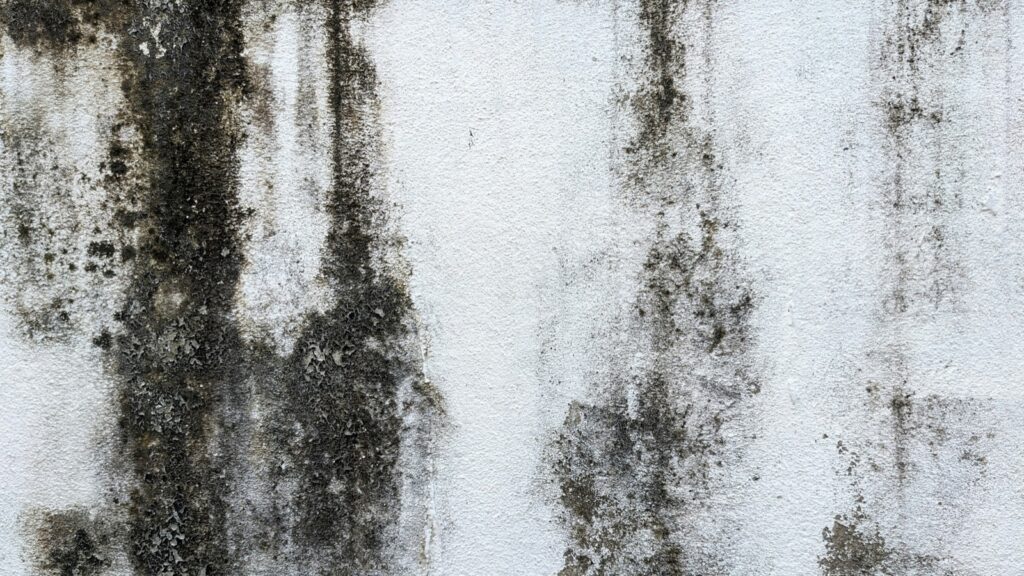
A bottle of supermarket mould spray and a wipe down feels like a fix. Without engineered containment behind it, the same action can aerosolise a colony and seed it through the rest of the house. Mould remediation is a system, not a product.
The spray bottle that makes things worse
A homeowner finds a patch of black growth in the corner of a bathroom ceiling, or behind a bedroom wardrobe against an external wall, and does the obvious thing. A trip to the supermarket, a bottle labelled as a mould killer, a scrub with a cloth, a wipe down, done. The patch is gone from view within minutes, and the homeowner reasonably assumes the problem has been solved. In a meaningful share of cases, what has actually happened is that a contained biological problem confined to one surface has been mechanically disturbed with no containment in place at all, and the spores released by that disturbance have now travelled further into the home than the original patch ever reached on its own.
This is the reframe this article exists to deliver. Mould remediation, done to the standard the industry has actually codified, is an engineered system of physical containment, air pressure management, and filtration, governed by IICRC S520, the recognised standard for professional mould remediation. It is not a spray and wipe treatment, and the gap between what a supermarket product implies and what a genuine remediation actually requires is where a great deal of avoidable contamination spread in Perth homes originates.
We are going to walk through what mould actually is biologically, why disturbing it without containment is precisely the wrong response, what a genuine containment system involves, and why the difference between the two approaches is not a matter of thoroughness but a matter of whether the contamination is removed or simply relocated.
What mould actually is, biologically
Mould is a fungal organism that grows as a network of thread like structures called hyphae, collectively forming a mycelium, across any organic or cellulose based material provided sufficient and sustained moisture is present. Common household substrates, plasterboard paper facing, timber, dust laden surfaces, and fabric, all carry enough organic content to support colonisation once moisture conditions allow it. The World Health Organization’s 2009 guidance on dampness and mould in the built environment states plainly that no safe threshold of indoor mould exposure has been established, and that persistent dampness is the central, correctable factor governing whether colonisation occurs at all.
Reproduction happens through spores, microscopic reproductive units released from the mycelium in enormous numbers once a colony is established, and normally present in outdoor and indoor air at low background levels as a matter of course. The health relevance of an indoor mould problem is overwhelmingly about the concentration of those spores in the air a household is breathing, not simply the visible size of a surface patch, and this is precisely the variable that an uncontained disturbance changes dramatically and immediately.
IICRC S520 organises the scale of a mould problem into recognised conditions to guide the response. Condition one describes a normal ecological presence with no elevated growth. Condition two describes settled spores or a light surface presence without active growth, often from an adjacent condition three area. Condition three describes actual, active growth on a surface, which is the condition a visible patch on a wall or ceiling almost always represents once it is large enough to notice. The condition present governs the containment level, the personal protective equipment required, and whether affected material can be cleaned or must be removed.
Why disturbance without containment spreads the problem
Mechanical disturbance of an active mould colony, whether by spraying it directly, scrubbing it, or even the simple air movement created by wiping a cloth across it, dislodges spores from the mycelium into the surrounding air at concentrations far above ambient background levels. Documented industry testing on remediation activity consistently shows airborne spore counts rising sharply during any physical disturbance of an active colony, which is precisely why professional remediation treats disturbance as the most dangerous single moment in the entire process rather than the moment the problem gets solved.
Without a controlled negative pressure environment isolating that moment of disturbance, the spore laden air generated has nowhere defined to go, and normal household air movement, an open door, a draft, a person walking through the space, carries it into adjoining rooms that had no mould problem at all before the cleaning attempt began. A homeowner who sprayed and wiped a single bathroom ceiling patch can, within this mechanism alone, seed spore levels into a hallway, a bedroom, or a wardrobe that will show no visible sign of the problem for weeks, while the underlying moisture and organic conditions in those newly seeded areas quietly determine whether a fresh colony establishes itself there next.
The Crusader containment system
Our mould remediation protocol begins with the assumption that the condition present is a system problem, not a surface problem, and the response is built accordingly, aligned to IICRC S520 at every stage. Physical containment goes up first. Polyethylene sheeting is sealed across doorways, vents, and any opening connecting the affected area to the rest of the property, creating a defined, isolated work zone before any surface is touched.
Negative air pressure is then established inside that containment using a HEPA filtered negative air machine, exhausted to the exterior of the property wherever practical. The machine is set to hold a measurable pressure differential, typically in the order of five to ten pascals lower inside the containment than in the surrounding space, confirmed with a manometer rather than assumed from the equipment’s rated output. This differential ensures that air only moves in one direction, into the containment, so that any spores disturbed during the work that follows are drawn into the negative air machine’s HEPA filtration rather than escaping into the rest of the home. HEPA filtration captures particles down to a fraction of a micron with a documented efficiency of ninety nine point nine seven percent at the specified test particle size, which is the filtration standard genuinely capable of removing mould spores from the air stream rather than simply recirculating them.
Only once containment and negative pressure are confirmed does source work begin. Affected porous material that cannot be reliably cleaned, certain plasterboard sections or heavily colonised soft material, is removed under containment and bagged before it ever leaves the work zone. Non porous and semi porous surfaces that can be properly cleaned are treated with HEPA vacuuming first, to remove loose surface material before any chemistry is applied, followed by an appropriate antimicrobial treatment. The moisture source that allowed colonisation in the first place is identified and addressed as part of the same visit wherever within scope, because remediation without correcting the underlying moisture condition is a temporary result by definition. The area is then dried to an appropriate moisture reading, verified rather than assumed, before containment is removed and a final clearance check confirms the work zone is fit to reopen to the rest of the home.
Verification before the containment comes down
A system is only as credible as its final check, and this is the stage a spray and wipe approach skips entirely because there was never a defined endpoint to verify against in the first place. Under our protocol, the work zone is not considered complete once the visible growth is gone. It is considered complete once a defined verification step confirms the condition has actually returned to what IICRC S520 describes as condition one, a normal ecological presence with no elevated growth remaining.
That verification runs on three levels. A visual inspection of every treated surface under adequate lighting, checking specifically for any residual growth in corners, junctions, and behind fixtures that a first pass may have missed. A moisture reading across the treated area and the surrounding material, confirmed with the same meters used at intake, because a surface that looks clean but still carries elevated moisture is a surface that will support renewed colonisation within weeks regardless of how thoroughly it was treated. Where the scale or history of the job warrants it, an independent air sampling and laboratory analysis, arranged through a third party, provides an objective spore count comparison between the treated area and an unaffected reference room, the same reference logic used in flood restoration drying verification. Only once these checks are satisfied does the physical containment come down, and only then is the area handed back to the household as clear.
This sequencing exists because the entire argument of this article collapses without it. A containment system that removes spores from the air during the work but never confirms the result has simply moved the uncertainty from the beginning of the job to the end of it. Verification is what turns containment from a good process into a demonstrated outcome, and it is the step most conspicuously absent from any DIY approach, because a homeowner with a spray bottle has no instrument to check their own work against in the first place.
Eco chemistry for mould remediation
Confirmed biological contamination is precisely the scenario our chemistry bench is built to escalate for. Where mould is present, our protocol uses a hydrogen peroxide based antimicrobial treatment rather than a chlorine based product, because hydrogen peroxide breaks down to water and oxygen after use, leaving no persistent chemical residue on a surface inside a home. Routine surface cleaning within and around the containment uses our standard plant derived surfactant bench, biodegradable within twenty eight days under OECD 301 testing and left deliberately unfragranced, because masking an odour with fragrance inside a property that may still carry an active moisture problem does nothing to address the actual contamination and can delay a homeowner noticing a recurrence. We do not use quaternary ammonium compounds in this work, consistent with our bench across every service line.
Long lasting client tips
First. Do not spray, scrub, or wipe a suspected mould patch yourself before it has been properly assessed. Any physical disturbance without containment risks releasing spores into the rest of the home rather than removing the problem.
Second. Identify and address the moisture source behind any mould patch as the priority action, whether that is a leaking pipe, poor ventilation, or condensation against an external wall. A patch that is cleaned without fixing the moisture behind it will return.
Third. Monitor humidity in problem prone rooms, bathrooms, laundries, and rooms with poor cross ventilation, using a simple hygrometer. Keeping indoor relative humidity below roughly sixty percent meaningfully reduces the conditions mould needs to establish itself.
Fourth. Close the door to an affected room rather than opening it up for ventilation once you have identified an active growth patch. Instinct says to air the room out. The correct instinct is to isolate it until it has been properly assessed, because uncontrolled airflow is exactly the mechanism that spreads a contained problem.
Fifth. Treat a mould patch larger than a small coin sized area, or any mould discovered after a known water event such as a leak or flood, as a job for a qualified remediator rather than a DIY task. The condition and containment requirements scale with the extent of the growth, and a homeowner has no reliable way to judge that extent from the surface alone.
Sixth. Ask any remediator you engage whether their process includes physical containment, negative air pressure, and HEPA filtration, and whether they will provide a clearance check before removing containment. If the answer describes a spray and a wipe, the process being offered is not remediation in the sense the industry has actually defined it.
The bold position
A large share of what is marketed to Australian households as mould treatment, the supermarket spray bottle and the DIY wipe down, is not remediation at all. It is an uncontained disturbance of an active biological colony, and the industry standard that actually governs proper remediation, IICRC S520, exists specifically because that disturbance, done without containment, makes the airborne concentration of the problem measurably worse in the moments after the product is applied, not better.
We will name this plainly. The trade has allowed mould remediation to be sold to the public as a cleaning task when it is, properly understood, an air management and containment engineering task with a cleaning component inside it. Cleaning Crusader will not spray a mould patch and call the job finished. We contain first, establish negative pressure, filter the air through HEPA at every stage, remove what cannot be safely cleaned, treat what can be, and verify the result before the containment ever comes down. The system is slower than a bottle and a cloth. It is also the only version of the process that actually removes the contamination rather than spreading it quietly through the rest of the house.
Restraint matters more than noise.
Cleaning Crusader. Built for impact. Driven by excellence. Guided by purpose.