Whether a tile floor needs a clean and reseal or a full regrout should never be a guess made on the day. This is the decision tree we run on every job, and the quality assurance scoring that proves the finished result met the standard before we leave.
A call that should never be made by feel
A tile and grout operator kneels in a kitchen in Morley, taps a grout line with the back of a probe, and makes a call. Clean and reseal, or pull it out and start again. In most of this trade, that call is made by feel, on the day, by whichever operator happens to be kneeling there, and the answer changes depending on who is asked. One operator sells a regrout to a floor that only needed a clean. Another operator seals over grout that was already structurally finished, and the client pays for a service that fails within a season.
Neither outcome is acceptable, and neither should depend on which operator turned up. This is a systems problem, not a skill problem, and it should be solved the way an industrialised operation solves any recurring decision. With a documented decision tree that produces the same answer regardless of who is holding the probe, and a quality assurance score at the end that proves the finished job actually met the standard rather than simply looking finished.
This article sets out that decision tree, the specific tests behind it, and the scoring system Cleaning Crusader runs on every completed tile and grout job before we consider the appointment closed. The chemistry of why grout is porous is its own topic, covered elsewhere in this series. This piece is about the system that turns that chemistry into a consistent, defensible business decision.
The four tests that replace the guess
Every tile and grout assessment runs through four specific tests, in the same order, on every job, regardless of the age of the floor or the operator attending. The result of these four tests, not impression or habit, determines which path the job takes.
Test one is a probe test for structural integrity. A firm, blunt pick is drawn along a sample of grout lines across the affected area. Grout that holds firm and produces only fine dust is structurally sound. Grout that crumbles, that releases chunks rather than dust, or that separates cleanly away from the tile edge under light pressure, has failed structurally and is a regrout candidate regardless of how it looks from a standing position.
Test two is a crack and void assessment. Hairline surface crazing in grout is common and is frequently cosmetic rather than structural. A crack that runs the full depth of the joint, visible light or a feeler test showing the crack passing through to the substrate below, is a different finding entirely and typically indicates substrate movement that a clean and reseal cannot address, because resealing a joint that continues to move will fail again within months.
Test three is an absorption test. Water is applied in a controlled bead to a sample area of cleaned, dry grout. Grout with an intact and viable sealant, or grout dense enough to reseal effectively, holds the bead on the surface for a measurable period before slow absorption begins. Grout that absorbs the bead within seconds has lost enough of its surface density that a topical sealant will not adhere or perform adequately, which points toward regrout rather than reseal.
Test four is a contamination depth assessment. Staining that sits on the surface of the grout, lifting substantially under professional cleaning, is treated differently from staining or biological growth that has clearly penetrated through the joint’s full depth. Surface staining is a cleaning and reseal outcome. Contamination through the full depth of a porous, failing joint is not something a reseal resolves, because the source of the discolouration remains inside the material after the surface is cleaned.
Reading the four tests together
No single test decides the job on its own. A joint can pass the probe test and still fail the absorption test, if it is structurally sound but has simply worn through its existing sealant after years of foot traffic and cleaning cycles. That combination is a clean and reseal job, since the underlying structure is intact and only the protective layer needs renewal. A joint can hold a water bead perfectly and still fail the probe test, if it was set in a mix that never cured correctly, and that combination points to regrout regardless of how the surface behaves, because the failure lives underneath what the water test can see.
The decision tree combines the four results into three outcomes. A pass on structure, crack depth, and absorption, with only surface level staining, is a clean and reseal job. A fail on structure or full depth cracking, on any meaningful portion of the area, is a full regrout job for that section regardless of how the rest of the floor tests. A mixed result across a large floor, sound in most areas and failing in isolated sections, is a partial regrout limited to the failing sections, paired with a clean and reseal across the sound remainder. This third outcome is the one most operators skip, defaulting instead to treating the whole floor the same way the worst section tested, which either overcharges the client for sound area or under services the failing section.
The Crusader protocol for each outcome
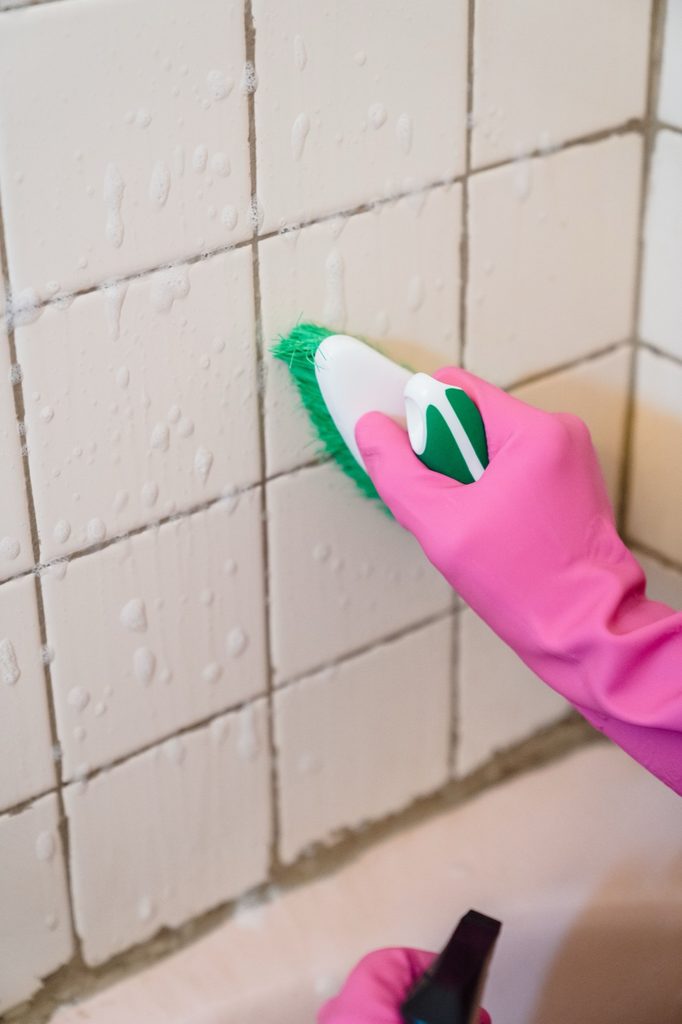
For a clean and reseal outcome, the sequence is a deep extraction clean of the grout line using appropriate agitation and a controlled dwell time, full drying verification before any sealant is applied, and a penetrating sealant applied at the manufacturer’s specified coverage rate rather than a visual guess at how much product a joint needs. Cure time is respected fully before the area returns to normal foot traffic or any water exposure, typically twenty four to seventy two hours depending on the specific sealant used and ambient humidity.
For a regrout outcome, failing grout is removed to full depth using a mechanical grout removal tool set to the joint width, avoiding damage to the tile edges on either side. The joint is vacuumed clear of dust and debris, since residual dust in the joint compromises the adhesion of the new grout. New grout is mixed to the manufacturer’s specified ratio, applied and packed to full joint depth rather than skimmed across the surface, tooled to a consistent profile, and allowed to cure fully before sealant is applied. Rushing the sealant application before the grout has cured is one of the most common causes of early regrout failure in this trade, because trapped moisture beneath a premature sealant has nowhere to release.
The quality assurance score
A job is not closed when it looks finished. It is closed when it passes a documented quality assurance score, checked against three criteria before the operator leaves the property.
The first criterion is visual consistency. Grout colour is checked for uniformity across every joint in the treated area under both natural and artificial light, since colour variation under a single light source can hide inconsistency that becomes obvious to the client later under different lighting. Joint width and tooling profile are checked for consistency across the regrouted sections, since an uneven joint profile is one of the most visible signs of a rushed job to any client who looks closely afterward.
The second criterion is sealant cure verification. A water bead test is repeated on the finished, cured surface, confirming the new sealant is performing as specified before the job is considered complete. A sealant that has not been verified after cure is a sealant that has been assumed to work rather than confirmed to work, and the two are not the same standard.
The third criterion is a pH neutral rinse check. Any residual cleaning chemistry left in the joint from the preparation stage is tested with a simple pH check on the rinsed surface, confirming the area has returned to a neutral state before sealant is committed. Sealant applied over a residual alkaline or acidic film from an earlier cleaning stage can fail to adhere correctly or can continue reacting with the grout underneath the new seal, undermining a job that otherwise looked complete on the day.
Each of these three checks is recorded against the job file, with photographs, so that the finished result is documented evidence rather than a verbal assurance from whichever operator attended.
Eco chemistry for the grout bench
The chemistry used across every stage of this system is drawn from the same bench we use across the business. Plant derived surfactants for the extraction clean, biodegradable within twenty eight days under OECD 301, unfragranced, with no quaternary ammonium compounds used in routine cleaning. Where biological contamination is identified during the depth assessment, a hydrogen peroxide based product is used rather than a chlorine based one, both for the operator’s safety in an often enclosed space and because hydrogen peroxide leaves no persistent residue that could interfere with the pH neutral rinse check that follows before sealing.
Long lasting client tips
First. Ask any operator quoting a tile and grout job what specific tests were used to decide between a clean and reseal and a full regrout. A specific answer describing a probe test, a crack assessment, and an absorption test is a different standard from a general impression given while standing in the doorway.
Second. Request photographs of any section identified as requiring regrout, showing the specific failure, whether structural crumbling, full depth cracking, or a failed absorption test, rather than accepting a verbal description alone.
Third. Confirm the cure time required before the area returns to normal use, and respect it fully. A sealant or new grout used before its stated cure time is a job that has not actually finished, regardless of how it looks on the day.
Fourth. Reseal grout on a defined schedule rather than waiting for visible failure. Most penetrating sealants perform for one to two years under normal residential foot traffic before absorption performance begins to decline, and resealing before that decline becomes visible protects the joint underneath.
Fifth. If only part of a floor tests as failing, ask specifically whether a partial regrout, limited to the failing section, is available rather than a full floor regrout by default. A properly systemised assessment should be able to isolate the failing area rather than treating an entire floor the same way.
Sixth. Keep the job file, including the photographs and test results, for your own records. A documented quality assurance score is useful evidence if any question about the work arises months or years later, for you and for whoever services the floor next.
The bold position
This trade has a quiet, structural problem with the regrout decision, and it runs in both directions at once. Some operators default to selling a full regrout on every job, because a regrout invoice is larger than a reseal invoice and a probe test takes longer than a glance. Others default to resealing everything, including joints that have already failed structurally, because a reseal is faster to complete and the failure will not become visible again until well after the invoice is paid.
We will name this plainly. A decision this consequential, sitting on top of a client’s kitchen or bathroom floor for years, should never be made by feel, by habit, or by which outcome is more convenient for the operator standing there that day. It should be made by a documented test, run the same way on every job, producing the same answer regardless of who is kneeling on the tile.
Cleaning Crusader runs the same four tests, in the same order, on every tile and grout assessment, and closes every job against the same three point quality assurance score before it is considered finished. The system is not a substitute for the operator’s judgement. It is what makes the operator’s judgement consistent, checkable, and defensible, on the first job and on the thousandth.
Innovation creates legacy.
Cleaning Crusader. Built for impact. Driven by excellence. Guided by purpose.