A mattress is upholstered furniture with its own internal climate of heat and moisture, remade fresh every night by the body resting on it. This is the fabric science of that climate, told as upholstery chemistry, not as a sleep or health story.
A climate that never sees daylight
Every upholstered item in a home experiences wear. A sofa cushion compresses under a sitting body for perhaps three hours a day. A mattress carries a resting body for closer to eight, night after night, for years without a season off. No other piece of upholstered furniture in the house is subjected to a longer, more consistent load cycle, and no other piece develops a more distinct internal climate as a result.
We treat the mattress the way we treat any upholstered asset. Not as a health object, not as a wellness purchase, but as a manufactured textile structure with a fabric shell, a quilted panel, and internal fill layers, all of which respond to heat, moisture, and organic load exactly the way a sofa or an armchair does, only more so. The chemistry underneath a mattress cover is the same chemistry that governs any upholstery fibre. The intensity of the exposure is what makes the mattress the most demanding upholstery item we clean.
This article is the physics and biology of that internal climate. What heat and moisture actually do to the fabric and fill across a night. What organism colonises that environment and why. Where the allergen load actually accumulates within the textile structure, which is not where most people assume. And the extraction method that removes it properly, because a mattress cannot be soaked, tumbled, or steam saturated the way a smaller upholstered item can.
The heat and moisture cycle
A resting body generates a continuous output of heat and water vapour. Core body temperature sits close to thirty seven degrees Celsius, and skin temperature under a covered body commonly runs in the low thirties. Across an eight hour period, the body releases moisture through the skin at a rate that documented physiology places between roughly two hundred millilitres and a full litre, depending on ambient temperature, humidity, and the coverings involved. In a Perth summer, with the airconditioning off and a doona still pulled up out of habit, the higher end of that range is common.
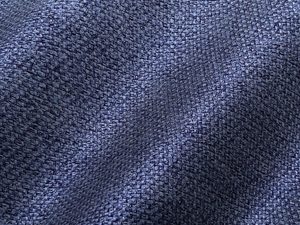
That moisture does not evaporate into open air. It is trapped between the body and the mattress surface, absorbed first into the surface fabric, and then, over repeated cycles, into the quilted foam or fibre layer beneath it. The fabric shell of a mattress is typically a woven or knitted textile fused to a thin foam or fibre quilting layer a few millimetres thick. That quilting layer has enough density to hold moisture for hours after the body has left it, which is longer than most people assume. A mattress touched at seven in the morning can still carry measurably elevated humidity within its surface layer from the night before.
Heat behaves the same way. The insulating structure of a mattress, foam or pocket spring beneath the quilted surface, is designed to prevent heat loss to the outside air, because that is what makes it comfortable to lie on. The same design that holds warmth against the body holds warmth within the fabric after the body has gone. The result, repeated every night, is a microclimate inside the upper layers of the mattress that cycles between warm and humid overnight and gradually cools and dries during the day, never quite reaching the ambient dryness of the room around it. That cycle, repeated over years, is what makes the mattress fabric a distinct textile environment rather than a generic piece of upholstery.
The biology of the tenant
The organism that colonises this environment is the house dust mite, genus Dermatophagoides, with two species dominating Australian home textiles, Dermatophagoides pteronyssinus and Dermatophagoides farinae. Both are microscopic arachnids, roughly a quarter of a millimetre in length, invisible without magnification, and both feed on shed human skin cells, the keratin rich flakes that every person sheds continuously and that settle into fabric surfaces at a documented rate of several hundred million cells a day across the whole body.
Dust mites do not bite, do not carry disease, and do not live on the body. They live in fabric, and mattress fabric with its cycling warmth and moisture is close to an ideal habitat for them. Dust mite ecology research documents that populations thrive within a narrow band of relative humidity, broadly seventy to eighty percent, and a temperature range close to twenty five degrees Celsius, which is almost exactly the microclimate described in the previous section. Below around fifty percent relative humidity sustained for any length of time, mite populations decline sharply because the mite itself loses water through its cuticle faster than it can replace it from the surrounding air. This is the single most important fact in mattress fabric science. The mite is not defeated by killing it directly. It is defeated by managing the humidity of the fabric it lives in.
The feeding cycle is straightforward. Skin flakes settle into the weave of the fabric and the surface of the quilting layer. Mites digest the keratin using a set of enzymes and excrete faecal pellets at a rate of roughly twenty pellets a day per mite. A mature mattress fabric, undisturbed by extraction cleaning, can accumulate a population density that dust mite studies commonly express in the hundreds to low thousands per gram of surface dust, concentrated most heavily in the top few millimetres of quilting where warmth, moisture, and food coincide.
Where the allergen actually lives
This is the point most people, and most cleaning companies, get wrong. The mite itself is not the allergen. The primary allergenic material is the faecal pellet, a particle roughly ten to forty micrometres across, small enough to become airborne with disturbance and to lodge deep in fabric weave. Each pellet is coated in digestive enzymes, principally a group of cysteine proteases documented in the allergen literature under the designations Der p 1 and Der f 1, named for the two dominant species. These enzymes are what the fabric actually holds onto, and they are considerably more persistent in a textile structure than the mite bodies themselves, which break down faster once the mite dies.
This changes what a mattress cleaning protocol is actually trying to achieve at the fibre level. Vacuuming the surface removes visible dust and some proportion of loose pellets sitting on top of the weave. It does not reach pellets bound into the quilting layer beneath the surface fabric, and it does nothing to the enzyme residue that remains adhered to fibre surfaces after a pellet has been physically removed. Fabric structure matters here as much as chemistry. A tightly woven surface ticking holds less material at depth than a looser knit, but sheds surface soil more readily under agitation. A thicker quilted layer holds more material overall but is harder to fully extract from without oversaturating the mattress core, which introduces its own moisture problem. Every mattress fabric construction is a different extraction problem, and treating all mattress covers with one standard pass is how most surface cleaning fails to shift the actual allergen load.
The Crusader upholstery protocol for mattress fabric
A mattress cannot be treated like a carpet. It cannot be flooded with extraction fluid and left to dry over hours, because a saturated core takes days to dry fully and a mattress that stays damp at depth simply rebuilds the humidity microclimate that supports mite colonisation in the first place. The entire protocol is built around one constraint. Maximum extraction of surface and near surface material, minimum moisture introduction, and rapid drying.
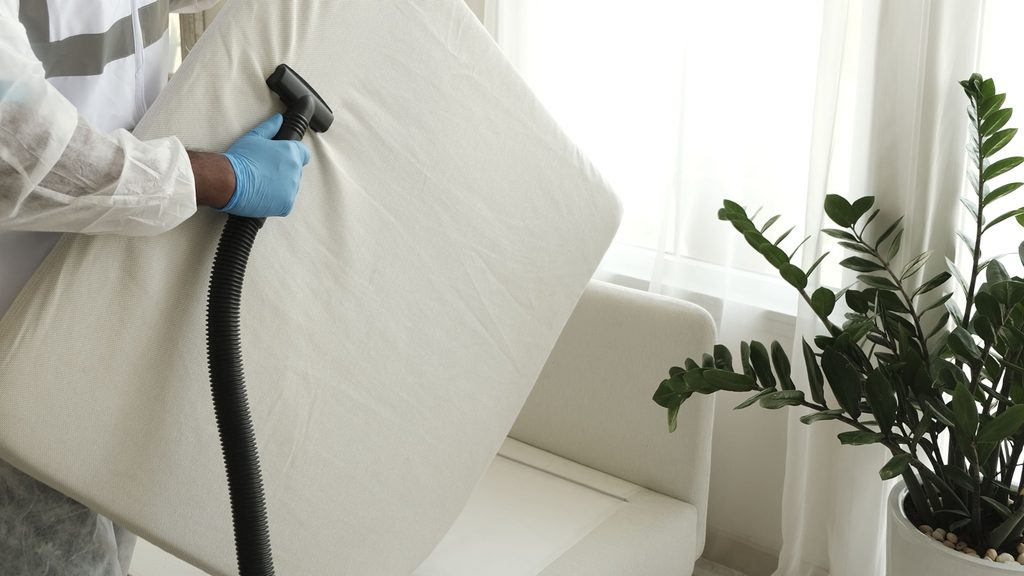
Stage one is dry agitation and HEPA extraction across the full surface, including the sides and the piped seam where fabric folds trap the highest concentration of shed material. This stage alone removes a substantial proportion of loose surface pellets and skin debris before any liquid is introduced.
Stage two is low moisture encapsulation cleaning, using a plant derived surfactant applied as a controlled fine mist rather than a saturating spray, agitated into the surface fabric with a soft brush head, and left to crystallise as the moisture evaporates. The encapsulation chemistry binds residual soil and allergenic material into a dry crystalline form that lifts away with a second HEPA pass once fully dry, typically within one to two hours under good airflow, rather than the many hours a full saturation extraction would require on a mattress core.
Stage three is targeted deep extraction only where staining or contamination has actually reached the fill layer, using low moisture equipment with high vacuum recovery, so that any liquid introduced is removed at close to the same rate it is applied. This stage is used sparingly and only where the fabric condition genuinely requires it, never as a routine default.
The chemistry bench
Our chemistry bench for mattress and upholstery work is unfragranced and plant derived, biodegradable within twenty eight days under OECD 301 testing. There are no quaternary ammonium compounds in the routine encapsulation formula. Quaternary compounds are effective surface antimicrobials in some settings, but they are not what a fabric infestation problem calls for, because the target here is organic soil load and allergen protein, not a microbial pathogen. Where genuine biological contamination is present, such as a fluid stain with organic decomposition, we use a hydrogen peroxide based treatment specifically for that contamination, applied locally rather than across the whole surface.
The unfragranced formulation matters more on a mattress than almost anywhere else in the home, because a fragranced product applied to a surface a face rests against for eight hours a night leaves a residue the sleeper is in constant close contact with. A clean mattress should smell of nothing. That is the correct outcome, not an oversight.
Long lasting client tips
First. Rotate and flip the mattress according to the manufacturer’s instructions, typically every three to six months, so that moisture and load exposure is distributed across the whole surface rather than concentrated in one zone. Second. Use a breathable, washable protector between the body and the mattress fabric, and wash it regularly at the temperature the manufacturer specifies. The protector intercepts a large share of the skin cells and moisture before they ever reach the mattress fabric itself. Third. Air the mattress whenever practical. Pulling back coverings for thirty minutes after rising allows the surface humidity built up overnight to disperse into the room rather than sitting trapped against the fabric all day. Fourth. Vacuum the mattress surface, including the seams and sides, at least monthly with a HEPA filtered machine, more often in humid months. This is the single most effective thing a household can do between professional visits. Fifth. Keep the bedroom’s general humidity managed. A room that sits consistently above sixty five percent relative humidity works against every other step on this list, because the fabric will re absorb moisture from the air regardless of how well it was cleaned. Sixth. Schedule a professional low moisture extraction on the mattress fabric roughly every twelve months, or more frequently in a household with pets or a history of high humidity, because surface vacuuming alone never reaches the material bound into the quilting layer at depth.
The bold position
The wider industry has decided that mattress cleaning is a wellness product. It is sold with language about sleep quality, health outcomes, and hygiene programs, dressed up with claims that a single service will change how a customer feels in the morning. Most of that language is not grounded in the actual textile science. It is grounded in what sells.
We will not make that claim, because we cannot verify it and a company that cannot verify a claim should not make it. What we can verify is the fabric science described in this article. A mattress is an upholstered textile structure that develops a distinct internal climate, hosts a specific organism, and holds a specific allergenic protein in a specific location within its layers. Our job is to extract that material properly, using a method calibrated to the mattress’s particular construction, without oversaturating a core that cannot dry quickly. That is upholstery cleaning, done with the same rigour we apply to a sofa or a dining chair. It does not need a health claim attached to it to be worth doing well.
The honest position is the harder one to market and the easier one to defend. We clean the fabric. We do not sell the sleep.
Authenticity is the ultimate competitive advantage.
Cleaning Crusader. Built for impact. Driven by excellence. Guided by purpose.