Most people treat a dirty grout line as a stain sitting on a surface. It is not. A standard grout line is a structure with roughly a fifth of its own volume standing open, and the stain is simply what has moved in to occupy that space.
The floor that is mostly empty space
Kneel down at a grout line in any Perth kitchen or bathroom and look closely. The surface appears solid. It is grey or beige or white, it feels hard under a fingernail, and it looks, to the untrained eye, like a continuous mineral seal between one tile and the next. It is not continuous. It is not fully solid. A standard cementitious grout, properly cured, still carries a genuine void fraction of roughly fifteen to twenty five percent of its total volume as open pore space, more again where the grout was mixed too wet, cured too fast, or never sealed at all.
That number deserves to sit uncomfortably with anyone who has ever mopped a grout line and assumed the job was done. A floor that looks clean at the surface can still be one part in five open air beneath it, and open air beneath a wet, food adjacent, foot trafficked surface is not a passive fact. It is an active invitation.
This is the reframe this article exists to deliver. Grout is not a coating. It is a porous ceramic and cement composite with a genuine internal architecture, and the contamination that a Perth household worries about, the greying lines, the persistent smell, the dark shadow along a shower fold, is overwhelmingly a phenomenon of that internal architecture rather than of the visible top skin. Cleaning the top skin and ignoring the internal volume is the single most common and most forgivable mistake in Australian household maintenance. It is also why the problem always returns.
We are going to walk through the chemistry and physics of that pore structure in this article. Why it exists in the first place, how contamination migrates into it, why ordinary mopping can never reach it, and what an extraction based protocol actually has to achieve to close the problem rather than paper over it.
What grout actually is
Cementitious grout, the sanded and unsanded product used in the overwhelming majority of Australian tile installations, is a mixture of Portland cement, fine aggregate, water, and in most modern formulations a polymer additive intended to improve flexibility and reduce shrinkage. The cement and water undergo a hydration reaction that forms a crystalline lattice of calcium silicate hydrate. This lattice is what gives cured grout its hardness. It is not, however, a solid block. The hydration reaction consumes water chemically, but a portion of the mixing water was never destined to become part of the crystal structure. That water occupies space during curing and, once it evaporates or is drawn out, leaves behind a network of capillary pores.
The resulting pore network is not a handful of large holes. It is a fine, interconnected lattice of channels, most well under one millimetre across, running through the entire depth of the grout line. Industry materials science literature on cementitious systems generally documents void fractions in the range of ten to thirty percent depending on the water to cement ratio used at installation, with fifteen to twenty five percent a realistic working figure for typical Australian residential tiling. A higher water to cement ratio at the time of installation, common where a tradesperson mixed the batch too wet for workability, produces a higher void fraction and a more open, more absorbent grout line for the life of the installation.
This matters because the pore network is not sealed off from the room. It is open at the surface, which is exactly where a wet mop, a shower, a spilled sauce, or a bare foot makes contact every day. Every one of those pores at the surface is a doorway into the volume below.
Capillary action and the migration of contamination
Physics does the rest of the work without any assistance from the household. Capillary action, the same force that draws water up a paper towel or through a wick, operates inside a pore network whenever the pore diameter is small enough relative to the surface tension of the liquid involved. The pores in cured grout sit comfortably inside that range. When water, oil, or a soil bearing liquid touches the surface of an unsealed or poorly sealed grout line, it does not simply sit on top. It is drawn inward, along the capillary gradient, into the body of the grout.
Soil particles suspended in that liquid, fine grit, food residue, skin cell fragments, soap scum components, travel with it as far as their particle size allows before they are filtered out by the narrowing channels. Oils behave differently again. Cooking oils and skin sebum are lower in surface tension than water and wick even more readily into a fine pore structure, coating the internal channel walls rather than simply passing through. Once an oil film has coated the internal surface of a pore, it becomes a durable anchor point. Soil that would otherwise be rinsed away in ordinary cleaning instead adheres to that oil film and stays.
The biological dimension compounds the problem. A grout pore that retains even a small residual film of moisture and organic material provides exactly the conditions a biofilm forming organism needs to establish itself, a protected, nutrient adjacent, intermittently moist microenvironment shielded from the mechanical action of surface cleaning. Bathroom and kitchen grout lines are near universally colonised at some depth by bacterial and fungal biofilm communities once installed, and the discolouration a household identifies as a stain is frequently the visible fraction of a biofilm that extends further into the pore structure than the eye can see. A biofilm growing inside a pore network is mechanically protected from a mop or a cloth in a way that a biofilm on a flat, non porous surface never is. The extracellular matrix that biofilm organisms secrete further binds them to the pore walls and resists simple rinsing.
Why surface mopping fails
This is the point at which the article’s central reframe becomes practical rather than theoretical. A mop, a spray cleaner, or a scrub brush applies mechanical and chemical action to the outer skin of the grout line only. Ordinary household cleaning tools cannot generate the pressure or the dwell time required to draw contamination back out of a capillary structure that pulled it in over months or years. The result is a floor that looks clean immediately after cleaning and greys again within days, because the visible improvement was confined to the top layer while the reservoir of contamination in the pore volume beneath was untouched.
This explains a pattern that almost every Perth household has observed without naming it correctly. The grout line that seems to resist cleaning products that clearly worked when the packaging was tested. The grout line that looks acceptable after mopping but returns to its previous state within a week. The grout line that develops a persistent, faint odour that no surface product seems to shift. None of these are failures of the cleaning product’s chemistry in isolation. They are failures of reach. The chemistry may be entirely correct and still never contact the contamination sitting two or three millimetres below the surface inside the pore network, because nothing has forced it there.
The industry’s quiet failure mode is treating grout restoration as a surface job when it is, properly understood, a volumetric extraction problem. A cleaner who applies a product, waits thirty seconds, and wipes has addressed the skin. A cleaner who has not addressed the volume beneath has not addressed the source of the recurring problem, and the customer, entirely reasonably, concludes that grout simply cannot be kept clean. It can. It requires a different kind of intervention.
The Crusader tile and grout protocol
The Crusader protocol begins with the assumption that visible discolouration is a surface indicator of a deeper volumetric problem, not the problem itself. The first stage is a low pH acid safe pre treatment appropriate to the specific soil type, applied with sufficient dwell time, typically eight to ten minutes, to begin breaking down the surface film and to start drawing contamination toward the pore openings rather than deeper in.
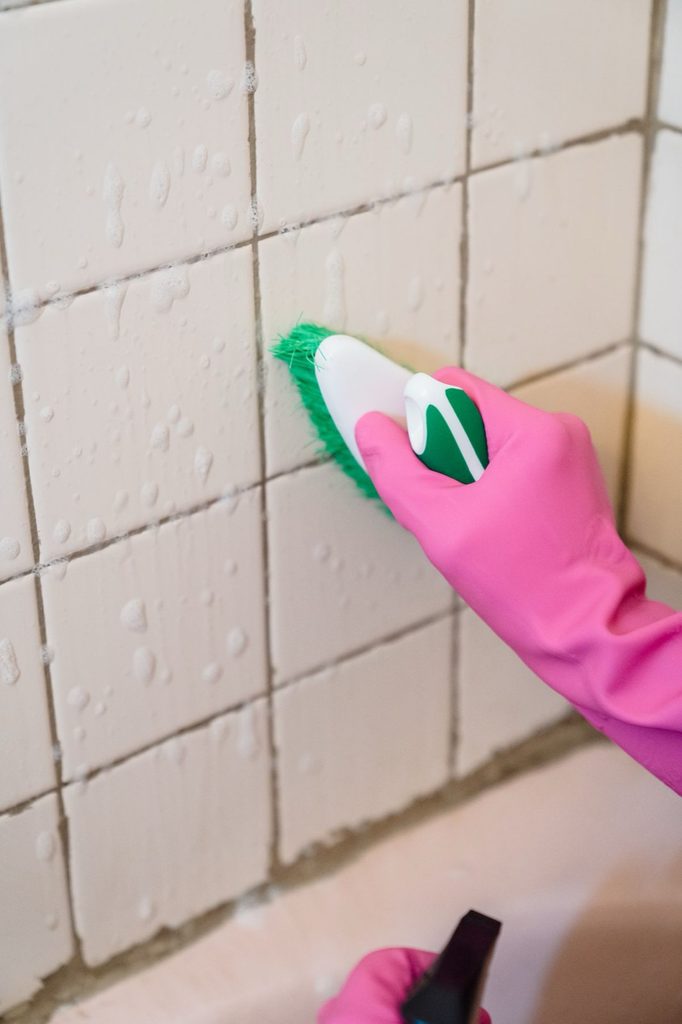
The second stage is mechanical agitation using a rotary or oscillating brush matched to the grout width and depth. Agitation at this stage does two things simultaneously. It disrupts the biofilm matrix at the pore openings, and it opens the capillary channels mechanically so that the subsequent extraction step can reach further into the pore volume than chemistry alone would achieve.
The third stage is hot water extraction under pressure, delivered at temperatures typically between sixty and eighty degrees Celsius. Heat matters here for a specific reason. Raising the temperature of the water lowers its viscosity and reduces its surface tension, which increases how effectively it can flow into and back out of a fine pore network within a workable dwell time. The extraction step uses a wet vacuum recovery to pull the loosened contamination, along with the water carrying it, back out of the pore structure rather than allowing it to simply be pushed further in, which is the specific failure mode of an under powered household mop and bucket approach.
The fourth stage, where the grout condition warrants it, is a penetrating sealer application once the grout line has been allowed to dry fully. A sealer does not close the pore structure. It coats the internal pore walls with a hydrophobic or oleophobic barrier that raises the threshold at which capillary wicking occurs, meaning future contamination is far less able to migrate into the volume in the first place. Sealing without the prior extraction stage seals contamination inside the grout permanently. The sequence matters as much as the individual steps.
Eco chemistry for tile and grout
Our tile and grout chemistry bench is built on plant derived surfactants, formulated to be biodegradable within twenty eight days under OECD 301 testing protocols, and left unfragranced so that no fragrance chemical is introduced into a porous structure that a household’s hands, feet, and food preparation surfaces will contact daily. We do not use quaternary ammonium compounds in routine grout cleaning. Quaternary compounds are effective surface biocides in some settings, but they build up as a residue inside a porous substrate over repeated use, and a residue inside a pore structure is precisely the outcome this article has spent its length arguing against.
Where biological contamination is confirmed rather than assumed, our chemistry bench uses a hydrogen peroxide based formulation rather than a chlorine based one. Hydrogen peroxide breaks down into water and oxygen after it has done its work, leaving no persistent chemical residue lodged in the pore network to react unpredictably with future cleaning products or to irritate a household member with a sensitivity. Chlorine based products, common in supermarket grout cleaners, leave chloride residues and can degrade grout’s polymer additive over repeated exposure, which is a separate and avoidable source of the same problem this protocol is designed to solve.
Long lasting client tips
First. Reseal grout on a schedule rather than waiting for visible staining to prompt action. A penetrating sealer in a wet area typically performs well for twelve to twenty four months before its hydrophobic performance drops meaningfully, and resealing before that period ends keeps the pore structure closed to new contamination rather than reopening it to a fresh cycle.
Second. Use a squeegee on shower tiles after each use. Removing standing water from the tile and grout surface before it has time to wick inward removes the single largest ongoing source of new capillary migration in any bathroom, at zero chemical cost and under thirty seconds of effort.
Third. Avoid vinegar and other low pH household acids as a routine grout cleaner. Vinegar sits around pH two to three, well outside the stable range for cured cement grout, and repeated exposure etches the surface, widening the very pore openings this article has described and accelerating the rate at which contamination can migrate inward.
Fourth. Address a greying grout line early rather than waiting for it to darken further. A grout line in the early stages of contamination has a shallower reservoir of embedded soil and biofilm than one left for years, and it responds to professional extraction far more completely and in less time.
Fifth. Improve bathroom ventilation wherever practical. Extraction fans that actually clear humidity within twenty to thirty minutes of a shower reduce the residual moisture available to sustain biofilm growth inside the pore network between cleans, which is a passive intervention that compounds the value of every active clean that follows it.
Sixth. Ask any tradesperson quoting a regrout what water to cement ratio they intend to mix to. A tighter mix produces a lower void fraction and a more durable, less absorbent grout line for the decades that follow, and it costs nothing extra to ask for it at the point of installation.
The bold position
The cleaning industry, broadly, sells grout cleaning as a surface service, priced and delivered as though a stained grout line were equivalent to a stained bench top. It is not. A bench top is a non porous, near solid surface where a stain genuinely does sit on top. Grout is a porous composite with a real internal volume, and treating the two the same way is a category error that the industry has never corrected because correcting it requires selling a longer, more technical, more expensive service than most operators are equipped or willing to deliver.
We will name this plainly. A large share of the tile and grout cleaning performed in Australian homes is surface agitation dressed up as restoration, and it produces a result that looks good for days and fails within weeks because it was never designed to reach the volume where the contamination actually lives. The customer is not wrong to be frustrated. The customer has been sold the wrong description of the problem.
Cleaning Crusader treats every grout line as the porous structure it is. We pre treat, we agitate, we extract under heat and pressure, and where the grout warrants it, we seal the pore structure closed against the next cycle of contamination. This is slower than a mop and a spray bottle. It is also the only version of the job that actually closes the problem rather than deferring it to next month’s clean. The chemistry of the material dictates the method. We built the method to match the material, not the other way around.
Forged in Standard. Built on Excellence.
Cleaning Crusader. Built for impact. Driven by excellence. Guided by purpose.