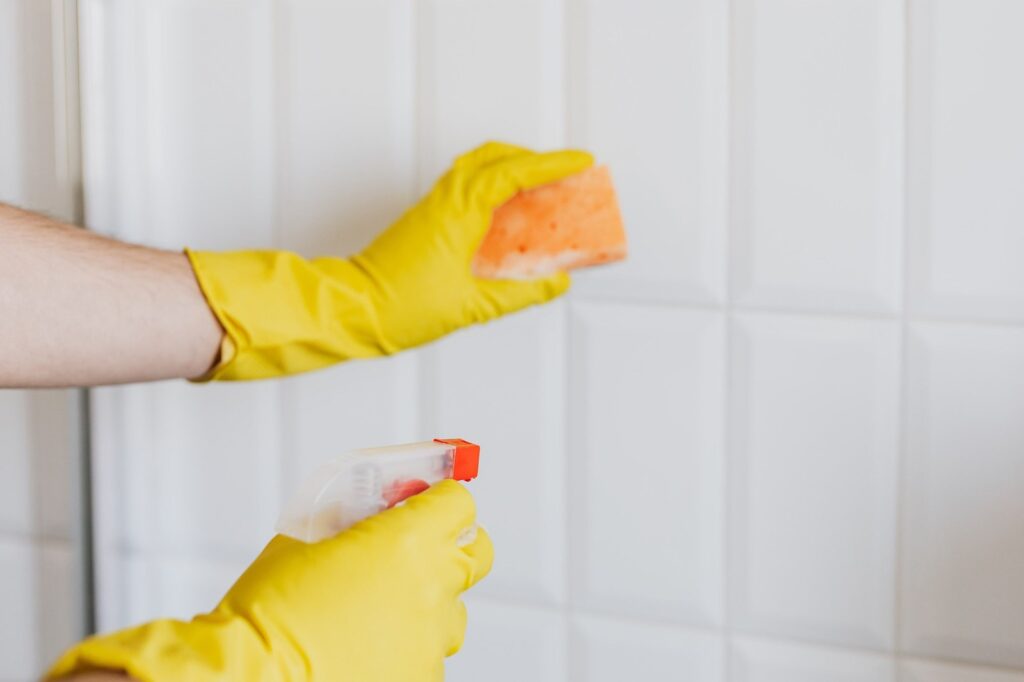
Reaching for a stronger clean on tile and grout, some homeowners combine a chlorine bleach product with an acidic bathroom cleaner without ever realising what the two bottles do when they meet. The reaction produces genuine chlorine gas, a real and documented hazard in an ordinary bathroom, and a pH neutral routine is the safer alternative that still gets the grout clean.
A bathroom, a bucket, and a mistake nobody meant to make
It happens in an ordinary bathroom, on an ordinary weekend, with the best of intentions. The grout has gone grey again, last week’s bleach spray did not quite finish the job, and there is a bottle of limescale remover under the sink that promises to cut through what the bleach left behind. Neither product carries a warning that specifically anticipates the other sitting on the same shelf. Both are entirely legal, widely sold, and individually safe when used as directed. Combined, even accidentally, in a bucket, on a cloth, or simply applied to the same surface in close succession without a proper rinse between them, they produce a genuine and dangerous chemical reaction, one that has sent people to hospital in ordinary domestic bathrooms with nothing more exotic involved than two cleaning products from the same supermarket aisle.
This is not a rare or theoretical hazard reserved for industrial settings. It is a real risk sitting in an enormous number of Australian bathroom cabinets, made worse by exactly the kind of small, poorly ventilated room a bathroom typically is, and it deserves to be explained plainly rather than left as a small print warning nobody reads until after the fact.
The chemistry, stated simply
Chlorine bleach, sold under many household names, is a solution of sodium hypochlorite, an alkaline compound that works as a cleaner and disinfectant partly through its chlorine content and partly through its high pH. Bathroom cleaners marketed for limescale, soap scum, or rust, by contrast, are commonly formulated around an acid, which might be hydrochloric acid, phosphoric acid, sulfamic acid, or in milder retail products, citric or acetic acid, chosen because acids are effective at dissolving the mineral deposits that build up on tile, grout and tapware in hard water areas.
When a hypochlorite solution meets an acid, the chemistry runs in a well documented and entirely predictable direction. The acid protonates the hypochlorite ion, and the reaction releases chlorine gas, an outcome so consistently reproducible that it forms the basis of safety warnings issued by poison control services, workplace safety regulators and product manufacturers worldwide. This is not a rare side reaction or an edge case dependent on unusual concentrations. It is the standard, expected outcome any time a chlorine based product meets an acid based product in meaningful concentration, and it happens whether the two are deliberately combined to make a stronger cleaner or simply applied to the same surface in quick succession without an adequate rinse removing the first product before the second goes on.
What chlorine gas actually does
Chlorine gas is not a mild irritant to be shrugged off with an open window. At low concentrations it produces immediate and unmistakable symptoms, a sharp, distinctive smell, coughing, burning in the eyes, nose and throat, and a tightening sensation in the chest that most people recognise instantly as wrong. At higher concentrations, more likely to occur in a small, enclosed bathroom with the door shut and the extraction fan not running, exposure can progress to significant respiratory distress and, in serious cases, fluid accumulation in the lungs requiring urgent medical treatment. This progression from mild irritation to a genuine medical emergency is well established in occupational and toxicological literature and is precisely why chlorine gas exposure incidents from mixed household cleaning products are a recurring and recognised category of call to poison information services, not a rare curiosity.
The domestic bathroom is, if anything, a worse setting for this reaction than an industrial one, precisely because it is small, often has limited ventilation, and the person mixing the products is standing directly over the reaction with their face at close range, kneeling to scrub a shower base or a grout line. A reaction that might disperse relatively harmlessly in a large, well ventilated space concentrates quickly in a closed shower recess or an unventilated ensuite, and the person most exposed is the one doing exactly the job they set out to do properly.
How this actually happens in real bathrooms
Nobody sets out to make chlorine gas. The pattern that leads here is almost always well intentioned. A household treats mould or mildew on shower grout with a chlorine based spray, lets it sit, and rinses, satisfied with the result on the mould but frustrated that the same grout still looks chalky and mineral stained from hard water deposits. Reaching for a stronger result, they follow up soon after with a limescale or rust remover on the same grout, not realising that product is acid based, and either apply it before the bleach residue has been properly rinsed away, or combine a small amount of both directly to make what feels like a more powerful solution for a stubborn stain. Either path brings the two chemistries into contact on the same wet surface, in a room that traps the resulting gas close to the person doing the cleaning.
The same pattern shows up with pool chlorine granules stored near acidic pH reducer in a garage, with chlorine based spa sanitiser stored alongside an acidic descaler, and with commercial strength chlorine products used by well meaning homeowners who believe a stronger, undiluted product will simply do a better job, unaware that concentration makes the reaction, if it occurs, considerably more dangerous rather than simply more effective.
The Crusader position on chemical safety
Cleaning Crusader operators are trained never to combine cleaning chemistries in the field, a discipline that exists specifically because this exact hazard, and others like it involving different chemical families, is genuinely present in ordinary domestic products. Every product used across a job is applied, allowed to work, and fully rinsed before a different chemistry is introduced to the same surface, and no product is ever combined directly with another to create a supposedly stronger solution, because the risk of an unpredictable and hazardous reaction outweighs any marginal cleaning benefit a combined product might offer. This discipline is not a special precaution reserved for professional grade chemicals. It applies equally, and arguably more importantly, to the ordinary retail products sitting in most bathroom cabinets, precisely because those products carry the same underlying chemistry without the training or the ventilation controls a professional job would bring to the same task.
If the reaction has already started
Knowing what to do in the moment matters as much as knowing how to avoid the reaction in the first place, because the pattern that leads here is common enough that plenty of households will recognise the smell before they ever read a warning about it. The moment a sharp, distinctive chlorine odour is noticed, whether or not the two products were knowingly combined, the correct response is to leave the room immediately, close the door behind if it can be done without lingering, and open external windows and doors elsewhere in the home to encourage the gas to disperse rather than settle. Nobody should re enter the room to rinse the surface, retrieve a product, or attempt to finish the job until the space has been ventilated for a genuine period of time, well beyond the minute or two it takes for the smell to seem to fade, because the sensory fatigue that dulls a person’s perception of the odour is not the same as the gas having actually cleared. Anyone who experienced coughing, chest tightness or eye irritation during the exposure should be monitored for a period afterward and seek medical advice if symptoms persist or worsen, since chlorine gas exposure can, in some cases, produce a delayed worsening of respiratory symptoms some hours after the initial exposure has apparently passed.
The property manager and rental context
This hazard carries a particular weight in shared and rental housing, where a bathroom tile and grout surface is sometimes cleaned by more than one person over time, a tenant, a family member, whoever is rostered on for the week, none of whom necessarily know what the last person used on that grout the week before. A property standing empty between occupants is a common setting for exactly this risk, since tile and grout cleaning done under time pressure and with nobody living in the home sometimes involves a cleaner reaching for whatever combination of products seems likely to lift a stubborn stain fastest, with no occupant present to notice a chemical smell building in a closed, unoccupied bathroom until the door is opened again. Anyone coordinating tile and grout cleaning across a change of occupant carries a genuine responsibility to standardise on a single, documented chemistry approach rather than leaving the choice of product to whoever happens to be rostered on that day, precisely because a documented approach removes the guesswork that leads to two incompatible bottles meeting on the same surface.
The safe pH neutral routine that actually works
The good news for a household wanting clean, mineral free grout without the mould returning is that a safe, pH neutral routine achieves both outcomes without ever requiring a chlorine and acid combination in the first place. Routine grout maintenance can be carried out with a pH neutral cleaner, one sitting close to the neutral point on the pH scale rather than strongly alkaline or strongly acidic, which lifts everyday soil and soap residue without the aggressive chemistry that either damages grout over time or creates a hazard when combined with something else already on the surface. Where mould or mildew genuinely needs addressing, a chlorine based product can still be used safely on its own, provided the surface is then thoroughly rinsed with plain water and allowed to dry completely before any different product, particularly an acidic one, is ever applied to the same area. Where mineral scale genuinely needs addressing, an acidic descaler can be used safely on its own, under the same condition, a full rinse and dry before any chlorine based product returns to that surface.
The rule that keeps a household safe is not memorising which specific chemicals react. It is a simple habit, never combine two different cleaning products in the same application, always rinse a surface fully and let it dry before switching product families, and treat any product carrying a warning label mentioning bleach, chlorine, acid, ammonia or hydrochloric, phosphoric or sulfamic acid as one that must always be used alone.
Long lasting client tips
First. Never combine two bathroom cleaning products, whether deliberately to boost strength or accidentally by applying one before the other has been fully rinsed away, regardless of how safe each product is individually.
Second. Read the label of any bathroom product mentioning bleach, chlorine, hypochlorite, hydrochloric acid, phosphoric acid or sulfamic acid, and store chlorine based and acid based products on separate shelves to reduce the chance of accidental contact.
Third. Ventilate the bathroom fully, running an extraction fan and opening a window where possible, any time a chlorine based or acid based product is in use, even for a routine clean that feels too minor to warrant the precaution.
Fourth. Rinse a surface thoroughly with plain water and allow it to dry before applying a different type of cleaning product to the same area, even where the first product appears to have worked well and a second application feels like it will finish the job faster.
Fifth. Use a pH neutral cleaner for routine grout maintenance, reserving stronger chlorine or acid based products for occasional, targeted use on their own rather than as a regular combined routine.
Sixth. If a sharp chemical smell, coughing or eye irritation develops while cleaning, leave the room immediately, ventilate it fully before returning, and seek medical advice if symptoms persist, treating the reaction as a genuine exposure event rather than something to simply push through.
The bold position
We will say this plainly. Chlorine gas from mixed household cleaning products is not a rare industrial accident. It is a real and recurring domestic hazard, sitting quietly in the combination of two entirely legal, individually safe bathroom products that many households already own, and the industry has done a poor job of making that risk plain in a way that actually changes behaviour rather than sitting in fine print nobody reads.
Cleaning Crusader would rather every household understand this hazard clearly and adopt the simple habit that avoids it entirely than sell a stronger looking combined solution that trades a marginal cleaning gain for a genuine safety risk. A pH neutral routine, used correctly and consistently, gets the grout clean without ever putting the two bottles in the same bucket. That is not a compromise. It is the safer version of the same result, and it is the standard we hold to on every job and recommend to every customer at home.
Silent strategy. Visible legacy.
Cleaning Crusader. Built for impact. Driven by excellence. Guided by purpose.