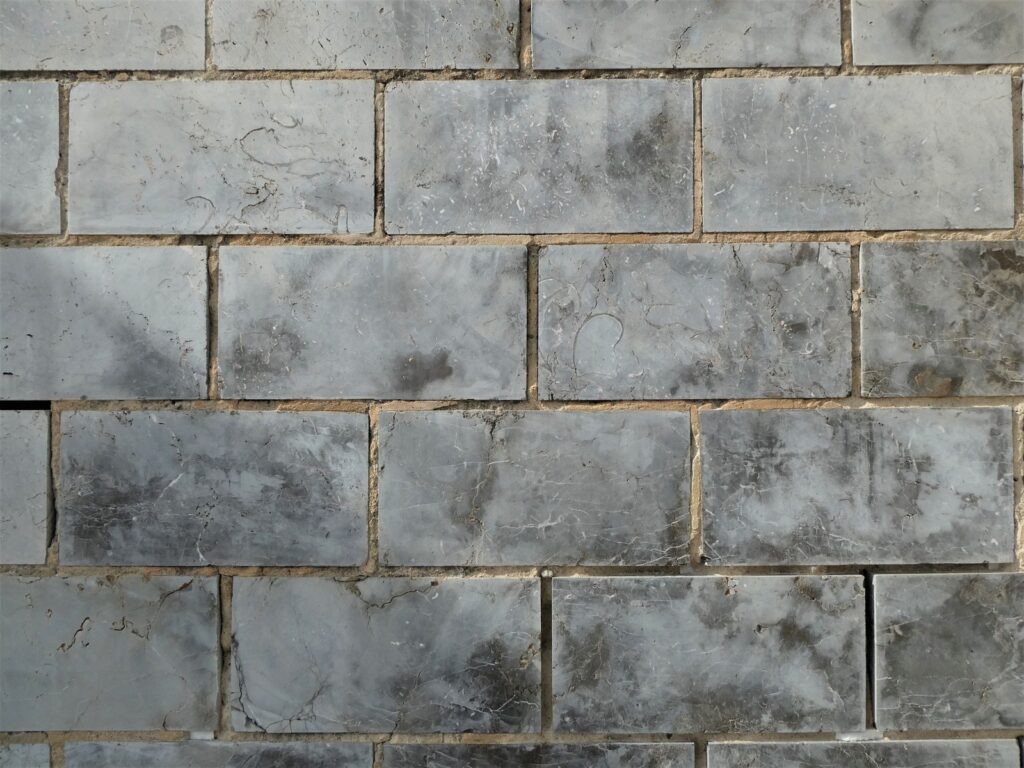
Large format tile has quietly changed the maths of every wet area in Perth. Fewer, thinner grout lines are now carrying the same waterproofing burden that older small format tile once spread across many times as many lines, and almost nobody has recalculated what that means for the consequence of a single failure.
A bathroom that looks safer than it is
A newly renovated bathroom with large format porcelain tile reads, to almost every homeowner who walks into it, as the cleaner and more modern option. Fewer lines. Less grout to look at. Less grout to clean. The visual logic is obvious and it is also, in one important respect, exactly backwards. Grout is not decoration sitting on top of the waterproofing. In most standard tiled wet areas it is a working part of the water management system, the flexible seal that keeps moisture from tracking into the substrate between otherwise impermeable tiles. When the industry moved from small format tile to large format tile over roughly the last fifteen years, it did not reduce the amount of waterproofing work being done. It reduced the number of lines doing it, and concentrated the same total burden onto each one that remained.
This is not an argument against large format tile, which has real advantages in appearance, in cleaning simplicity on the tile face itself, and in overall installation speed. It is an argument for understanding what changed underneath the surface when the industry adopted it, because the consequence of ignoring that change is a bathroom that looks pristine right up until the point a single compromised joint lets water travel somewhere nobody is watching.
The geometry nobody recalculated
The relationship between tile size and total grout line length per square metre is simple geometry, and it is worth working through once because the scale of the change surprises most people who have not seen it laid out. A small format tile, the one hundred millimetre mosaic or the three hundred millimetre tile common in older Perth bathrooms, sits in a grid with joints running in both directions at a spacing set by the tile edge length. Cut that grid down to a one square metre panel and count the total metres of joint running through it. A one hundred millimetre tile with a standard narrow joint produces something in the order of twenty linear metres of grout line within that single square metre, because the grid repeats so many times across the same area. A three hundred millimetre tile in the same square metre produces roughly six or seven linear metres, already a substantial drop.
Move to the six hundred millimetre format that now dominates new Perth bathroom and kitchen renovations and the same square metre holds only around three linear metres of grout line. Move again to the large slab formats now common in premium renovations, tiles of one metre or more on the long edge, and the total joint length in that square metre can fall to less than two linear metres. The waterproofing task facing that square metre of floor or wall has not changed. The same total area still needs to be sealed against water ingress. What has changed is that a task once distributed across twenty metres of joint is now distributed across two or three, meaning each remaining metre of grout is doing something in the order of six to ten times the work it used to do in an equivalent small format installation.
Fewer lines, less redundancy
The reason this matters is redundancy, a concept borrowed directly from structural and asset engineering. A system with many small components sharing a load has a built in tolerance for any single component underperforming, because its neighbours are close by and lightly enough loaded to absorb the shortfall. A system with few components carrying a heavy load has very little such tolerance. A single compromised metre of grout in a twenty metre network is a small, localised weak point surrounded by nineteen metres of healthy seal. A single compromised metre of grout in a three metre network is a third of the entire waterproofing perimeter of that room, and its neighbours are already carrying several times the load they would have carried under the old small format standard.
This is precisely the asset protection lens Cleaning Crusader applies to every wet area, tile floor and shower recess it assesses. The question is never simply whether the grout looks clean or intact on the surface. It is whether the reduced number of lines carrying a large format installation are each individually sound, because a large format bathroom does not have the small format bathroom’s luxury of nineteen other lines to lean on if one gives way. Australian Standard AS 3958.1, which governs the installation of ceramic tiles, specifically addresses movement joint spacing for exactly this reason, requiring regular flexible joints at set intervals because a rigid slab of tile and adhesive that cannot accommodate the building’s natural movement will eventually crack somewhere, and a large format installation has fewer places for that crack to travel before it reaches a functional seal rather than another tile.
Where the consequence actually lands
Water that tracks past a failed grout joint in a wet area does not stop at the tile. It travels into the substrate below, whether that is a fibre cement sheet, a screed bed, or in older Perth homes a timber subfloor, and the consequence compounds with time rather than announcing itself immediately. A membrane beneath the tile bed, where one exists and is intact, will usually intercept this moisture and direct it to a floor waste, which is why a well specified wet area with a genuine waterproof membrane underneath the tile is considerably more forgiving of an ageing grout line than one relying on the grout itself as the primary barrier, a common shortcut in older Perth construction and in some lower cost renovations. Where no membrane exists, or where the membrane itself has been compromised by a fixing point or an edge detail, the grout line is not a secondary defence. It is the only defence, and in a large format installation it is a defence with very little redundancy left in it.
The failure, when it eventually surfaces, tends to appear a long distance in time and often a long distance in location from the joint that actually let the water through. A stain on a ceiling below a bathroom, a soft patch in flooring in an adjoining room, or a persistent musty smell behind a wardrobe on the other side of a wet wall are all downstream consequences of a grout failure that may have been quietly running for months or years before anyone traced it back to its source. The asset protection argument is that the cost of ignoring a single hairline failure in a large format grout line is not the cost of one line. It is the cost of everything that line was the last defence for.
The Crusader protocol for large format grout
Assessing a large format installation starts with a joint by joint inspection rather than a general visual pass, because a room with only three metres of total grout line can be checked entirely in the time it would take to sample a fraction of a small format room’s twenty metres, and every metre of that inspection matters more given how few of them exist. Each joint is checked for surface integrity, for any softening or crumbling at the edge where grout meets tile, and where accessible, for signs of moisture migration at the substrate level using a moisture meter rather than a visual guess. Restoration where warranted involves full removal of compromised grout to a consistent depth rather than a surface skim, repacking with a grout matched to the original in both colour and, where the installation calls for it, flexibility, and a sealing step appropriate to the substrate and the room’s moisture exposure.
Sealing itself deserves particular care in a large format context. A sealer applied over grout that is already compromised does not restore the joint, it only delays the visible evidence of the problem while the underlying failure continues, and in a room with few redundant lines that delay is more costly than in a small format room with joints to spare. The correct sequence is restoration first, sealing second, never the reverse, and never as a substitute for addressing a joint that has already failed structurally rather than cosmetically.
Eco chemistry in a lower redundancy room
The chemistry used across this work sits within the same low impact bench used across every Cleaning Crusader service, plant derived surfactants biodegradable within twenty eight days under OECD 301, unfragranced formulations, and no quaternary ammonium compounds in routine cleaning, with hydrogen peroxide based agents reserved for genuine sanitising requirements. In a large format wet area this matters in a specific practical sense as well as an environmental one. A harsh, high pH stripping product used repeatedly on grout can accelerate the very crumbling that reduces a joint’s integrity, and in a room where each joint is carrying several times the load of its small format equivalent, that acceleration has a proportionally larger consequence. A gentler, well matched chemistry protects the asset it is cleaning rather than quietly wearing it down.
Long lasting client tips
First. Have large format tile grout inspected on a shorter interval than the visual condition alone would suggest, because a room with only a handful of joints carrying its entire waterproofing load shows very little visual warning before a failure becomes a substrate issue.
Second. Ask any renovator or builder specifically whether a waterproof membrane sits beneath the tile bed in a large format wet area, not simply whether the room is waterproofed. The membrane is what determines whether the grout is a backup defence or the only defence.
Third. Address a single failing joint immediately rather than waiting for a wider resealing project, because in a low redundancy installation that one joint may already be the room’s only remaining barrier at that location.
Fourth. Avoid high pH stripping products on large format grout as a routine maintenance habit. A gentler regular clean preserves joint integrity for longer than an occasional aggressive one.
Fifth. Request grout colour and profile matching when any restoration work is carried out on a large format floor, since a poorly matched repair on a room with only a few visible lines is far more noticeable than the same mismatch would be across twenty lines in an older small format room.
Sixth. Keep a simple record of when grout was last restored or resealed in each wet area of the home, particularly where large format tile is installed, so that the interval between inspections can be tracked against the manufacturer or installer’s recommended maintenance cycle rather than left to memory.
The bold position
We will say this plainly. Large format tile did not reduce the waterproofing task in a modern wet area. It reduced the number of lines available to carry it and concentrated the same burden onto whatever remained, and most of the trade has not adjusted its inspection or maintenance thinking to reflect that change. A grout line in a large format bathroom is not a smaller version of the grout line it replaced. It is doing several times the work with none of the redundancy the old small format grid provided, and treating it with the same casual, occasional attention as a decorative detail is a genuine asset risk rather than a cosmetic oversight.
Cleaning Crusader assesses every large format installation with this arithmetic in mind, because a property owner who understands that fewer lines means less tolerance for failure will make different decisions about inspection frequency, about sealing schedules, and about how quickly a single compromised joint gets addressed. The line does more work now. The maintenance discipline around it has to match.
Forged in Standard. Built on Excellence.
Cleaning Crusader. Built for impact. Driven by excellence. Guided by purpose.