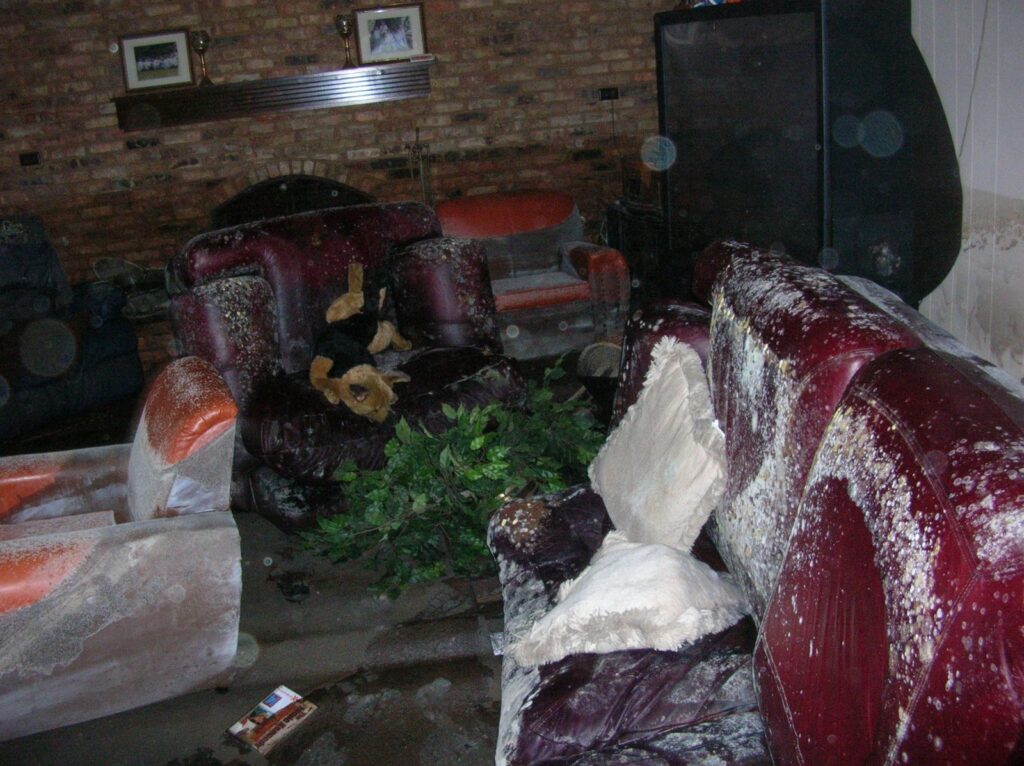
Rugs and upholstered furniture caught in a flood run on their own triage protocol, entirely separate from the building around them, and the decision to dry and save a piece rather than write it off is made on exactly the same clock that governs the structural drying, not on a calmer timeline once the walls and floors are sorted.
Two clocks running at once
A flood event in a home starts two separate restoration jobs at the same moment, and the industry’s own language sometimes obscures this by describing both under a single umbrella. There is the structural job, drying the building itself, the plasterboard, the framing, the flooring, the cavity behind the skirting. And there is the contents job, the rugs, the upholstered furniture, the soft goods that were sitting in the affected area when the water arrived. Both jobs share the same clock, because both are governed by the same underlying fact of building science, that damp organic material left untreated begins to support active microbial growth within a window commonly cited across the restoration industry as roughly twenty four to forty eight hours under typical indoor conditions. Beyond that window, the calculation for every affected item, structural or contents, shifts from can this be saved to can this be saved economically, and the answer changes fast the longer the clock runs.
The mistake we see most often in properties attended by other operators, or by well intentioned homeowners managing the event themselves before calling a specialist, is treating contents triage as the secondary task, something addressed once the structural drying equipment is running and the immediate crisis feels under control. By the time contents receive that kind of attention, several of the same hours that were burning against the structure have burned against the rug and the sofa too, and pieces that were genuinely salvageable at hour six are no longer salvageable at hour thirty six. Contents triage does not wait for the structural job to be sorted first. It runs in parallel, on the same clock, from the moment the technician walks in the door.
Why rugs and upholstery need a different triage entirely to the building
The building materials affected by a flood, plasterboard, timber framing, tile and grout, are relatively uniform and well understood, and the S500 standard gives restoration technicians a consistent framework for assessing and drying them. Rugs and upholstered furniture are neither uniform nor simple, because both categories combine multiple different materials in a single item, each with its own tolerance for water, its own drying behaviour, and its own economic value that has almost nothing to do with the other materials in the same piece.
A rug is not one material. A wool or natural fibre rug has a face fibre, a foundation weave often built from cotton or jute, and in many cases a natural fibre backing, and each of those three layers absorbs and releases water at a different rate, which is precisely why a rug that looks dry on its visible pile can still be holding significant moisture in its foundation and backing layers, hidden from a casual inspection the same way a ceiling cavity hides moisture behind a dry painted face. Upholstered furniture is similarly layered, a fabric or leather outer, a foam or fibre fill, and a timber or engineered timber frame, and each layer again behaves completely differently once wet. Foam in particular behaves almost like a sponge, absorbing water readily and releasing it slowly, which means a sofa cushion can remain saturated for days after the visible fabric surface reads dry to a casual touch.
The triage decision matrix
A properly run contents triage is not a judgement call made on gut feeling in the moment. It is a documented decision process applied consistently across every affected item, because consistency is what allows a household, an insurer, or a second technician reviewing the job later to understand why one rug was saved and another was written off, rather than the outcome appearing arbitrary.
The first factor is category of water. Category 1, water from a clean source such as a supply line failure, gives every material, rugs and upholstery included, a genuinely better salvage prognosis than Category 2 or 3 water, which carries contamination that can render even a technically dryable item unsafe or impractical to fully decontaminate, particularly where the item’s construction makes thorough decontamination difficult, a densely piled rug foundation being a clear example. The second factor is elapsed time since the water event, assessed against the same twenty four to forty eight hour window that governs the structural job, because a rug assessed at hour four is a different economic and hygienic proposition to the same rug assessed at hour sixty.
The third factor is construction and material composition specifically, since a synthetic fibre rug with a synthetic foundation tolerates aggressive drying intervention far better than a natural fibre rug with a jute foundation, which is genuinely vulnerable to both dimensional instability and odour development if not dried correctly and promptly. The fourth factor is economic and sentimental value assessed honestly and separately from each other, because a low value synthetic rug from a chain retailer and a hand knotted wool rug carrying family history are not the same decision even when their physical condition after the flood looks similar, and a competent triage process asks the household directly rather than assuming replacement value alone should drive the call.
What actually happens to a salvageable piece
Where triage assesses an item as salvageable, the process that follows looks nothing like drying it in place in the affected room, which is both slower and less controlled than the alternative. Rugs assessed as salvageable are typically removed from the affected area entirely and transported to a dedicated facility where they can be properly flushed of contamination, if any, and dried under controlled conditions, in a purpose built drying chamber or a comparable setup where temperature, airflow and humidity can be managed precisely across the rug’s full thickness rather than relying on ambient conditions in a room that is also trying to dry a building around it. This off site drying process typically takes considerably longer than a straightforward structural drying cycle, because a densely constructed rug’s foundation layer releases moisture far more slowly than an open weave carpet or a painted plasterboard face, and rushing the process by returning a rug to service before it has genuinely reached a safe moisture content risks exactly the kind of hidden reservoir problem that produces mould and odour weeks after the rug is back in the home.
Upholstered furniture assessed as salvageable follows a comparable logic adapted to its specific construction. Where the fabric or leather outer and the timber frame have tolerated the water event without contamination and the fill has not been saturated beyond a reasonable drying window, the piece can often be dried, cleaned and returned to service using the same principles applied in our routine upholstery work, fibre identification, appropriate chemistry, careful extraction. Where the fill, particularly foam, has been saturated for long enough to fall outside a safe drying window, our default position mirrors the position we take with saturated ceiling insulation. The fill is frequently more practical and more reliable to replace than to dry in place, because foam’s structure resists efficient moisture release in exactly the way that makes it comfortable to sit on, and a technician gambling on drying a heavily saturated cushion fill in place is taking a risk the economics rarely justify once the alternative of replacement fill inside a salvaged frame and cover is available.
Documenting the contents decision
Every triage decision on every item is logged, not simply performed. The log records the item, its construction where relevant, the category of water it was exposed to, the elapsed time at assessment, the decision reached, and the reasoning behind it, whether that reasoning is water category, construction vulnerability, or elapsed time exceeding a safe window. This documentation exists for the same reason a structural drying job needs a moisture log. It is the only record that lets an insurer, a homeowner, or a second reviewer understand and verify the decisions made under time pressure at the scene, rather than simply trusting a verbal account after the fact. A contents claim submitted with an itemised, reasoned triage log moves through insurance assessment more smoothly than one submitted as a simple list of items with no documented basis for what was kept, restored or discarded.
Eco chemistry in the contents process
Where a salvaged rug or upholstered item requires cleaning as part of its restoration, the same plant derived surfactant bench used across every Cleaning Crusader service applies, unfragranced, biodegradable within twenty eight days under OECD 301, without quaternary ammonium compounds in routine work. Contents restoration after a Category 2 or 3 water event occasionally requires a stronger disinfection step specifically where contamination is confirmed, and that decision is made deliberately and explained to the household rather than applied as a blanket default, consistent with our approach to chemistry across every service we provide.
Long lasting client tips
First. Ask, before any drying equipment is placed in the affected room, whether contents triage has already started separately. A technician who cannot answer that question clearly is likely treating your rugs and furniture as a secondary concern rather than as items running on the same clock as the building.
Second. Photograph every affected rug and upholstered item as soon as it is safe to do so, before anything is moved, removed or discarded. This record supports both the technician’s triage reasoning and your own contents claim, and it costs you nothing beyond a few minutes with a phone camera.
Third. Ask for the construction of any rug you are attached to, wool, synthetic, natural fibre foundation, before accepting a triage decision on it. A natural fibre foundation carries a different risk profile to a synthetic one, and that distinction should be explained to you, not simply applied silently.
Fourth. Separate the economic question from the sentimental one honestly, and say so out loud to your technician. A rug or chair with family history deserves a different conversation to a low cost replaceable item, and a competent operator will ask rather than assume.
Fifth. Request the triage log as part of your final paperwork, the same way you would request a structural moisture log. It is the record that explains, months later, exactly why a decision was made under time pressure at the scene.
Sixth. Do not attempt to dry a valuable rug or a saturated upholstered piece yourself while waiting for a specialist. Placing a wet rug in direct sun or in front of a household fan can fix contamination into the fibre or accelerate dimensional damage before a technician ever assesses it properly.
The bold position
We will say this plainly. Contents triage is treated as an afterthought on a large share of flood restoration jobs in this country, addressed once the structural drying equipment is running and the immediate crisis feels managed, rather than run in parallel from the first hour on the same clock that governs the building itself. The rugs and the upholstered furniture in the affected area are burning through the same twenty four to forty eight hour window as the plasterboard and the framing, and every hour spent treating contents as secondary is an hour that pushes a genuinely salvageable rug or sofa closer to a point where saving it is no longer the sensible economic call.
The consequence lands on the household twice over. They lose items that could have been saved had triage started sooner, and they are left, in many cases, with no documented reasoning for why anything was discarded, which weakens their contents claim exactly when they need it to be strong. A systemised, documented triage process run from the first hour is not an added cost to a flood job. It is the difference between a household keeping a rug that mattered to them and losing it to a delay that had nothing to do with the water itself.
Cleaning Crusader runs contents triage from the moment we arrive, on the same clock as the structural work, with a documented decision for every item and a clear, honest conversation with the household about what can genuinely be saved. The rescue happens before the rebuild, because by the time the rebuild is underway, the window for the rescue has usually already closed.
Silent strategy. Visible legacy.
Cleaning Crusader. Built for impact. Driven by excellence. Guided by purpose.