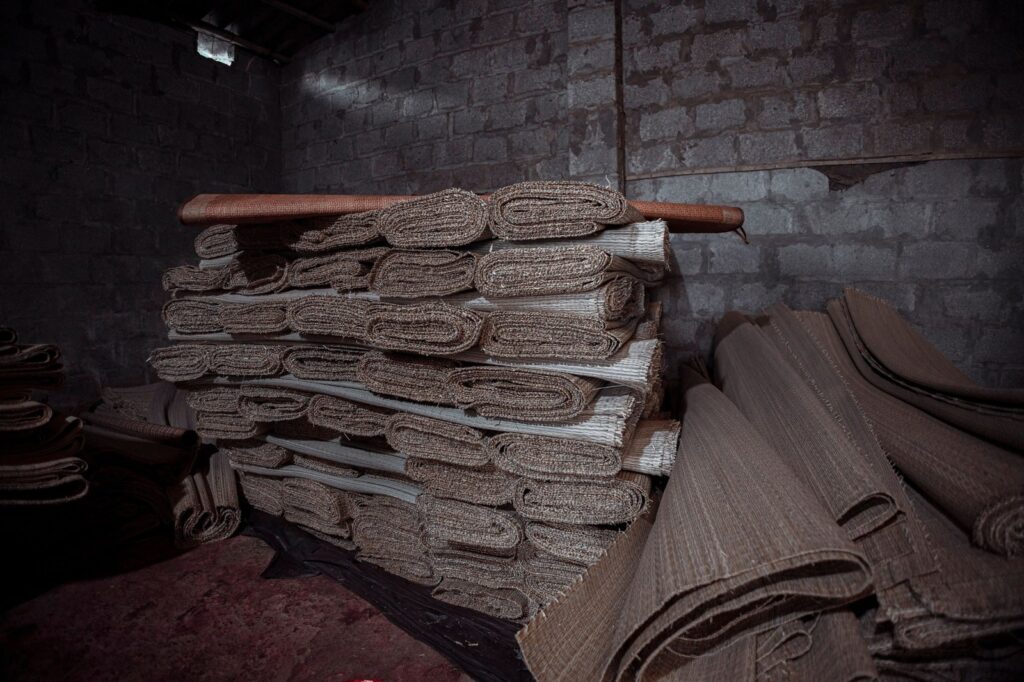
A wool rug rolled up and put away for a Perth summer is not in storage. It is sealed inside its own small, dark, humid room, and a rug in that condition can grow mould the same way a poorly ventilated bedroom wall grows it, quietly, for months, before anyone unrolls it to look.
The rug that came back changed
A family clears a room for a renovation and rolls up the good rug, a wool piece that has sat in the lounge for a decade, older than that if it came down from a parent’s home before this one. It goes into the linen press because there is nowhere else for something that size to sit for a few months, tucked behind the towels, out of the way, forgotten in the way anything is forgotten once the renovation takes over the household’s attention. Three months later the room is finished, the rug comes out, and it is not the rug that went in. A smell rises off it before it is even fully unrolled, damp and faintly sour. Unrolled flat, there are patches, grey and dark green freckling across sections that were folded into the inside of the roll, worse where the fibre was tightest against itself.
The family’s first assumption is almost always that something leaked in the cupboard, or that the rug was damp when it went in. Neither is usually true. The rug went into the press clean and dry to the eye, and the linen press itself had no water event, no leak, nothing anyone would call a moisture problem in the space. What happened is quieter and, once explained, entirely predictable. The rug did not need an external source of water to grow mould in storage. It carried everything mould needed inside the roll itself, and the way it was stored gave that everything nowhere to go for months at a time.
This is one of the more counterintuitive failures a household encounters, because storage is supposed to be the safe option, the thing you do to protect an item from damage rather than the thing that causes it. With a natural fibre rug, stored the wrong way, storage can be the more dangerous environment than the room the rug came out of.
Wool is not an inert material
The first part of the explanation sits in what a wool rug is actually made from. Wool is keratin, the same structural protein found in hair, hooves, and horn, and it is a genuinely hygroscopic material, meaning it absorbs and holds moisture from the surrounding air far more readily than a synthetic fibre does. Wool can take up something in the order of thirty percent of its own dry weight in moisture from humid air alone, without ever being wet to the touch, because the moisture is drawn into the fibre’s internal structure rather than sitting on its surface where it would be obvious.
This matters because mould is a living organism, and like every living organism it needs an organic food source and available moisture to establish and grow. A synthetic fibre rug, built from petrochemical polymers such as nylon or polypropylene, offers almost nothing for a mould colony to metabolise directly, because the fibre itself is not organic material a fungus can digest. Wool, cotton, jute, and sisal are the opposite case entirely. Keratin, cellulose, and plant fibre are all organic substrates that fungi can and do break down as a food source, and they hold the ambient moisture a fungal colony needs to do it. A natural fibre rug is, from a mould’s perspective, food and water sitting together in one convenient object, and the only thing standing between a colony establishing and a colony never getting the chance is whether the moisture stays low enough for long enough.
The physics of a rolled rug in a closed cupboard
This is where the storage decision becomes the actual cause rather than a neutral backdrop. The World Health Organization’s 2009 guidance on dampness and mould in indoor environments identifies sustained elevated relative humidity, generally above the region of sixty to seventy percent, as the threshold where mould growth becomes a realistic risk on suitable organic material, and a closed linen press or a garage over a Perth summer routinely sits in or above that range, particularly if the space has no active ventilation or air conditioning running through it.
A wall cavity grows mould under conditions that combine three things. A source of moisture, whether from humidity infiltration, a slow leak, or condensation. An organic substrate the fungus can use, timber framing, paper faced plasterboard, dust. And critically, no drying cycle, meaning the moisture that arrives has no route to leave again before the fungal colony has had time to establish. A rolled rug inside a closed cupboard meets all three conditions in miniature, and it meets them more severely in one specific respect than the wall does. Rolling a natural fibre rug tightly presses each layer against the next, and that contact seals off the air movement that would otherwise let any residual moisture in the fibre evaporate away. Ambient humidity that the rug absorbed during a humid week, or moisture left over from a professional clean that was not given a full and complete drying cycle before rolling, becomes trapped inside the layers of the roll with no path to leave. It does not matter that the outside of the linen press is a normal, dry looking cupboard. The interior of the roll is its own sealed microclimate, holding a stable pocket of high humidity against an organic fibre, in the dark, at a warm ambient temperature for an entire Perth summer, which is close to an ideal set of laboratory conditions for a fungal colony rather than an incidental risk.
This is the precise parallel the title of this piece is pointing at. The wall grows mould because moisture arrives and cannot leave. The rug grows mould because moisture is carried in and cannot leave. The mechanism is the same physics, applied to two different objects, and the household that would never dream of sealing a damp patch on a bedroom wall behind an airtight cover does exactly that, without meaning to, every time a rug goes into storage rolled tight and wrapped in plastic.
The Crusader rug mould remediation protocol
Mould established inside a rolled natural fibre rug is treated as a specific, contained process, distinct from general carpet mould work and distinct from anything to do with clothing or wardrobe hygiene, because a rug is a discrete, portable, valuable object rather than a fixed surface, and that changes the correct method.
Stage one. Containment and safe unrolling. The rug is unrolled and assessed in a controlled area away from the rest of the home’s air, because disturbing a mould affected rug releases spores into the surrounding air, and a rug that has been sealed in a cupboard for months can carry a genuinely significant spore load in its fibre once it is finally opened up.
Stage two. Dry HEPA vacuum extraction. Before any wet process begins, loose surface spore material and fungal debris are removed with a HEPA filtered vacuum, working from the back of the rug as well as the face, because mould growing in a rolled rug frequently establishes as heavily on the underside and inside the fold lines as it does on the visible pile.
Stage three. Assessment of the fibre and the affected zones. The rug’s construction, wool, wool blend, or a plant fibre such as jute or sisal, and the extent and depth of the fungal staining determine how the wash and treatment stage proceeds, because wool responds differently to chemistry and to heat than a plant fibre does, and an aggressive process suited to one can damage the other.
Stage four. Controlled wash and antimicrobial treatment. The rug is washed using a process suited to its fibre type, with an antimicrobial step appropriate to a protein fibre where required, addressing the active fungal contamination directly rather than only lifting the visible staining it left behind.
Stage five. Full, controlled, two sided drying. This is the stage most home storage attempts skip entirely, and it is the single most important one. The rug is dried under active airflow, both faces, until moisture content is confirmed low throughout the fibre, not just on the surface, because a rug that looks dry on top while still holding moisture in its base is a rug set up to repeat the exact failure that caused the original problem.
Stage six. Verification before return. Where staining or odour was significant, a spore assessment confirms the treatment has brought the rug back to an acceptable condition before it is returned to the home, rather than relying on visual inspection alone.
The psychology of a rug worth keeping
A rug like this is rarely just floor covering. It is very often the one item in a room carrying real sentimental weight, a piece that came from a parent’s house, a wedding gift, something chosen together early in a marriage, or simply the object a family has built years of memory around without ever consciously noticing it had become part of the room’s identity. The distress a household feels finding mould on an heirloom rug is genuinely disproportionate to the item’s replacement cost, because what is actually at risk is not a floor covering, it is a fragment of continuity between one home and the last one, or between one generation and the next.
This is precisely why the storage decision deserves more care than it typically receives. A rug correctly cared for through a renovation, a move, or a season of storage is a rug that continues its role in the next home and the one after that, carried forward rather than lost to a preventable failure in a cupboard nobody thought to check. Treating storage as seriously as the room the rug normally lives in, understanding it as an environment with its own humidity and airflow rather than a passive holding space, is what protects the psychological asset the rug represents, not only its physical one.
Eco chemistry for a protein fibre
Wool is a protein fibre, and it is genuinely vulnerable to damage from harsh alkaline chemistry and from chlorine bleach, both of which can degrade the keratin structure and leave the fibre brittle or discoloured well beyond the mould problem itself. The Cleaning Crusader bench avoids both entirely in rug work, relying on the plant derived, unfragranced surfactant system for the wash stage and reserving a hydrogen peroxide based sanitiser, used at a controlled strength suited to protein fibre, for the antimicrobial step where an active fungal load needs to be addressed directly. Nothing on the bench leaves a fragrance behind to mask an odour that has not actually been resolved, and every product used biodegrades within twenty eight days under OECD 301, which matters particularly here because a rug that has just come through a mould event is often destined to sit close to family living space again, and the chemistry used on it should leave nothing behind for anyone in that room to breathe.
Long lasting client tips
First. Never roll a rug for storage until it is completely dry, including inside the base of the pile, not just dry to the touch on the surface. A rug cleaned professionally should be given its full recommended drying time before it is ever rolled.
Second. Choose breathable storage over sealed plastic. A cotton or breathable fabric wrap allows any residual moisture to continue equalising with the surrounding air, where a sealed plastic bag or wrap traps humidity against the fibre exactly the way a tightly rolled cupboard does.
Third. Avoid storing a natural fibre rug in a garage, a linen press, or any enclosed space through a Perth summer without some form of ventilation or periodic air exchange, because sustained heat and still air are exactly the conditions a fungal colony needs to establish undisturbed.
Fourth. Unroll and air a stored rug periodically rather than leaving it sealed for the entire storage period. A few hours of airflow every couple of months breaks the still, humid microclimate before it has the chance to become established.
Fifth. Place a moisture indicator or a small silica gel sachet inside the wrap of a rug in long term storage, and check it periodically. It gives an early, physical warning long before a smell or a visible stain would otherwise alert you.
Sixth. If a rug does come out of storage with a smell or visible staining, do not leave it rolled up while you decide what to do. Unroll it, get airflow across it immediately, and treat it as an active problem, because the same still, humid conditions that caused the original growth will continue to feed it for every extra day it stays rolled.
The bold position
We will say this plainly. Storage is not automatically safe, and for a natural fibre rug it can be the more dangerous option compared with simply leaving the item in daily use in a normally ventilated room. Wool and other natural fibres carry the moisture and the organic substrate a fungal colony needs inside their own structure, and rolling them tightly into a sealed, dark, unventilated space removes the one thing standing between a stable rug and an active mould event, which is a drying cycle.
The failure mode most households never hear named is the assumption that a cupboard is a neutral space. It is not neutral. It is its own microclimate, and a linen press through a Perth summer can sit at a humidity and temperature that would be recognised instantly as a mould risk if it were happening on a bedroom wall, yet goes completely unquestioned when it is happening inside a rolled rug three shelves down.
Cleaning Crusader treats rug mould remediation as its own careful, contained discipline, from safe assessment and HEPA extraction through fibre appropriate washing, targeted antimicrobial treatment, and full two sided drying verified before the rug ever returns to the home. And we tell every client the same thing before they put a valued rug away again. A rug in storage still needs to breathe. The room it leaves does not stop needing airflow just because nobody is standing on it, and neither does the rug.
Innovation creates legacy.
Cleaning Crusader. Built for impact. Driven by excellence. Guided by purpose.