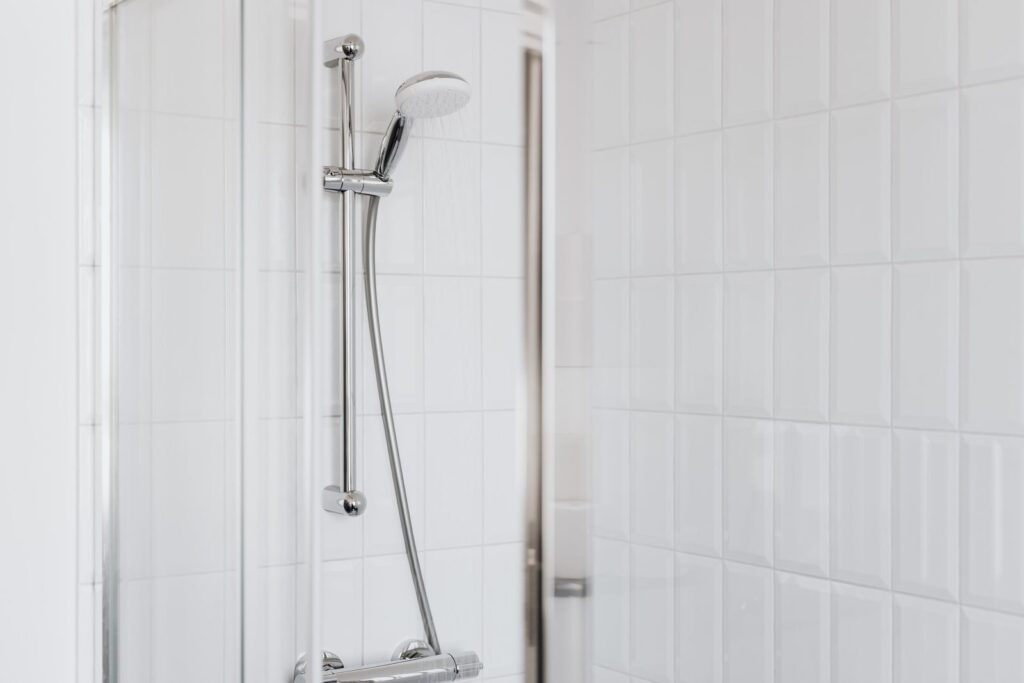
The shower defeats domestic cleaning for a reason that has nothing to do with effort. It is four different chemistry problems stacked on the wettest surface in the house, and treating them as a single wipe is exactly why it never stays clean.
The room that never stays clean
Everyone has a shower they have given up on. It gets scrubbed on a Saturday, it looks acceptable for a week, and then the film comes back on the glass, the grout goes grey again, the silicone in the corner turns from white to a spotted brown that no scrubbing lifts, and a chalky white bloom appears at the base of the tiles as if the wall is sweating salt. The customer buys a stronger spray, scrubs harder, and gets the same result on the same timeline. They conclude they are not cleaning it well enough. That conclusion is wrong, and it is why the cycle never breaks.
The shower is the hardest cleaning problem in the home, and it is hard for a structural reason. It is not one dirty surface. It is four completely different chemistry problems, each needing a different agent, all sitting on top of each other, all driven by the same constant moisture, on the wettest and least ventilated surfaces in the house. Soap scum is one. Biofilm is a second, and it is alive. Mould in the grout and the silicone is a third. Efflorescence, the white bloom, is a fourth. They look like a single mess. They are four separate problems wearing one face.
A single product cannot solve four different chemistry problems, because the agent that defeats one is often useless against another, and you cannot beat them in the wrong order either. This is why the shower resists the single wipe, the all purpose spray, and the harder scrub. This article is the four problems, the chemistry of each, and why the grout and the silicone are always the point where it fails.
Problem one. Soap scum, and why an acid is the answer
Start with the film on the glass and the tiles, because it is the most misunderstood of the four. People call it soap scum and assume it is soap, something greasy a degreaser should cut. It is not soap and a degreaser is the wrong tool.
Soap scum is a chemical reaction product. Traditional soap is made of fatty acid salts, and the water across most of Perth carries dissolved calcium and magnesium, the minerals that make water hard. When the soap meets the hard water, the fatty acids swap their soluble sodium for the calcium and magnesium, and the result is calcium and magnesium salts of fatty acids. These are not soluble in water. They are a hard, chalky film that precipitates out and cements itself onto the glass, the tiles, and the grout, closer to a soft mineral scale than to grease, and that is why it resists ordinary cleaning. You are not washing away soap. You are trying to remove a mineral deposit bonded to the surface.
Because the film is built from mineral salts, the chemistry that removes it is an acid. An acid reacts with the mineral, breaks the insoluble salt apart, and returns it to a soluble form that rinses away. This is why a mild acid descaler cuts soap scum that a neutral spray and a hard scrub will not budge, and why an alkaline degreaser, the instinctive choice for anything that looks greasy, does almost nothing. The homeowner is using the wrong chemistry on the wrong assumption, and the film wins every time.
Problem two. Biofilm, and why it is alive
The second problem is the one people never name because they cannot see it clearly, and it is why a shower can feel slimy even when it looks clean. It is biofilm, and biofilm is not a stain. It is alive.
A biofilm is a community of microorganisms that colonise a permanently wet surface and build themselves a protective home. The organisms attach and secrete a matrix around themselves, a slippery layer of extracellular material that glues the community to the tile or grout and shields it from the outside world. The slick, faintly slimy feel on the floor of a neglected shower is that matrix. A shower is a near perfect habitat for it, wet almost constantly, warm, and fed a steady diet of the organic material that comes off a body and out of the products used in there, skin cells, oils, and soap residue.
The reason biofilm needs its own approach is that the protective matrix is the whole point of it. That secreted layer is what shields the organisms from being wiped or sprayed away, which is why a quick pass with a cleaner leaves the shower slimy again within days. Biofilm has to be broken down and removed, matrix and all, not wiped over the top. This is a fundamentally different task to dissolving a mineral film, which is why the acid that defeats soap scum does nothing useful against biofilm.
Problem three. Mould in grout and silicone
The third problem is the one the customer sees as the ugliest, the black or brown spotting that colonises the grout lines and, worse, the flexible silicone seal in the corners and along the base of the screen. This is mould, and where it grows changes everything about whether it can be removed.
Mould is a fungus, and like any fungus it needs moisture, a food source, and time. The shower gives it all three, and grout and silicone give it a way in. The open pores of grout hold water long after the surface looks dry and give the mould a sheltered structure to root into. Silicone is not porous in the same way, but when mould grows in it over time it does not just sit on the surface. It penetrates and stains the body of the sealant itself, and that staining frequently cannot be removed by any cleaning agent, because the discolouration is inside the material. You can kill the mould and the black stain remains, printed through the silicone.
This is the hard truth of shower mould, and an honest operator states it plainly. Mould on the surface of a tile or lightly in a grout line can often be treated and the discolouration removed. Mould that has grown into and stained silicone is very often a permanent stain, and the correct answer is not a stronger chemical, it is removal and replacement of the silicone. Resiliconing is not a failure of cleaning. It is the recognition that the material is stained through its body and no cleaning agent can reach where the stain lives. The World Health Organization set out the case against indoor dampness and mould in its 2009 guidelines on dampness and mould, and the principle in a shower is the same as anywhere. You do not win against mould by treating the surface. You win by removing the growth and correcting the moisture that fed it.
Problem four. Efflorescence, the wall itself
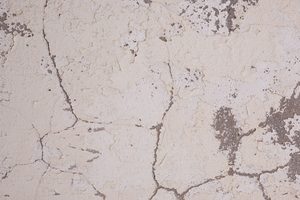
The fourth problem is the chalky white deposit that appears at the base of the tiles and in the grout, the bloom that looks like the wall is sweating powder. This is efflorescence, and it is different in kind from the other three because it does not come from anything in the shower. It comes from inside the structure.
Efflorescence is a mineral salt deposit that migrates out of the building materials behind and beneath the tile. Cement based products, the mortar bed, the render, the grout itself, contain soluble mineral salts. When water moves through those materials, and in a shower water is always moving through them, it dissolves the salts and carries them toward the surface, where the water evaporates and leaves the salts behind as a white crystalline bloom. The water is the vehicle. The salt is the passenger. Evaporation drops the passenger at the surface.
Efflorescence matters here, beyond the white mark, because it is a message about water. A shower that is throwing efflorescence is one where water is moving through the substrate freely enough to dissolve and transport mineral salts, which points to grout and seals that are letting water into the structure. It is a mineral, so like soap scum it responds to an acid, but removing the bloom without addressing the water that produced it simply means it returns. It is the fourth chemistry problem and also the diagnostic that ties the other three together, because everything in a shower that fails, fails through water getting into places it should not.
Why grout and silicone are the weak points
Stand back from the four problems and one pattern runs through all of them. The tile face is the easy part. Glazed ceramic and porcelain are hard, sealed, and largely inert, and soap scum on a tile face comes off with an acid without much drama. Everything difficult happens not on the tile but in the lines between the tiles and the seals in the corners. The grout and the silicone are the weak points, and all four problems concentrate there.
Grout is porous, and that porosity is the vulnerability. The open pore space holds moisture, which feeds biofilm and mould and keeps the substrate wet enough to move salts to the surface as efflorescence. Grout that has eroded, cracked, or lost its seal is the doorway through which the shower’s water reaches everywhere it should not be. Silicone fails differently. When it perishes, lifts, or grows mould into its body, it stops sealing and lets water behind the tiles, and it stains permanently in a way that grout, being treatable and resealable, often does not.
This is why a shower is not a surface to be wiped but a system to be restored. The weak points are where the shower is won or lost, and they are exactly what a quick clean never addresses.
The Crusader shower protocol
A shower cannot be cleaned in a single pass with a single product, because the four chemistries interfere with one another and have to be addressed in the right order. The wrong order wastes the work.
Stage one. Acid descale the soap scum first. The mineral film is removed with a mild acid descaler appropriate to the tile and grout, worked, dwelled, and rinsed. This comes first because the scum is a physical film sitting over everything else, and removing it exposes the true condition of the grout and silicone underneath.
Stage two. Address the biofilm. With the mineral film gone, the living biofilm is broken down and removed, matrix and all, rather than merely wiped, which returns the tile and grout to an actually clean surface rather than one that feels slick again in days. It is a distinct step because the acid that handled the scum does nothing to a biofilm.
Stage three. Restore the grout and remediate the mould. The grout is cleaned into its pores rather than across its surface, and mould in the grout is treated to remove the discolouration where the material will give it up. Grout that has eroded or failed is restored, and the moisture pathway that fed the growth is identified, in the spirit of the WHO 2009 guidance on dampness and mould.
Stage four. Reseal. Once the grout is clean and restored, it is sealed. A porous grout line left unsealed simply reloads with water, soil, and mould, so sealing is the difference between a clean that lasts and a clean that fails on the old timeline.
Stage five. Advise silicone replacement where it is stained through. Where the silicone is stained into its body, perished, or lifting, the honest recommendation is replacement, not further cleaning. Cutting out the failed sealant and laying a fresh bead is the only real answer, and pretending a stained silicone can be cleaned back to white is selling a scrub that will never work.
Stage six. Advise on ventilation, because it is the root cause. Every problem in the shower is driven by constant moisture, and a shower that cannot dry between uses will rebuild all four problems no matter how well it is cleaned. The customer is advised on running the exhaust fan properly, opening the space to dry, and squeegeeing the glass. The cleaning addresses the present state. Ventilation governs how fast it comes back.
Eco chemistry for the wet area
The Cleaning Crusader bench is built on plant derived surfactants, biodegradable within twenty eight days under OECD 301, unfragranced, with no quaternary ammonium compounds in routine cleaning. The shower tests that bench harder than most rooms, because it stacks a mineral, a living, and a fungal problem in a small, poorly ventilated, constantly wet space that people wash their bodies in every day.
For the mineral problems, the bench uses a controlled acid descaler strong enough to break the calcium and magnesium salts but diluted to work on tile and grout without the fumes and hazard of a crude strong acid in an unventilated room. For mould, where sanitising is required, the bench reaches for a hydrogen peroxide based approach rather than routine quaternary ammonium compounds, because peroxide is effective against the growth and breaks down to water and oxygen, leaving no persistent residue in a space with constant skin contact. Nothing on the bench is fragranced, because a fragranced shower cleaner does the one thing a shower must not do, masking a moisture and mould problem with a smell of clean while the growth continues underneath. The bench does not perfume the room. It removes the four problems and leaves nothing to feed the next round.
Long lasting client tips
A few rules help a customer keep a shower from rebuilding all four problems between professional restorations, and help them read what the shower is telling them.
First. Squeegee the glass and walls after every shower. This is the single most effective habit available, because it denies all four problems the standing water they need. Soap scum precipitates from water left to evaporate, and biofilm and mould need the surface to stay wet. Take the water off with thirty seconds of squeegeeing and every problem slows at once.
Second. Run the exhaust fan during the shower and for a good while after. The problems are driven by moisture, and the fan removes it. Running it only during the shower is not enough, because the room is wettest just after. Leave it running until the space has dried, or fit a timer that does it for you.
Third. Do not attack soap scum with an alkaline degreaser. Soap scum is a mineral, not a grease, and a degreaser will not touch it. A mild acid based descaler suited to your tile is the correct tool, used with care and rinsed well. Using the right chemistry once beats scrubbing with the wrong chemistry every weekend.
Fourth. Never treat mould with fragrance and never paint over it. A scented spray that makes the shower smell clean while the black spotting remains is theatre, not remediation. Mould has to be removed and the moisture behind it corrected. If it keeps returning to the same corner, the message is a moisture or seal problem there, not a need for a stronger spray.
Fifth. Understand that stained silicone is a replacement, not a cleaning job. When the seal in the corners has gone brown or black through its body, no cleaner will bring it back, because the stain is inside the material. Budget for resiliconing rather than scrubbing a seal that is stained through. Fresh silicone in a well ventilated shower stays clean for years.
Sixth. Read the white bloom as a water message. Efflorescence at the base of the tiles is telling you water is moving through the grout and substrate. Scrubbing it off without addressing the grout and seals means it returns, because the salts keep migrating. If the bloom keeps coming back, the grout and silicone need restoration, not just the surface cleaned.
The bold position
We will say this plainly. The shower defeats domestic cleaning because it is four chemistry problems at once on constantly wet substrates, and treating it as a single wipe is exactly why it never stays clean. An insoluble mineral that needs an acid, a living biofilm that needs breaking down, mould that often needs the seal replaced rather than sprayed, and a structure pushing salt to the surface. One product cannot beat four chemistries, and no order but the right order will hold. The customer scrubbing harder was never going to win, because the problem was never a matter of effort.
The failure mode the trade will not name is the shower treated as a surface. An operator sprays the tile face, wipes it down, leaves it bright, and hands back a shower with failed grout, stained silicone, and a live moisture problem entirely untouched. It looks clean on the day and fails on the same timeline it always did, because the easy ninety percent was cleaned and the ten percent where every problem lives was ignored. Selling a wet area wipe as a shower clean is selling the appearance of a result with none of the substance.
Cleaning Crusader treats the shower as a system, not a surface. We take the mineral scum off first so we can see the true condition, break down the biofilm as its own step, restore and reseal the grout, remediate the mould rather than mask it, and tell the customer honestly when the silicone is stained through and needs replacing rather than scrubbing. And we finish by naming the root cause, moisture and ventilation, because a shower that cannot dry will rebuild all four problems no matter who cleaned it. The shower is hard for a reason, and the reason is chemistry, four times over, on the wettest surface you own. Respect the four problems and the shower stays clean. Treat it as one wipe and it never will.
Restraint matters more than noise.
Cleaning Crusader. Built for impact. Driven by excellence. Guided by purpose.