A burst pipe is an emergency everyone can see, so everyone acts. A slow leak is a liability nobody measures, so nobody acts, and the second one costs far more than the first. The damage in a slow leak is done by time, not by volume.
The water event that never announces itself
A burst pipe is a good problem, in the strange way that visible problems are good. Water arrives across a floor, someone sees it, someone panics, someone calls. The response is immediate because the event is undeniable. The volume is frightening, but the timeline is short, and a fast controlled dry usually returns the building to where it was. The householder remembers it as the day the laundry flooded. It is a story with an ending.
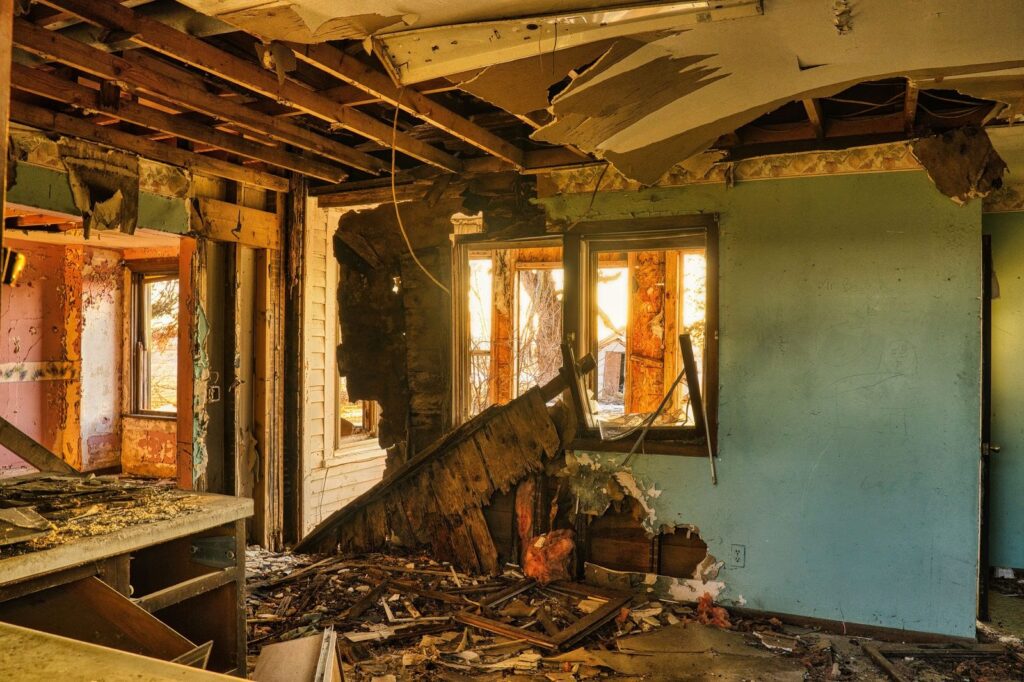
A slow leak has no such mercy. A weeping joint inside a wall cavity, a shower waterproofing membrane that has failed behind the tiles, a roof flashing that drips a few millilitres every time it rains, rising damp climbing from a failed damp course. None of these floods anything. None of them makes a scene. They release small volumes of water into places nobody looks, over weeks and months and sometimes years, and the building absorbs it quietly the entire time. There is no day the laundry flooded. There is only the morning, much later, when someone notices the skirting has swollen, or the paint is blistering, or there is a smell in the room that will not leave. By then the event is not a dry. It is a renovation.
This article is the economics of that difference, told without the drama that only visible water attracts. Why the damage in a slow leak is done by time rather than by volume. How a small controlled dry today compares, in plain dollars, against the structural repair and mould remediation and material replacement a neglected leak eventually demands. And why the most valuable instrument in water damage is not a pump or an air mover but a moisture meter, because the cheapest water event of all is the one caught before it is ever visible. The burst pipe caught in an hour is a service. The slow leak discovered at year two is a rebuild, and it did not need to be.
Why time, not volume, is the destroyer
The instinct is to measure a water event by how much water was involved, and the instinct is exactly wrong. Building materials do not fail in proportion to the volume of water that touches them. They fail in proportion to how long they stay wet. This is moisture dwell time, and it is the hinge on which the entire economics turns. A timber stud soaked by a burst pipe and dried within two or three days suffers almost nothing. The same stud held at elevated moisture for six months by a slow leak is a different material by the end. Fungal decay has begun. The fixings around it have started to corrode. The plaster bonded to it has lost its key. The volume was a fraction of the burst pipe. The damage is an order of magnitude worse, because the water was allowed to stay.
The reason is biological. Timber begins to lose integrity to decay fungi once its moisture content sits above roughly twenty eight to thirty percent for a sustained period, and these fungi need time to establish and spread. A short wetting never reaches that threshold for long enough. A slow leak parks the material above it for months. Mould is faster still, colonising a damp porous surface within twenty four to forty eight hours, and a slow leak provides not a single window of dampness but a permanent one. The leak is not one water event. It is thousands of consecutive small ones, and the material never gets the chance to dry between them that would have saved it.
The compounding cost curve
The cost of a water event behaves like an untreated liability. It compounds, and the longer it is left, the steeper the curve gets.
At the earliest point, before there is any visible sign, a slow leak is a small and almost boring problem. The source is repaired, the affected material is dried in place with controlled airflow and monitored back to a normal moisture content, and there is no demolition, no replacement, and no mould, because the water was never present long enough to grow any. This is the floor of the entire curve. A source repair and a controlled dry of a contained area is a modest, planned expense, and it is the cheapest this problem is ever going to be.
Move along a few months and the picture changes shape entirely. The prolonged dampness has begun to work on the materials. The plaster has blistered, the skirting and the bottom of the wall framing have swelled, and mould has established inside the cavity where nobody can see it, feeding on the paper facing of the plasterboard. Now the job is not a dry. It is a remediation. The affected plasterboard has to be removed, because a porous material that has grown mould through its thickness cannot be cleaned, only replaced. A meaningful part of the cost is now demolition and reconstruction rather than drying, which is the expensive kind of cost.
Go to the top of the curve, where a leak has run undetected for a year or more, and the arithmetic becomes brutal. Structural framing may need sections replaced because decay has compromised its load carrying. The waterproofing has to be redone, which means the tiling comes off, which means the bathroom is rebuilt. The mould has spread beyond the original cavity into adjacent walls and subfloor. The same leak that would have cost a source repair and a controlled dry at the bottom of the curve now costs a five figure renovation at the top, and every dollar of that difference was added by time. The cost stays flat and cheap while the moisture is caught early, then turns sharply upward the moment the material begins to fail, because the bill stops being about drying and becomes about demolition and replacement.
The moisture nobody measures
Here is the failure that sits underneath every expensive slow leak we attend. The moisture was never measured, because nothing visible had happened yet, and in this trade nobody measures what they cannot see.
Moisture behind a wall and under a floor is invisible by definition. Plasterboard can look completely normal on its painted face while the cavity behind it holds a leak that has run for months. A tiled floor can look immaculate while the screed beneath it is saturated from a failed shower membrane. The surface tells you nothing, because the surface is not where the water is. This is precisely why moisture measurement exists as a discipline, and why so little of it is done outside professional restoration. A non invasive meter reads through a surface to detect elevated moisture behind it. A pin meter reads moisture content directly at depth. A thermal imaging camera reveals the temperature differences that damp areas create, mapping the shape of a wet zone across a wall that looks perfectly dry to the eye. Together these instruments do the one thing the naked eye cannot. They make invisible moisture visible, and they do it before the material has failed.
When a water event is assessed properly, the work is a survey that produces a moisture map. Readings are taken systematically across the affected area and around it, and compared against a dry reference from an unaffected part of the same building, because moisture content is only meaningful relative to what that material reads when it is genuinely dry. The map defines the true boundary of the water, which is almost always larger than the visible mark, and the same readings that found the water become the measure of when the material is dry again. The principle that structural drying should be measured and verified rather than assumed is codified in the IICRC S500 Standard for Professional Water Damage Restoration, the reference the developed world’s restoration industry works to. A drying job is complete when measurement confirms it, not when the surface feels dry to a hand or enough days have passed that everyone assumes it must be. Measured in, measured out.
The trade largely does not reach for these instruments until the damage is already obvious, which is the same as not using them at all. The value of the instrument is not confirming visible damage. It is detecting the moisture months earlier, while the wall still looks perfect, when the reading is the only sign there is. A moisture meter used only after the damage shows is a smoke alarm switched on after the fire.
The value that a maintained building carries
There is a dimension to slow leaks that sits above the repair bill, and it matters most to anyone who owns the building as an asset rather than only lives in it. A property whose water events were caught early, dried, and documented carries a clean history, with no hidden decay in the framing and no concealed mould waiting for a buyer’s surveyor to find. A neglected property carries the opposite, and every slow leak that was never caught becomes a deduction from the value or a condition on the sale. This is why the documentation of a water event is not a bureaucratic afterthought. A dated moisture map, a record of the source repair, readings showing the material was dried back to a dry reference, and photographs of the work are the difference between a defect a buyer discovers and a maintenance event the owner can evidence. The maintained building carries a documented history. The neglected one carries hidden liabilities. The market can tell the difference.
The Crusader slow leak protocol
A slow leak resolved properly is a sequence of controlled steps, built around one principle. Find the true extent by measurement, resolve the source, dry to a verified target, and document the whole thing.
Stage one. Locate and measure before touching anything. The affected area and the areas around it are surveyed with non invasive and pin moisture meters and, where useful, thermal imaging, before any material is opened or removed, and the readings are compared against a dry reference from an unaffected part of the building. This produces the initial moisture map, the true boundary of the water, and often a strong indication of where the source is. Nothing is scoped until the extent is known, because the visible mark is almost never the real boundary.
Stage two. Resolve the source. A dry is meaningless while the leak is still leaking. The source, whether a failed pipe joint, a failed waterproofing membrane, a roof defect, or a failed damp course, is identified and referred for repair, because drying a building that is still taking on water is drying a bath with the tap running.
Stage three. Decide dry in place or remove, from the readings. Non porous and many semi porous materials, and framing timber, can very often be dried in place if the moisture is caught early enough, which avoids demolition entirely. Porous materials that have absorbed water, and critically any that have grown mould through their thickness, are removed, because a saturated and colonised porous material cannot be reliably restored. Catching the leak early is what keeps this stage on the dry in place side of the line, which is the cheaper side by far.
Stage four. Dry with controlled airflow and dehumidification, and monitor. Air movers and dehumidifiers create the airflow and the vapour pressure difference that draw moisture out of the materials and remove it from the space. The drying is monitored with repeat readings, not left to run on a guess, and the materials are dried toward the dry reference established at the start.
Stage five. Verify against the dry reference and document. The dry is complete when the affected materials read back at the dry reference, confirmed by measurement, not when a number of days have passed. The final readings, the moisture map, the source resolution, and photographs are recorded as a dated file. The building is not merely dry. It is documented as dry, which is what protects the asset afterwards. What is not in this protocol is the guess. Measurement defines the problem and measurement closes it.
Eco chemistry for water damage and mould
The whole reason slow moisture matters to health is that it degrades the air of the building through mould, so the last thing a remediation should do is trade a mould problem for a chemical one. Where cleaning and decontamination of affected surfaces is required, our agents are plant derived surfactant blends, biodegradable within twenty eight days under OECD 301, unfragranced, and free of quaternary ammonium compounds. Where sanitising is genuinely required, the approach is hydrogen peroxide based rather than a fragranced masking product, because hydrogen peroxide breaks down to water and oxygen and leaves no persistent residue in a building whose air the occupants breathe every hour of every day. Unfragranced is deliberate and it matters more here than almost anywhere, because a building recovering from a moisture problem already carries an occupant load sensitised by whatever mould was present, and adding a persistent fragrance to that air is adding a persistent volatile load to a room that needs less in its air, not more.
The deeper point is that chemistry is not the solution to moisture, and no responsible bench pretends otherwise. You cannot spray a slow leak dry, and you cannot spray away the conditions that grew the mould. The source has to be repaired and the material has to be dried, because moisture is a physical problem with a physical solution. The chemistry has one honest job, which is to decontaminate the affected surfaces cleanly and without loading the indoor air. The drying is what fixes the building. The chemistry just makes sure the recovery is clean.
Long lasting client tips
A few rules keep a slow leak from becoming a renovation, and every one is about catching the moisture while the cost curve is still flat.
First. Treat a smell before you treat a stain. A musty or earthy smell in a room with no visible water is very often the first and only sign of a slow leak feeding mould inside a wall or under a floor. The smell arrives before the blistered paint and the swollen skirting, sometimes by months. That smell is the early warning, and it is cheaper to act on than the stain that follows.
Second. Know the four usual suspects and watch them. A failed shower or wet area waterproofing membrane. A slow plumbing leak inside a wall or under a floor. A roof or flashing defect that drips only when it rains. And rising damp from a failed damp course. If you have a wet area more than fifteen or twenty years old, or an older building, these are where the money leaks out.
Third. Check the far side of your wet areas. A failed shower membrane leaks into the room behind the shower, and that room shows the first signs. Check the wall on the far side for any soft paint, any faint discolouration, any swelling at the skirting. Two minutes of looking can find a leak a year before the tiles have to come off.
Fourth. When you find moisture, resolve the source before you dry anything. Drying a building that is still leaking is effort spent against a running tap. If a leak is found, the plumbing or the waterproofing or the roof is repaired first, and the drying follows. A dry done while the source is still active will simply have to be done again.
Fifth. Insist the dry is measured, not assumed, and keep the file. Ask what the moisture readings were at the start and end, and ask for the dry reference they were compared against, because a building dried to a verified reading is genuinely dry while one declared dry after a few days may still be wet inside the wall. Then keep the record. A dated file of the readings, the source repair, and photographs of the work is worth real money when the building is later sold, insured, or inspected. Measured in, measured out. Accept nothing less than a number.
The bold position
We will say this plainly. The cheapest water event is the one caught by a meter before it is ever visible, and the most expensive is the slow leak that was left because nothing looked wrong. Every slow leak is a compounding liability. It sits inside the wall or under the floor releasing a little water at a time, and the cost of resolving it climbs quietly the entire time it is left, until the day it stops being a dry and becomes a renovation. Nothing about the leak got dramatically worse on that day. It had been getting worse the whole time. That was simply the day someone finally looked.
The failure mode of this trade is not that it dries buildings badly, though some do. The failure mode is that it does not measure moisture until the repair is already a renovation. The whole industry is built to respond to visible water, because visible water is what customers call about. Nobody is called to measure the wall that looks fine. So the slow leaks run undetected, feeding mould and decay inside closed structures, precisely because the only sign they give in the early months is a reading on an instrument nobody thought to use. By the time water damage is visible, the cheap window has already closed. The meter would have found it months earlier.
Cleaning Crusader treats moisture as something to be measured, not something to be waited for. We survey with meters and thermal imaging before we touch a wall, so the boundary of the water is known rather than guessed. We map the moisture against a dry reference, resolve the source before we dry, dry in place wherever early detection allows it, and verify the dry against the same reference we started from. And we document the whole event as a dated file, because a maintained building that can evidence its history is worth more than a neglected one that hides its damage. The slow leak caught early is a source repair and a controlled dry. The one left until it is visible is a structural repair, a mould remediation, and a rebuild. The water was the same. The only variable was how long it was allowed to stay, and how early someone was willing to measure. We measure early. That is the difference between a dry and a renovation.
Silent strategy. Visible legacy. The work is the proof.
Cleaning Crusader. Built for impact. Driven by excellence. Guided by purpose.